


 Platform Overview
The Work OS for AI-powered Work
Platform Overview
The Work OS for AI-powered Work
 Work Architecture
Live entity model of your enterprise
Work Architecture
Live entity model of your enterprise
 Map
Build the Work Context Graph
Map
Build the Work Context Graph
 Analyze
Your GPS for reinvention
Analyze
Your GPS for reinvention
 Build
Builder Studio · Workflows + agents
Build
Builder Studio · Workflows + agents
 Run
Deliver the new way of working
Run
Deliver the new way of working
 Measure
Track real, board ready ROI
Measure
Track real, board ready ROI
 Log
Source of truth · audit trail
Log
Source of truth · audit trail
 Update
Keep architecture current
Update
Keep architecture current

Author
Siobhan Savage

Read time
7 mins

Published
Jan 16, 2026
.png)
Blog Post Body
AI Work Design Blueprint
The responsibilities every CHRO must own to lead AI Work Design and build internal capability.
2026 will not be remembered as the year AI got better.
It will be remembered as the year organizations confronted whether they could actually change how work runs.
The last few years were about possibility. 2026 is about consequences.
Here is what I believe will be true.
Insight will stop being impressive
By 2026, insight will be expected.
Most large organizations will have ways to analyze work, tasks, skills, and AI opportunity. Dashboards will be common. Reports will be polished. Heatmaps will look convincing.
That will no longer be enough.
Insight that does not lead to work running differently will lose credibility quickly. Executives will stop funding visibility efforts that cannot point to real change in production.
The question shifts from what data shows to what actually changed. Insight without action will not be treated as progress. It will be treated as failure.
AI pilots will be openly recognized as a dead end
Pilots have been a socially acceptable way to delay commitment.
That tolerance disappears in 2026.
Boards and CEOs will stop asking where something was tested. The only question that matters: is this running in production as the default way work gets done?
Organizations that cannot answer that question will struggle to justify continued AI spend. The language of "we're still learning" will stop working.
Execution replaces experimentation as the baseline expectation.
Transformation programs will lose authority
Large transformation programs were designed for a world where change was episodic.
AI breaks that model.
Work will change continuously in 2026. Tasks will be added, removed, and recombined. Roles will evolve in months. Agents will enter workflows incrementally. Not through large, coordinated launches.
Programs built around multi-year roadmaps will slow organizations down instead of helping them adapt.
Authority will move away from transformation offices. It will move toward systems that let work change safely, continuously, and in production. Change stops being something organizations run. It becomes something they operate.
Change will become ambient, not managed
Employees will no longer be periodically "taken through" change.
In 2026, change becomes part of the environment. It is ongoing and expected.
As AI is introduced, work updates quietly. Tasks appear and disappear. Workflows evolve inside the systems people already use.
This makes traditional change management models ineffective. Organizations that succeed will stop treating change as an event. They will design systems where change is visible, normal, and absorbed through daily work.
Change stops being a moment. It becomes a property of how work runs. This is Stealth Change Management. The new way of working becomes the default before anyone has to "adopt" it.
"AI for everyone" will be recognized as a velocity killer
Throwing AI out to all employees and calling it a strategy will continue to slow organizations down.
If every team experiments independently, velocity collapses.
It is like putting a company in a canoe. Everyone rows in their own direction. You do not move faster. You go nowhere.
If I automate chaos, I just scale the chaos.
The unit of value will shift from technologies to workflows
Technologies do not change organizations. Workflows do.
By 2026, serious organizations will stop measuring AI progress by licenses activated. They will look at what is actually running differently.
Which workflows changed. Who is impacted. What value is being created. What is now locked in. These matter more than any adoption metric.
This shift exposes a hard truth. Most AI investments never touched the work itself.
AI ROI will become a monthly executive conversation
AI ROI will stop being a consumption dashboard.
By 2026, executives will expect a monthly view of real impact. Not usage metrics. Logins, prompts sent, or licenses activated will no longer be acceptable proxies for value.
Real ROI will be measured through observable changes to work:
- Hours recovered or redeployed
- Capacity created
- Velocity increased
- Risk reduced
- Clear attribution to revenue and growth
If AI has not changed how work runs, there is no ROI to report.
This will fundamentally change which AI initiatives survive scrutiny.
Job architectures will give way to Work Architecture
Job architectures were built for a static world.
That world is gone.
In 2026, companies will realize that jobs are an output, not a stable foundation. Tasks change. Workflows change. Agents enter and exit. Skills evolve continuously.
Every serious organization will need a Work Architecture as critical infrastructure. A living system that shows how work actually runs across humans and AI. One that updates as work changes.
From Job Architecture to Work Architecture.
Without it, companies will not govern AI, redesign roles, or protect people as work evolves.
Work Architecture will become as fundamental as financial architecture.
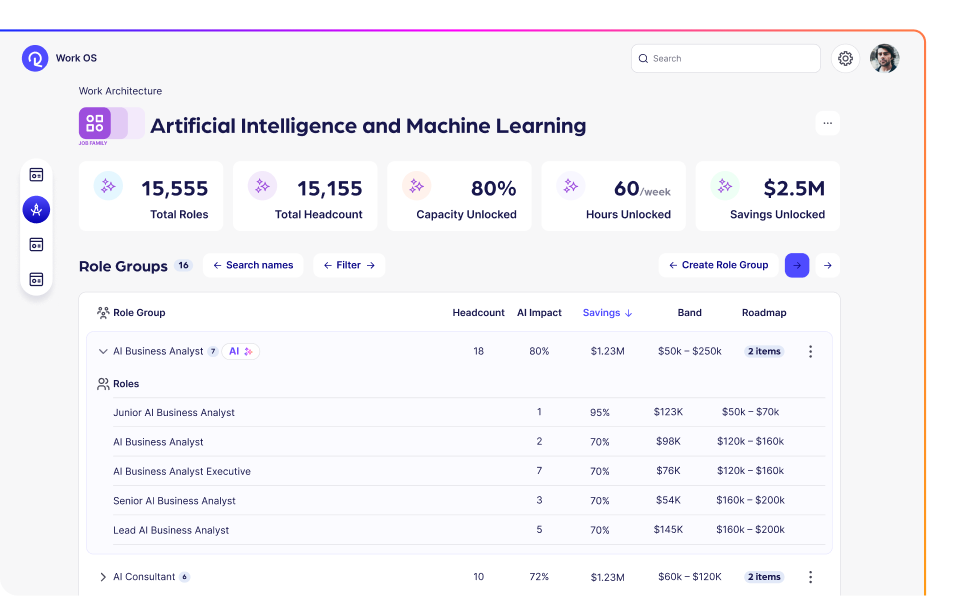
Every company will need a Work Operating System
As AI becomes embedded in daily work, companies will realize they need more than technologies and policies.
They will need a Work Operating System.
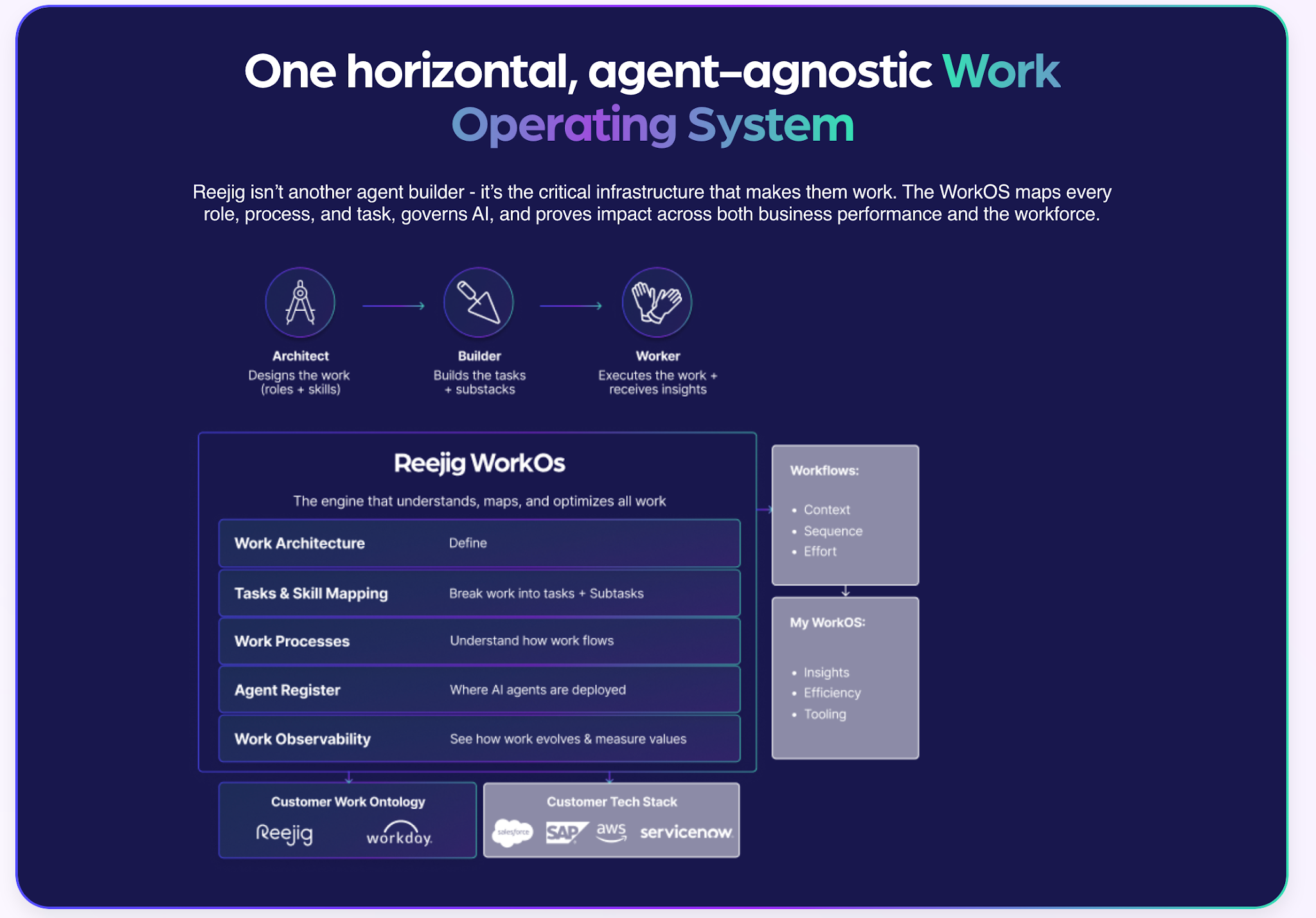
AI is infrastructure. It sits underneath how work runs. Without a system that sees work, governs it, changes it, and measures it, AI adoption stays fragile.
The Work Operating System becomes the control layer where:
- Work is defined
- Humans and agents are orchestrated
- Governance is applied
- Change is absorbed
- Value is measured
AI capability is compounding. Work visibility is not.
Without this infrastructure, organizations stay reactive. With it, they operate change deliberately and at speed.
Prompt training will be exposed as a shallow substitute
Sending your teams "prompt training" and calling it AI skills is not capability building.
It teaches people how to interact with technology. Not how to redesign work.
In 2026, this will be obvious.
Real AI capability comes from understanding work. From redesigning workflows. From orchestrating humans and agents together. From measuring impact in production.
Builders will matter more than strategies
Strategy will remain important. It will no longer be sufficient.
These builders will not sit in innovation labs. They will sit inside teams.
Their impact compounds because they change real work. They create evidence. They reduce fear for the next change.
Organizations without builders will move slowly. No matter how strong their strategy decks are.
AI will move from cost cutting to value creation
AI adoption will move beyond cost reduction.
In 2026, the focus broadens to:
- Helping companies make more money
- Reducing wasted and duplicated work
- Removing low-value, no-joy work from people
- Reducing operational and compliance risk
Employee fear will intensify, and HR leadership will matter more than ever
As AI narratives intensify, employee fear will increase.
There will be more noise. More headlines. More speculation about job loss and disruption.
In 2026, there has never been a more important moment for HR leadership.
This is how fear is reduced. Not through reassurance. Through clarity, agency, and real pathways forward.
The strongest HR leaders will not slow change. They will help people navigate it. By making work visible. By clarifying what is changing and what is not. By showing where evolution is possible.
Organizations that ignore this will lose trust and talent at the same time.
Leaders will be held accountable for how people are treated in AI change
We will see more companies publicly celebrating job cuts "because of AI."
That will not age well.
In 2026, leaders will increasingly be held to account for how they handle AI-driven change. Not just whether they are bold. Whether they are responsible.
The real divide will be action, not ambition
By the end of 2026, the gap between organizations will be obvious.
Not between those who believe in AI and those who do not. Not between those who invested early and those who waited.
The divide will be between organizations that act and those that cannot.
Some will have work running differently every quarter. Value compounding quietly over time.
Others will still be talking about potential.
That gap will be hard to close.
What I will be focused on in 2026
My focus is simple.
I will be obsessed with closing the gap between insight and action.
Ensuring work actually runs differently in production. Driving low-risk, real change quickly. Creating builders inside organizations. Making value visible, measurable, and locked in.
Not ideas. Not pilots. Not theatre.
Just work, redesigned and running better.
2026 will reward organizations that act. And expose those that cannot.
That is the year we are entering.
If your organization sits on insight but struggles to change how work runs, this is the conversation we are having with leaders right now.
Author


Siobhan Savage
CEO & Co-Founder of Reejig

AI Work Design Blueprint
The responsibilities every CHRO must own to lead AI Work Design and build internal capability.