Artificial intelligence is reshaping the pharmaceutical industry at the task level.
From drug discovery to clinical trials and manufacturing, AI is changing how work gets done inside roles. The organizations moving fastest are not simply adopting new systems. They are redesigning work, redefining roles, and building new workforce capabilities around AI.
For CHROs, CIOs, CAIOs, and transformation leaders, the challenge is not just deploying AI technology. It is understanding how AI changes tasks, workflows, and workforce structures across the enterprise.
Why this matters now
The pharmaceutical industry faces growing pressure to innovate faster. While managing cost and complexity.
- The global pharmaceutical market was valued at $1.48 trillion in 2022. (Grand View Research)
- The US pharmaceutical market reached $574.37 billion in 2023. (Grand View Research)
- AI-driven drug discovery reduces development timelines by 30 to 50%. That saves $150M to $200M per successful drug in early stages.
- Analysts estimate 50 to 60% of analytical tasks in pharma could be automated by 2030. (Deloitte)
These pressures make workforce redesign a strategic priority.
Every enterprise is deploying AI. Almost none can see the work they're deploying it into.
How AI is changing work in pharmaceuticals
AI is changing pharmaceutical work. It automates data-heavy tasks. It augments scientific decision-making.
Key shifts include:
- AI-assisted molecular modeling and protein structure prediction
- AI-driven clinical trial design and patient recruitment
- Predictive quality monitoring in manufacturing
- Analytics for commercial strategy and market access
Example: tasks evolving across pharma workflows
|
Traditional task
|
AI-augmented task
|
Likely impact
|
|
Manual molecular analysis
|
AI-supported protein structure and candidate analysis
|
Faster early-stage discovery
|
|
Manual patient screening
|
AI-assisted patient matching
|
Faster trial recruitment
|
|
Manual batch monitoring
|
Predictive monitoring and quality alerts
|
Higher manufacturing yield
|
|
Manual regulatory review
|
AI-assisted documentation analysis
|
Reduced administrative workload
|
The workforce redesign challenge in pharmaceuticals
Most pharmaceutical organizations struggle with AI because workforce planning still focuses on jobs. Not tasks.
That creates three challenges:
- Limited visibility into how work actually happens inside roles
- Difficulty identifying automation opportunities
- Weak alignment between workforce strategy, technology, and business leaders
Different parts of the enterprise also change at different speeds.
- R&D adopts AI quickly because of data-rich workflows
- Clinical operations face regulatory complexity
- Manufacturing requires infrastructure and process upgrades
This uneven pace makes task-level insight critical.
Why AI workforce strategy must start with tasks
AI changes tasks inside roles. Not just jobs.
Understanding those tasks reveals where automation, augmentation, or human oversight should occur.
|
Role
|
Task
|
AI impact
|
|
Drug Discovery Specialist
|
Molecular data analysis
|
AI-assisted
|
|
Drug Discovery Specialist
|
Hypothesis framing
|
Human-led with AI support
|
|
Clinical Trial Coordinator
|
Patient matching
|
Automatable
|
|
Clinical Trial Coordinator
|
Trial oversight
|
Human-led with AI support
|
|
Manufacturing Technician
|
Batch monitoring
|
AI-assisted
|
|
Manufacturing Technician
|
Process intervention
|
Human
|
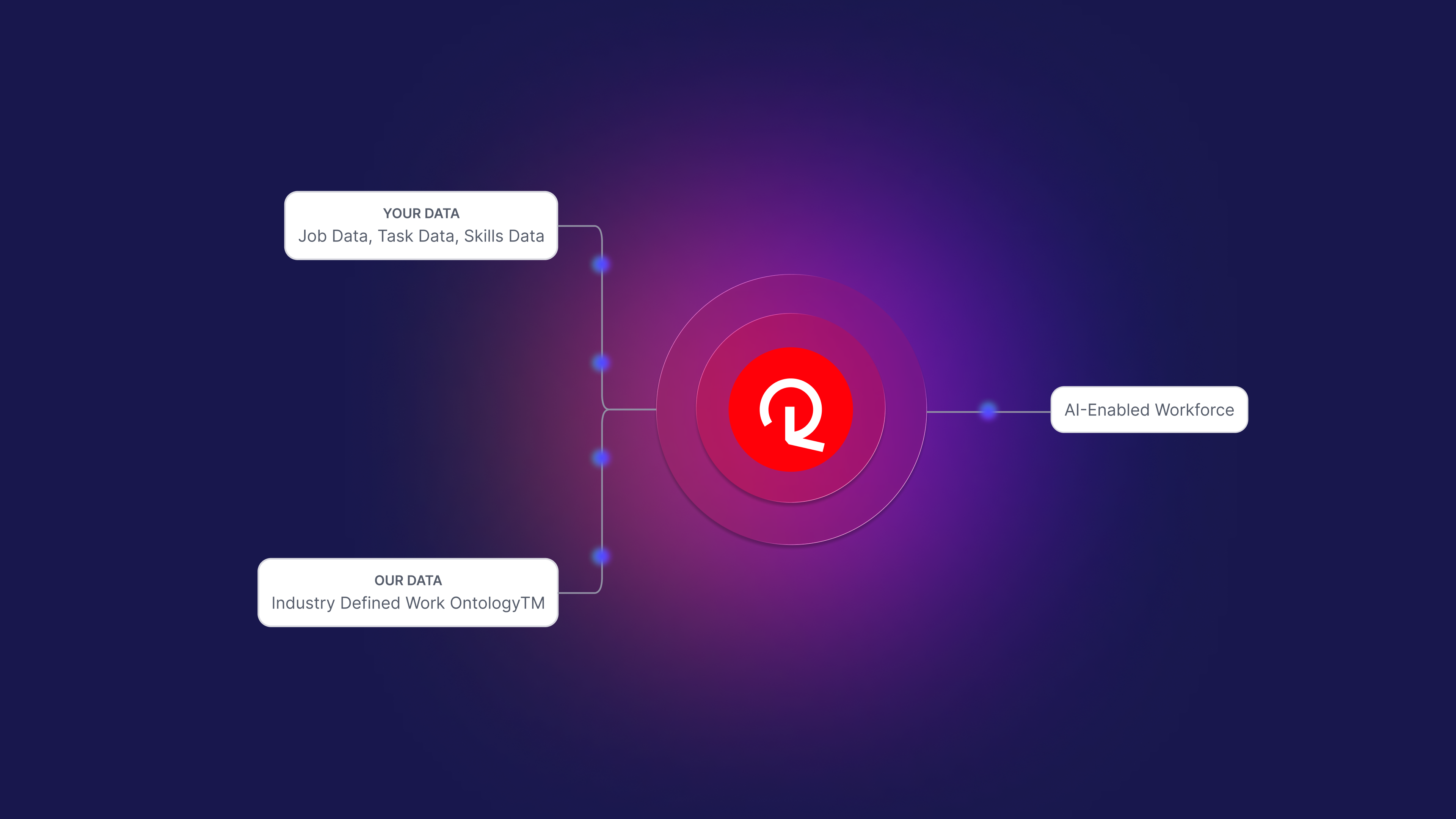
Reejig provides this task-level visibility. Organizations:
- Map work across tasks and subtasks
- Analyze AI impact across workflows
- Identify automation opportunities
- Redesign jobs and workflows
- Build new capabilities and redeploy people
- Support work movement
- Track workforce ROI
Framework: building the AI-powered workforce in pharmaceuticals
Pharma leaders approach workforce redesign in five steps.
1. Map work at the task level
Start with critical workflows. Drug discovery, clinical trials, and manufacturing.
2. Analyze AI impact
Identify tasks that are automatable, AI-assisted, or human-led.
3. Redesign jobs and workflows
Shift employees toward higher-value work. Oversight, interpretation, and decision making.
4. Build new capabilities and redeploy
Focus on capabilities in:
- Clinical data analytics
- Bioinformatics
- AI-powered manufacturing
5. Measure outcomes
Track workforce and operational performance together.
Workforce redesign checklist
- Identify priority workflows
- Break roles into tasks and subtasks
- Assess AI potential by workflow
- Redesign roles and handoffs
- Launch capability-building pathways
- Track operational and workforce metrics
Metrics that matter
- Drug discovery cycle time
- Clinical trial speed
- Manufacturing yield
- Workforce productivity
- Work movement
- Capability-building completion
AI capability is compounding. Work visibility is not.
What the AI-powered workforce looks like in pharmaceuticals
AI-powered pharmaceutical organizations shift human work toward scientific reasoning, oversight, and decision making.
People focus more on:
- Experimental design
- Regulatory judgment
- Strategic trial planning
- Cross-functional coordination
AI handles more:
- Data processing
- Pattern detection
- Documentation
- Workflow monitoring
|
Emerging role
|
Description
|
|
AI-powered Drug Discovery Scientist
|
Uses AI outputs to guide experimental direction
|
|
Clinical Data Analyst
|
Interprets clinical trial datasets
|
|
Bioinformatics Specialist
|
Applies computational genomics
|
|
Smart Manufacturing Specialist
|
Oversees AI-driven production systems
|
Where pharmaceutical leaders should prioritize first
Three areas stand out for early AI investment.
|
Function
|
AI potential
|
Operational efficiency impact
|
Likely time to value
|
|
Drug discovery
|
High
|
High
|
12 to 18 months
|
|
Clinical trials
|
Very high
|
High
|
18 to 36 months
|
|
Manufacturing
|
High
|
Very high
|
24 to 36 months
|
Drug discovery: AI accelerates target identification and molecular modeling. (AlphaFold)
Clinical trials: AI improves patient matching, monitoring, and coordination. (Deloitte)
Manufacturing: Predictive monitoring and automation increase quality and yield.
How leading pharmaceutical organizations are preparing today
Leading organizations treat AI transformation as workforce transformation.
That means:
- aligning CHRO, CIO, and R&D leadership
- linking AI investment to workflows
- building governance and compliance frameworks
- measuring workforce outcomes alongside operational impact
How pharmaceutical leaders can redesign work and create new career pathways
The strongest workforce transformations create internal mobility.
Our data highlights several transition pathways.
|
Current role
|
Work evolution
|
Possible next role
|
Capability focus
|
|
Clinical Data Entry Clerk
|
Less manual entry, more analysis
|
Clinical Data Analyst
|
analytics, statistics
|
|
Laboratory Technician
|
More genomic data analysis
|
Bioinformatics Specialist
|
genomics tools
|
|
Manufacturing Operator
|
AI-assisted monitoring
|
Smart Manufacturing Technician
|
robotics, systems monitoring
|
Reskilling programs can significantly reduce turnover costs while building critical capabilities.
FAQ
Will AI replace jobs in pharmaceuticals?
AI will change tasks within roles more than eliminate entire job families.
Which functions should pharmaceutical companies prioritize first?
Drug discovery, clinical trials, and manufacturing typically provide the strongest return on AI investment.
Why is task-level visibility important?
It reveals where automation and augmentation can happen within roles.
What skills will matter most?
Data analysis, bioinformatics, regulatory judgment, and AI literacy.
What should CHROs do now?
Map critical roles, identify opportunities, and build internal mobility pathways.
What should CIOs and CAIOs do now?
Align AI initiatives with real workflows and partner with HR on workforce redesign.
How should leaders think about responsible transition?
Responsible transition requires transparent workforce planning and clear career pathways.
Conclusion
AI is changing how work gets done across the pharmaceutical industry.
The real opportunity is not just deploying AI tools. It is redesigning work at the task level and building a workforce that can use those tools effectively.
Organizations that gain visibility into tasks, workflows, and capabilities will be best positioned to accelerate innovation while managing workforce transition responsibly.
About the data & methodology
Reejig’s workforce insights are built on independently audited Ethical AI and Work Ontology™, designed to map how work is actually performed at the task and subtask level.
The methodology analyzes 130M+ job records spanning the last 5–7 years, representing 41 million unique proprietary and public data points across 100+ countries and 23 global industry sectors.
Key elements of the methodology
Data integrity
The dataset consolidates insights from proprietary data, leading labor market platforms, and publicly available datasets. Reejig workforce strategists validate work structures and apply domain expertise to refine the analysis.
Unparalleled scale
More than 130 million job records were processed and deduplicated into 41 million unique job and role data points.
Global and industry coverage
The dataset covers workforce activity across 100+ countries and 23 industry sectors, providing a dynamic and current view of how work is evolving globally.
Validated outputs
Data is structured and verified to support reliable insights into task-level workforce transformation, automation opportunities, and career pathways.
Disclaimer: The information in this article is general in nature and does not take into account an organization’s specific circumstances, operating model, or location. Workforce transformation priorities may vary by organization, sector, and regulatory environment. For tailored insights, consult a workforce transformation expert.


 Platform Overview
The Work OS for AI-powered Work
Platform Overview
The Work OS for AI-powered Work
 Work Architecture
Live entity model of your enterprise
Work Architecture
Live entity model of your enterprise
 Map
Build the Work Context Graph
Map
Build the Work Context Graph
 Analyze
Your GPS for reinvention
Analyze
Your GPS for reinvention
 Build
Builder Studio · Workflows + agents
Build
Builder Studio · Workflows + agents
 Run
Deliver the new way of working
Run
Deliver the new way of working
 Measure
Track real, board ready ROI
Measure
Track real, board ready ROI
 Log
Source of truth · audit trail
Log
Source of truth · audit trail
 Update
Keep architecture current
Update
Keep architecture current