The Work Operating System for AI-powered work
A live log of every job, task, subtask, and workflow inside the enterprise.
Find wasted potential, unlock hours, and know exactly where agents deliver impact.
Connect all agents, recommend the right one for each task, and capture the context to build new agents.
Measure ROI based on actual work changes, not agent promises.
Replaces static job architecture with a dynamic model for humans and agents that updates as roles shift.
Shows how AI will change jobs and what skills your workforce needs.
Redesigns how work gets done and tracks every change automatically.
See the Work Operating System in action and start re-engineering work for AI.
The latest insights on re-engineering work for AI
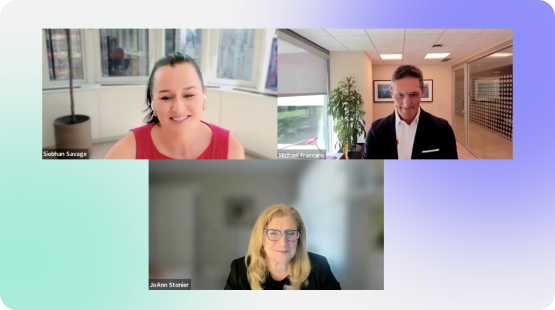
I’ve been in a lot of rooms with brilliant people solving workforce challenges, but the room I had the privilege of being in yesterday with Michael Fraccaro (Fellow and Former Chief People Officer at Mastercard) and JoAnn Stonier (Fellow of Data and AI at Mastercard) was something special.
These are two of the sharpest minds at the intersection of people, data, and AI and what we uncovered in our conversation is critical for any CHRO or CIO charting their AI transformation path.
Here’s what we learned, and what you need to know, if you're serious about building an AI-powered workforce:
AI adoption might be the starting point, but as Michael pointed out, the real challenge is transforming the workforce itself. AI isn’t a tech problem…it’s a workforce redesign challenge.
"This is not the time to wait to be asked," he said. "It’s the time to step forward."
The message: CIOs can’t silo AI into IT or innovation labs. You need HR in the room.. now. Because the people who will use, supervise, and adapt with AI? They’re already on your payroll.
People have skills, but jobs and work have tasks. If we keep designing for job titles, we’re designing for the past.
Want to move fast with AI? Break the work down to the task level. That’s where the real opportunities for automation, augmentation, and reinvention live. CIOs who win will have a line of sight into:
This isn’t theoretical.. it’s operational.
JoAnn outlined the typical AI maturity curve:
Where are you on that curve and what’s holding you back from moving up?
Spoiler: It’s usually not the tech. It’s knowing where to apply it, how to guide your workforce, and managing the change that follows.
One of my favourite moments came when I asked: “Are we in transformation forever?”
JoAnn’s answer? “Yes.. and eventually it won’t feel like transformation. It will just be work.”
CIOs must build for adaptability, not completion. That means tech stacks, training, and team models that flex as fast as the tools themselves.
Michael reminded us that AI won’t just reshape workflows.. it will reshape culture.
Your workforce is not a monolith. Different teams, age groups, and functions will adapt differently. Leaders must role model curiosity, transparency, and humanity.
“Tell your people you’re learning too,” he said. “And take them on the journey with you.”
Because if your people don’t adopt it.. your AI won’t deliver. Period.
To every CHRO or CIO reading this: you are sitting at the intersection of the biggest transformation of our time. You will either lead it.. or be disrupted by those who do.
You don’t need all the answers.
But you do need the right partners around the table:
AI, HR, Legal, Product.. and a unified strategy that puts people at the center.
That’s how we build boldly and responsibly. That’s how we build the workforce of now.
Siobhan 💜
See the Work Operating System in action and start re-engineering work for AI.
The latest insights on re-engineering work for AI