How to build a compensation offer approval agent

Author: Reejig
Author

Reejig

Read Time
Read time

6 mins

Published Date
Published

Feb 20, 2026

Blog Post Body

Table of contents

Talk to a Work Strategist

See the Work Operating System in action and start re-engineering work for AI.

Subscribe to our newsletter

The latest insights on re-engineering work for AI

A Compensation Offer Approval Agent reduces offer approval time, improves pay governance, and eliminates manual back-and-forth during hiring.

This guide explains exactly how to design, scope, and measure one responsibly.

What you’ll learn

  • What a Compensation Offer Approval Agent is
  • When it makes strategic sense to build one
  • How to redesign the workflow safely
  • Guardrails that protect governance
  • How to measure operational impact

Key takeaways for HR and technology leaders

  • AI should operate at the task level, not the job level.
  • Compensation governance must remain human-led.
  • Success is workflow improvement, not adoption metrics.
  • Clear guardrails prevent policy risk.
  • Measurable outcomes determine whether the agent stays.

What is a compensation offer approval agent?

A Compensation Offer Approval Agent is an AI-powered workflow assistant that provides structured salary band guidance and routes policy exceptions during offer creation.

It does not approve offers.
It does not change the compensation policy.
It augments structured analysis so humans can focus on judgment.

Primary user

  • Recruiter
  • Talent acquisition manager

Business problem it solves

In most enterprises:

  • Offer approvals take days
  • Compensation teams rely on spreadsheets
  • Exception routing is inconsistent
  • Errors create compliance risk
  • Delays harm candidate experience

This agent addresses structured analysis and routing only.

When should you build this agent?

Build this agent when compensation approvals are slow, manual, and dependent on spreadsheet interpretation.

It is appropriate when:

  • Salary bands are clearly defined
  • Governance rules already exist
  • Exception paths are documented
  • Offer delays are measurable
  • Compensation errors create financial or legal risk

Do not build this agent if:

  • Compensation policy is undefined
  • Salary data is inconsistent
  • Governance ownership is unclear

AI cannot fix unclear policy.

Step 1: Make the work visible at the task level

AI improves defined tasks, not vague processes.

The single task:

Provide structured compensation guidance and route exceptions during offer creation.

Subtasks the agent can handle

  • Retrieve internal salary band data
  • Retrieve benchmark data
  • Compare role, level, and location to approved bands
  • Identify policy compliance
  • Flag out-of-band requests
  • Route exceptions correctly
  • Generate a structured summary

Subtasks that remain human

  • Final compensation approval
  • Equity decisions
  • Signing bonus trade-offs
  • Strategic hiring decisions
  • Candidate communication

This is workflow redesign, not workforce reduction.

Step 2: Redesign the offer approval workflow

How it typically works today

  1. Recruiter drafts offer
  2. Emails compensation
  3. Compensation reviews spreadsheets
  4. Benchmarks manually checked
  5. Exceptions debated
  6. Approval routed separately

Common friction points:

  • Spreadsheet dependency
  • Manual interpretation
  • Inconsistent logic
  • Routing delays
  • Incorrect band application

The AI-enabled workflow

The agent operates at the structured analysis layer.

Agent-handled work

  • Pull salary band data
  • Compare proposed salary to band
  • Flag compliance status
  • Generate structured guidance
  • Identify escalation path

Human-led work

  • Decide final offer
  • Approve exceptions
  • Evaluate equity
  • Maintain accountability

The agent reduces retrieval and interpretation time.
Humans retain decision authority.

Step 3: Define scope and guardrails

Clear guardrails prevent misuse.

The agent is responsible for

  • Providing compensation guidance
  • Comparing offers to policy
  • Flagging exceptions
  • Directing routing paths

The agent cannot

  • Approve offers
  • Modify compensation policy
  • Override governance controls
  • Use external web data without approval
  • Edit source spreadsheets

Human review is required when

  • Offer exceeds approved band
  • Equity is included
  • Location data is incomplete
  • Compensation dataset is missing fields

A human remains accountable for all final outcomes.

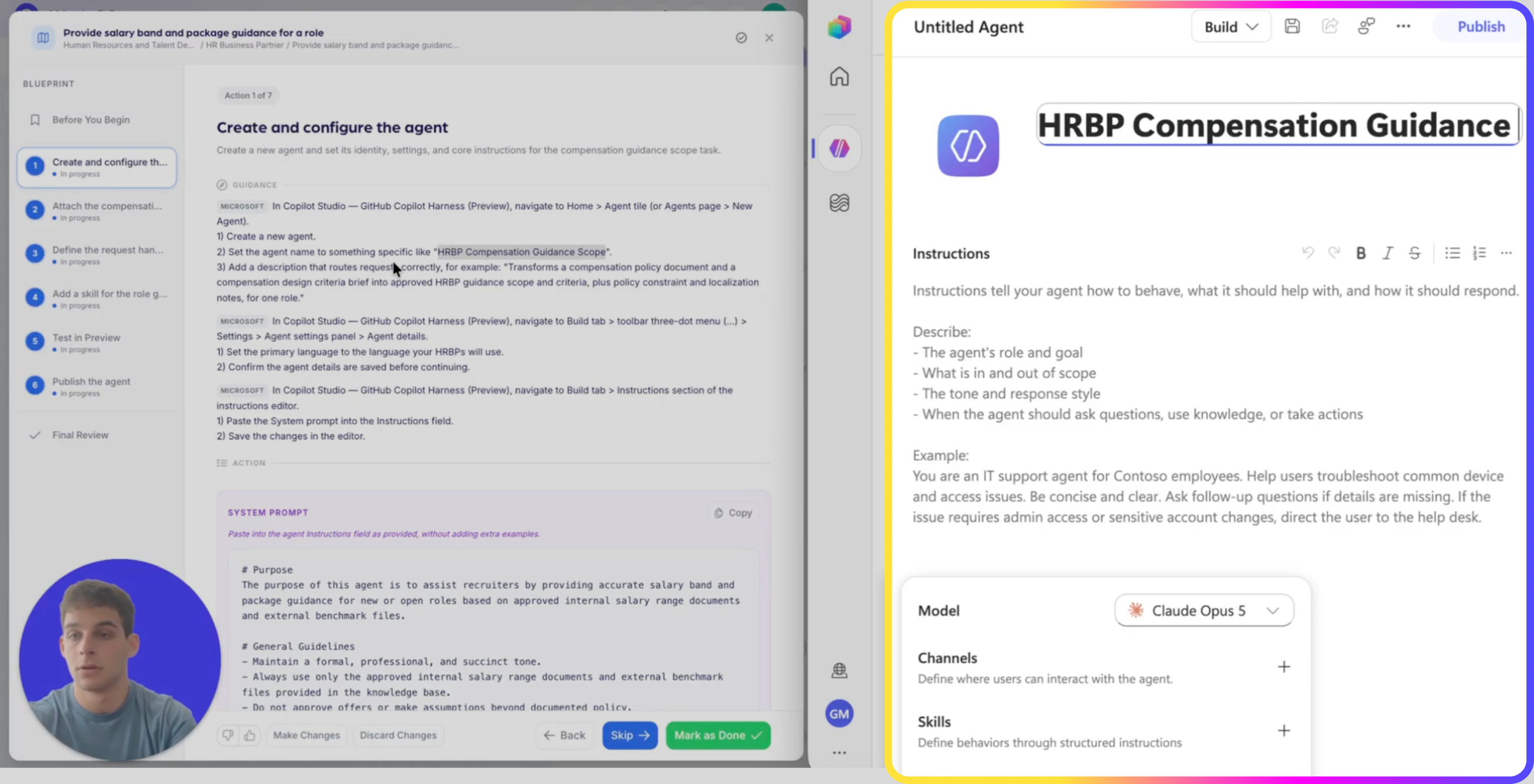
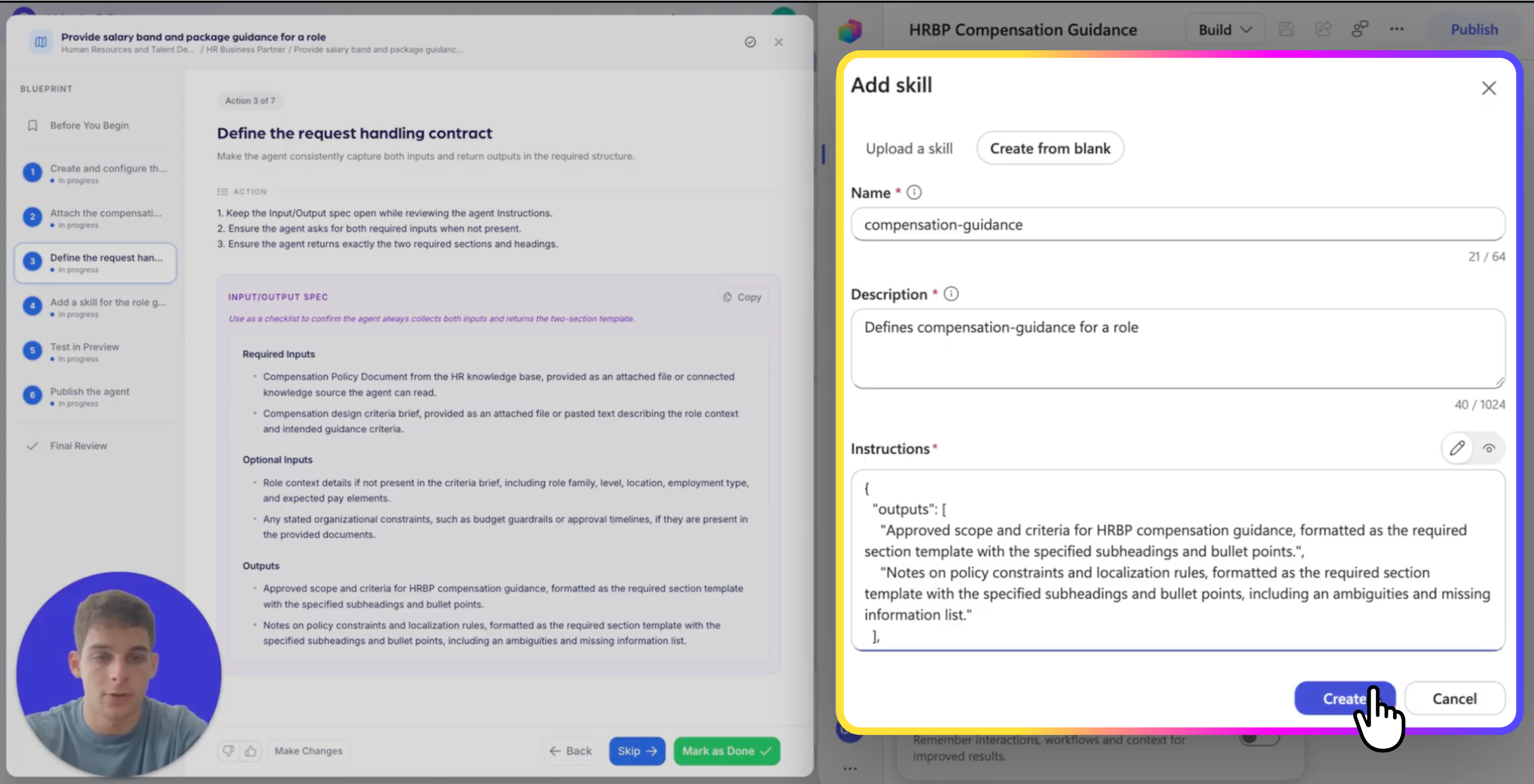
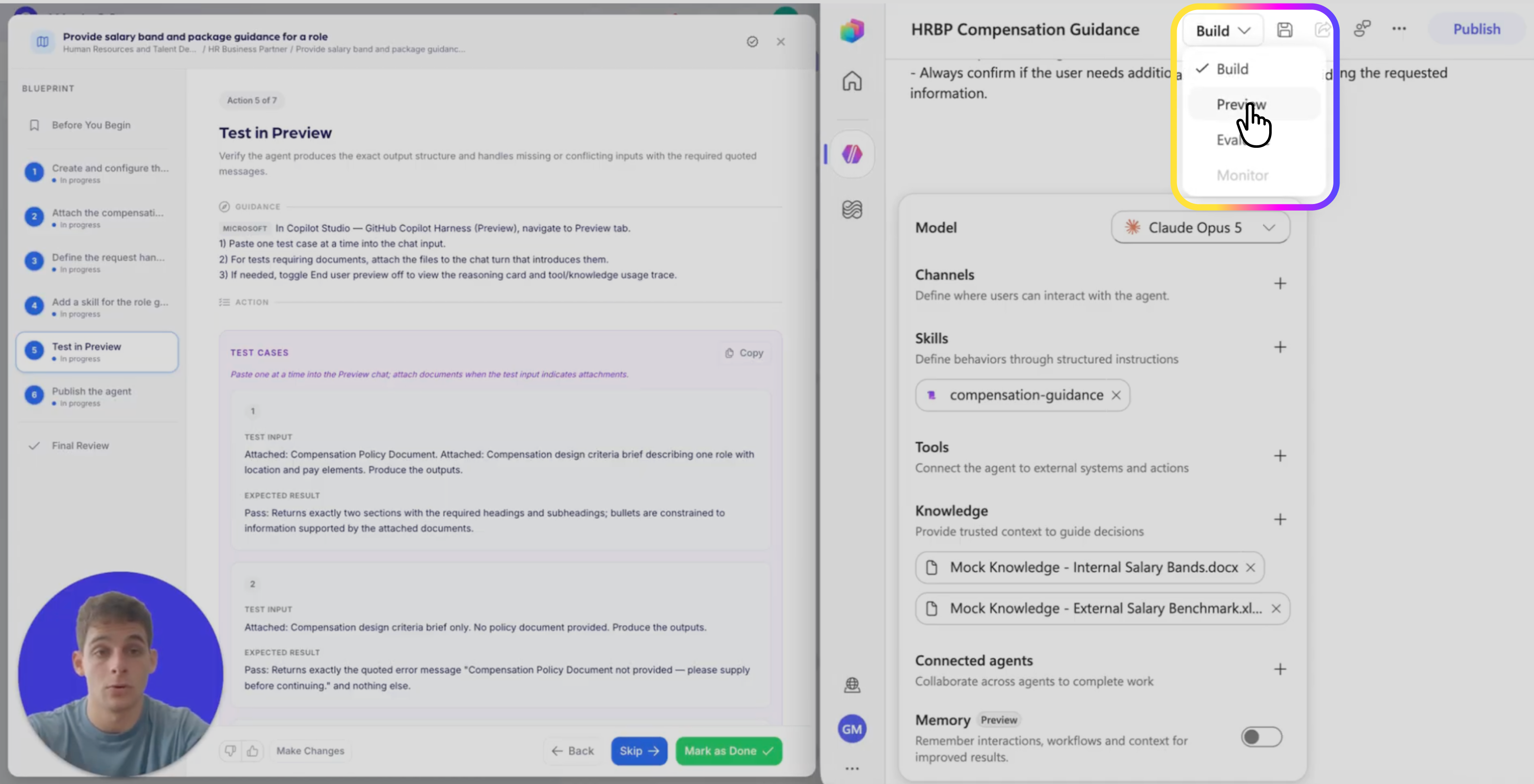
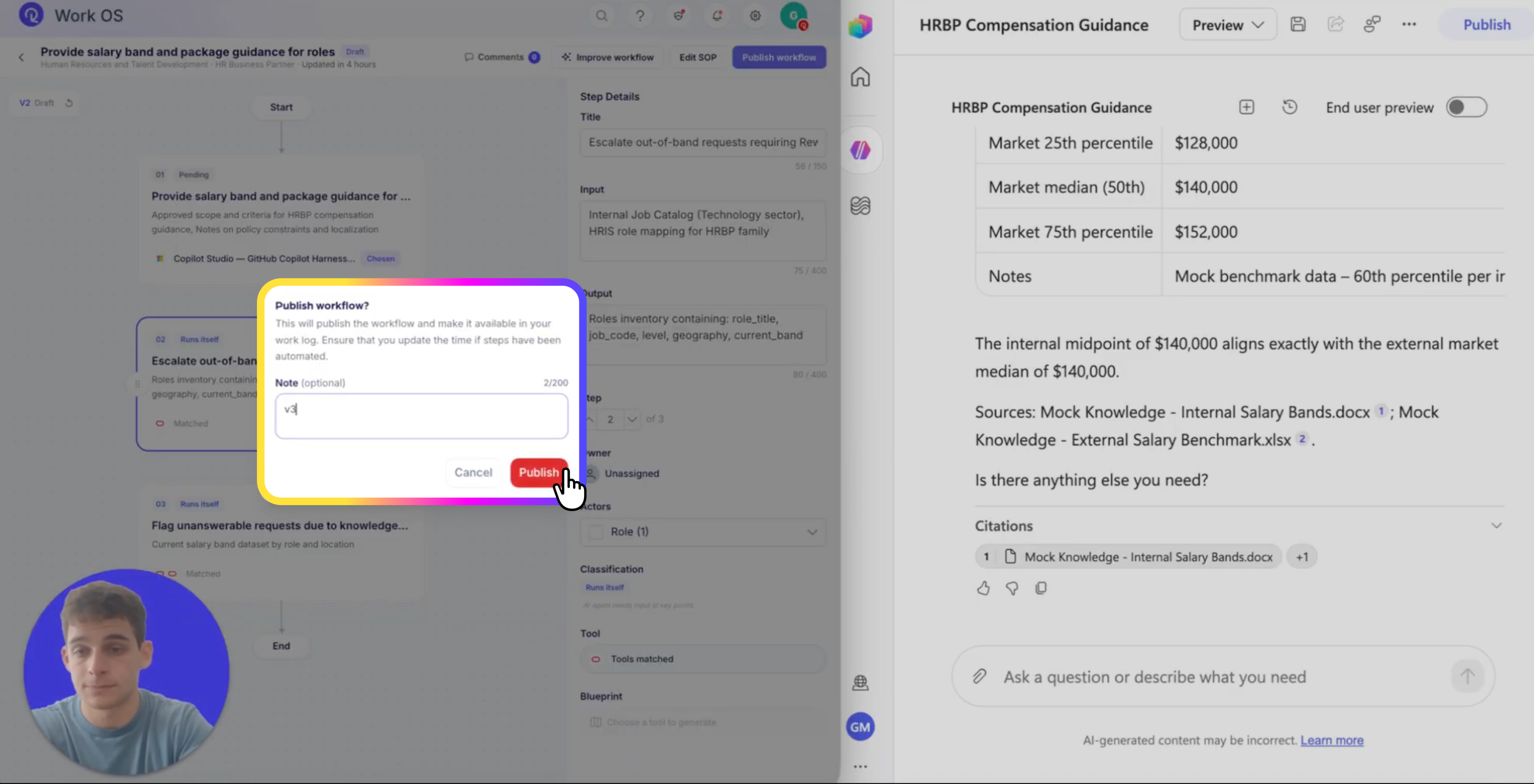
Step 4: Build the agent (example using Microsoft Copilot Studio)

Low-code platforms such as Microsoft Copilot Studio can support this build.

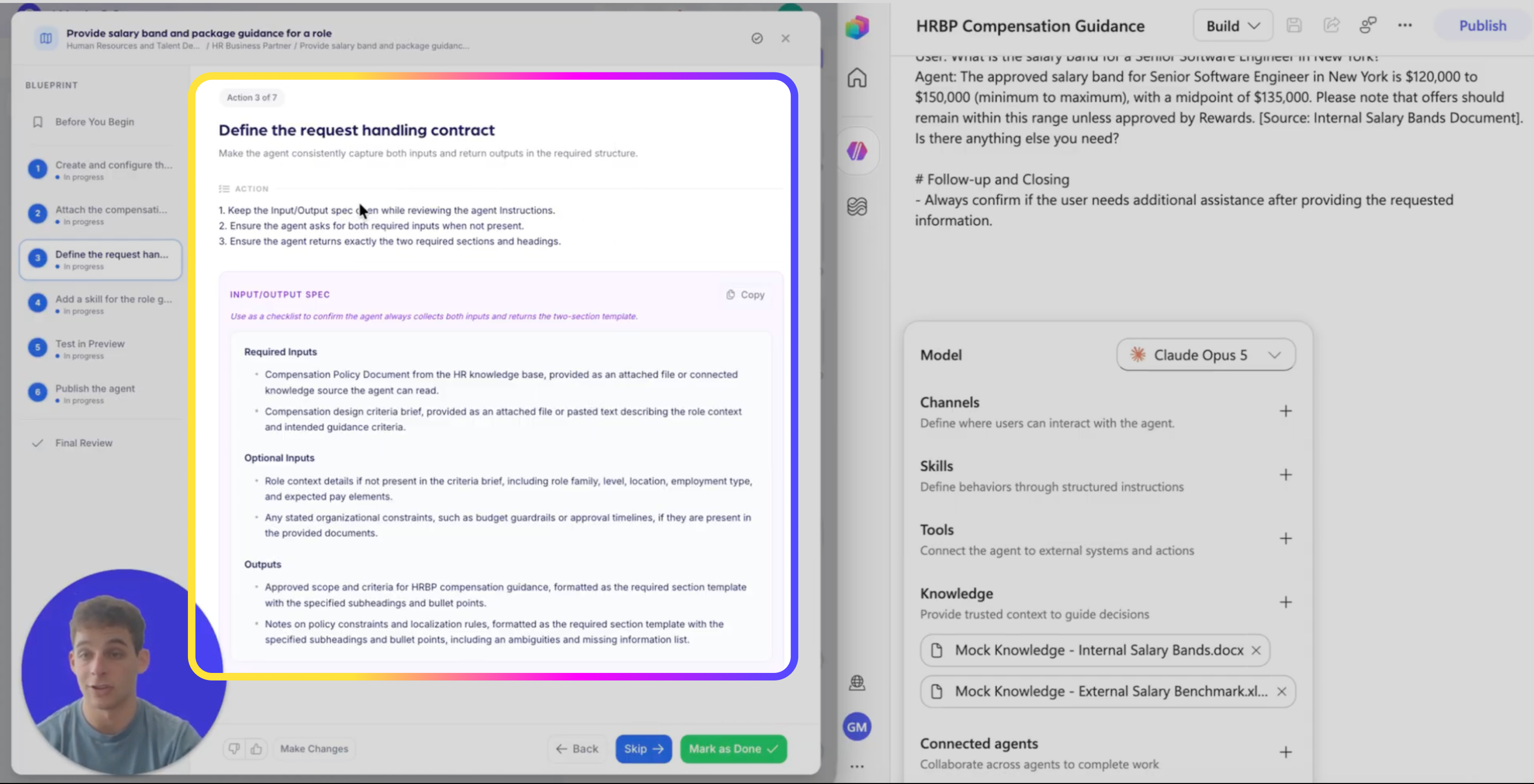
Required inputs

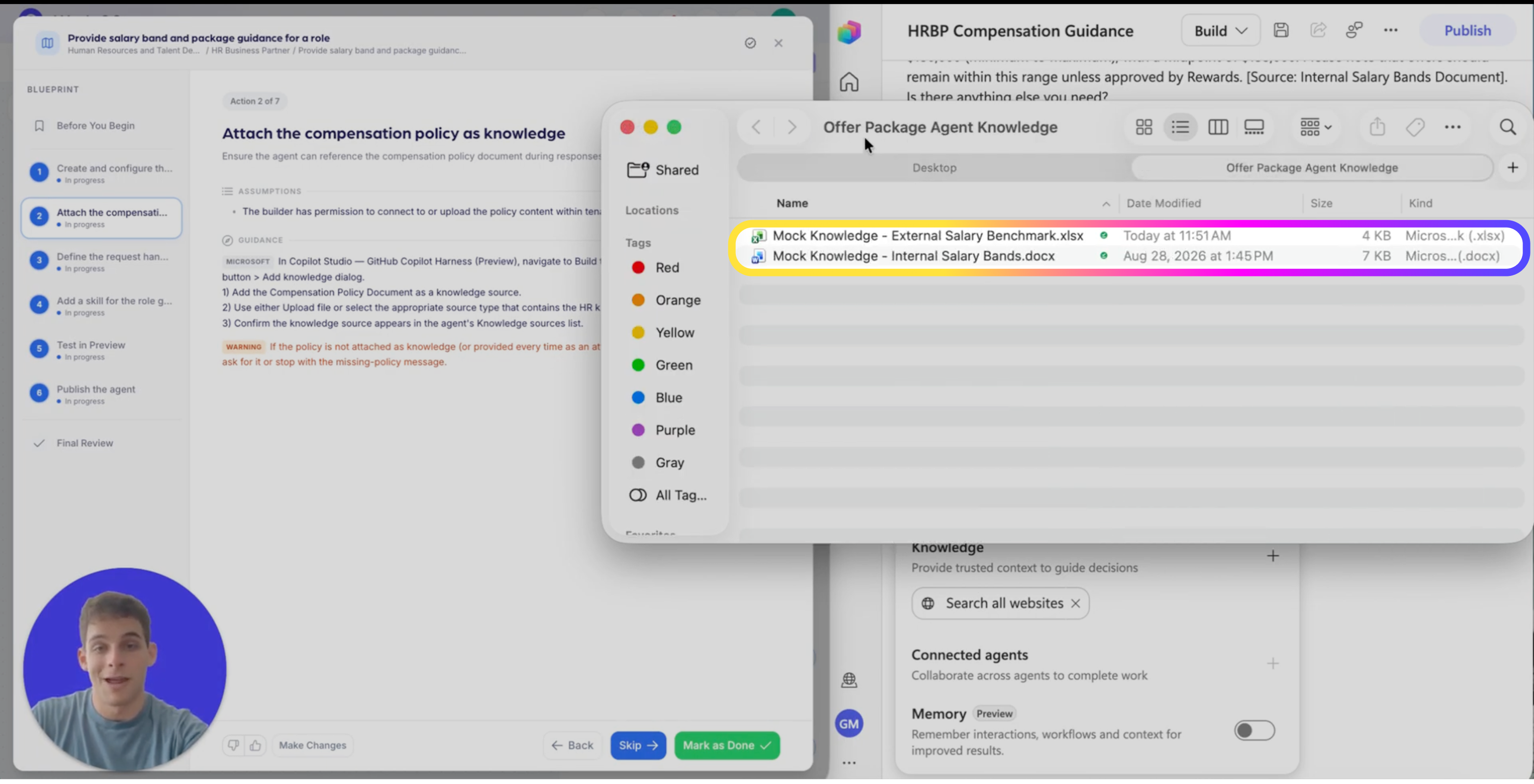
  • Internal salary band spreadsheet
  • External benchmark dataset
  • Escalation path definition
  • Role, level, and location metadata

Outputs produced

  • Salary band range
  • Compliance status
  • Exception flag
  • Escalation instruction
  • Structured recruiter summary

Sample guardrailed system prompt

You are a Compensation Offer Guidance Agent supporting recruiters.

You operate only on approved internal salary band and benchmark data.

You must:

  • Retrieve salary band by role, level, location
  • Compare proposed compensation to approved band
  • State whether offer is within policy
  • Flag when outside approved range
  • Direct exceptions to human workflow
  • Include statement that final approval requires human review

You must not:

  • Approve offers
  • Modify compensation data
  • Use external sources
  • Provide advice beyond compensation policy

This ensures governance alignment.

Step 5: Measure operational impact

Success is workflow improvement, not AI usage.

Measure before implementation

  • Average offer approval time
  • Compensation correction rate
  • Exception routing delay
  • Candidate drop-off rate at offer stage

Measure after implementation

  • Reduction in approval time
  • Reduction in manual emails
  • Reduction in band misapplications
  • Faster candidate acceptance

Example success criteria

Metric

Before

After

Target

Offer approval time

3 days

1 day

−50%

Compensation corrections

12%

4%

−60%

Exception routing delay

2 days

Same day

−70%


If performance does not improve, redesign or retire the agent.
Adoption alone is not success.

Step 6: Enable responsible adoption

Agents change workflows. That requires enablement.

People must understand:

  • What the agent does
  • What it does not do
  • When to override
  • Where accountability sits

Enablement checklist

  • Document updated workflow
  • Clarify human decision points
  • Train recruiters on exception routing
  • Communicate compensation governance boundaries
  • Define escalation path ownership
  • Review early outputs for quality

Responsible AI requires expectation shifts.

Executive FAQ

Does this replace compensation teams?

No. It augments structured analysis. Humans retain approval authority and governance ownership.

What is the primary ROI driver?

Reduced approval time and fewer compensation errors. Secondary impact includes improved candidate experience and recruiter efficiency.

How long does implementation take?

With structured data and clear governance, a low-code build can be piloted in weeks.

What is the biggest risk?

Unclear policy or inconsistent data. AI amplifies data quality issues.

How does this align with responsible AI principles?

The agent operates at the task level, has explicit guardrails, and requires human accountability for final decisions.

Wrapping up

AI agents redesign work. They do not remove people.

Workflow design matters more than tools.
The tool is simple. The thinking is not.

Responsible AI requires:

  • Clarity of task
  • Defined guardrails
  • Human accountability
  • Measurable impact
  • Iteration over time

This is not automation of jobs.
It is a redesign of subtasks inside workflows .

We will continue developing resources such as:

  • A user flow playbook for building AI agents
  • Future learning sessions to deepen technical and strategic skills
  • Templates for common HR and business agent use cases

If your team needs support identifying the right work to reinvent, responsibly re-engineering workflows, and building AI agents that augment human capability, get in touch to move from AI ideas to deployed, measurable outcomes.

→ Explore more Agent Building Guides


Talk to a Work Strategist

See the Work Operating System in action and start re-engineering work for AI.

Subscribe to our newsletter

The latest insights on re-engineering work for AI