


 Platform Overview
The Work OS for AI-powered Work
Platform Overview
The Work OS for AI-powered Work
 Work Architecture
Live entity model of your enterprise
Work Architecture
Live entity model of your enterprise
 Map
Build the Work Context Graph
Map
Build the Work Context Graph
 Analyze
Your GPS for reinvention
Analyze
Your GPS for reinvention
 Build
Builder Studio · Workflows + agents
Build
Builder Studio · Workflows + agents
 Run
Deliver the new way of working
Run
Deliver the new way of working
 Measure
Track real, board ready ROI
Measure
Track real, board ready ROI
 Log
Source of truth · audit trail
Log
Source of truth · audit trail
 Update
Keep architecture current
Update
Keep architecture current

Author
Reejig

Read time
7 mins

Published
Mar 20, 2026

Blog Post Body
AI Work Design Blueprint
The responsibilities every CHRO must own to lead AI Work Design and build internal capability.
An HR Regulatory Change Agent reduces manual monitoring, accelerates regulatory awareness, and improves compliance response without removing human accountability.
This guide explains exactly how to design, scope, and measure one using a task-level workflow approach demonstrated in Reejig’s Build the Builder session.
What is an HR regulatory change agent?
An HR Regulatory Change Agent is an AI-powered workflow assistant that monitors trusted sources, summarises regulatory changes, and produces structured briefing notes for HR teams.
It does not interpret legal risk.
It does not make compliance decisions.
It augments monitoring and summarisation so humans can act faster.
Agent overview
|
Element |
Description |
|
Agent name |
HR Regulatory Change Agent |
|
Primary user |
HR, Employee Relations, Compliance teams |
|
Task supported |
Monitoring and summarizing regulatory updates |
|
Stage of work |
HR operations / compliance |
|
Success outcome |
Faster awareness, reduced manual effort, clearer action routing |
Responsible AI positioning
This agent is designed to augment human work, not replace roles.
It supports the monitoring and summarisation subtasks, but it does not own interpretation or decision-making.
Human-led decisions include:
- Determining regulatory relevance
- Interpreting legal and policy implications
- Deciding required organisational action
- Approving communications or policy updates
AI operates at the task and subtask level, not the job level.
A human remains accountable for all outcomes produced with this agent.
Business problem it solves
In most organisations:
- One or two people manually review multiple sources weekly
- Updates are compiled into documents or emails
- This process takes hours and is repetitive
- Important updates may be missed or delayed
As described in the session, this is often a weekly manual briefing process that consumes time without adding strategic value.
This agent addresses monitoring and summarisation only.
When should you build this agent?
Build this agent when regulatory monitoring is manual, repetitive, and time-consuming.
Appropriate when
- Trusted regulatory sources are defined
- A regular reporting cadence exists (e.g. weekly briefings)
- Outputs follow a consistent format
- Manual effort is measurable (hours per week)
Do not build when
- No standard briefing format exists
- Sources are unclear or untrusted
- There is no defined owner for reviewing updates
AI cannot fix unclear ownership or governance.
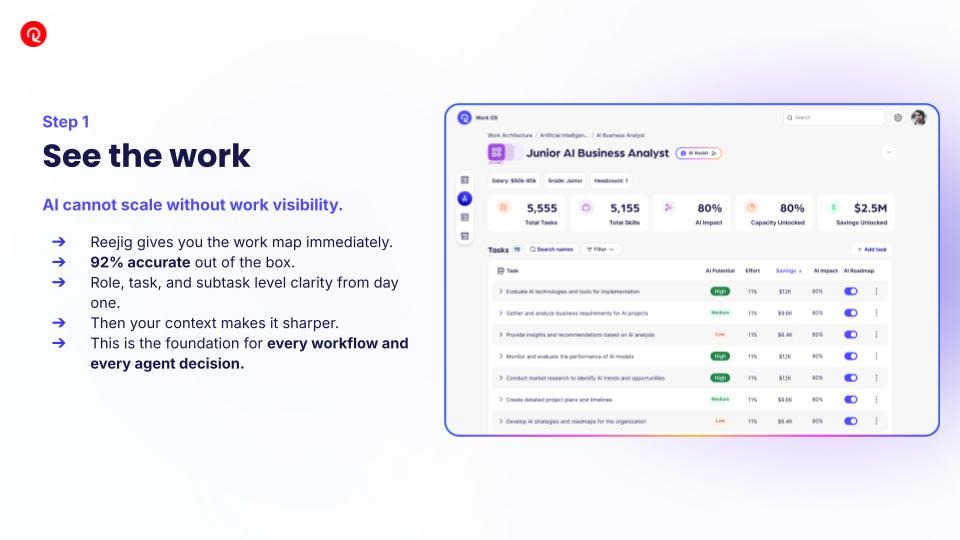
Step 1: Make the work visible at the task level
AI cannot scale without work visibility.
The session makes this explicit: work must be broken into tasks and subtasks before applying AI.
The single task
Monitor HR regulatory updates and produce a weekly briefing.
Subtasks the agent can handle
- Search trusted regulatory sources
- Identify recent updates (e.g. last 7 days)
- Extract relevant HR changes
- Summarise updates into structured format
- Generate a briefing note
Subtasks that remain human
- Interpret legal impact
- Decide organisational response
- Approve communications
- Own compliance accountability
This is workflow redesign, not workforce reduction.
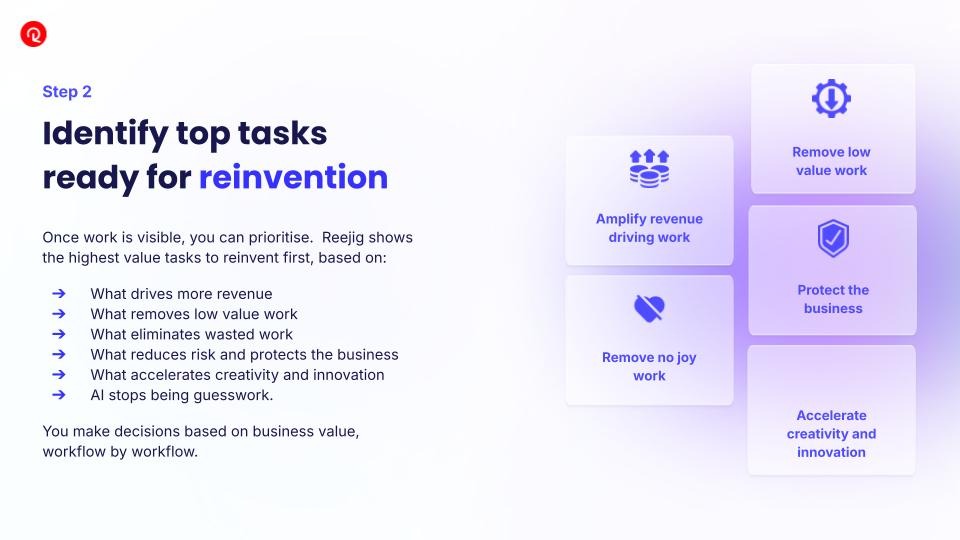
Step 2: Redesign the workflow
The goal is not to automate everything. It is to redesign how the task is completed.
How the task works today
- HR reviews multiple websites manually
- Reads articles and extracts key points
- Compiles a document or email
- Sends to stakeholders
This process can take several hours per week.
Where friction occurs
- Manual searching across sources
- Repetitive summarisation
- Inconsistent formatting
- Time delays in distribution
The AI-enabled workflow
The agent replaces manual monitoring and drafting.
Agent-handled work
- Search defined sources (e.g. SHRM, DOL, CIPD, HBR)
- Filter for recent updates
- Summarise changes
- Generate structured briefing
Human-led work
- Review briefing
- Validate relevance
- Decide action
- Communicate changes
The agent reduces hours of manual work to minutes.
Humans retain decision authority.
Step 3: Define scope and guardrails
Clear prompts and constraints determine agent quality.
The session highlights that strong prompts must define:
- Role
- Rules
- Inputs
- Outputs
- Guardrails
The agent is responsible for
- Monitoring trusted sources
- Producing structured summaries
- Following defined output format
The agent cannot
- Provide legal advice
- Approve compliance decisions
- Use unapproved sources
- Act beyond defined scope
Human review is required when
- Regulatory impact is unclear
- Policy changes are required
- Legal interpretation is needed
A human remains accountable for outcomes produced with this agent.
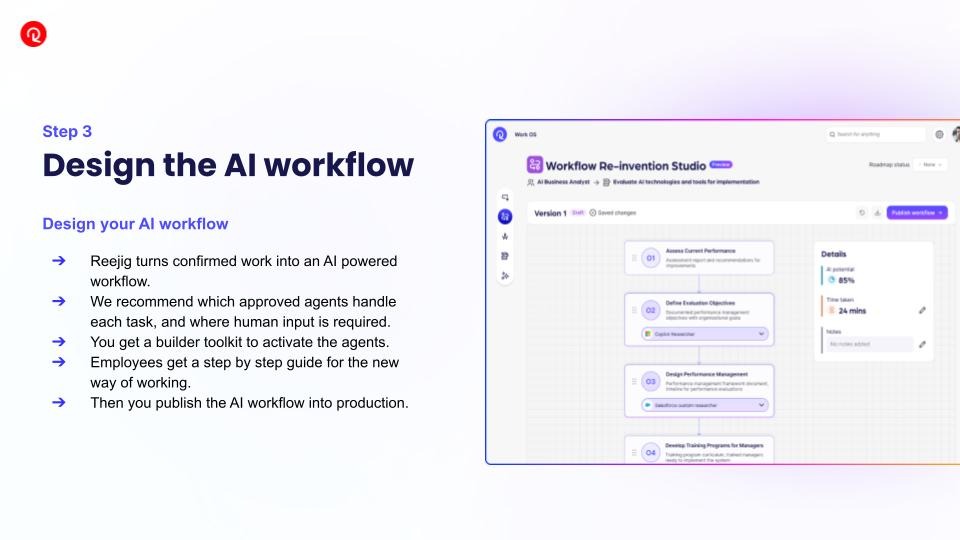
Step 4: Build the agent
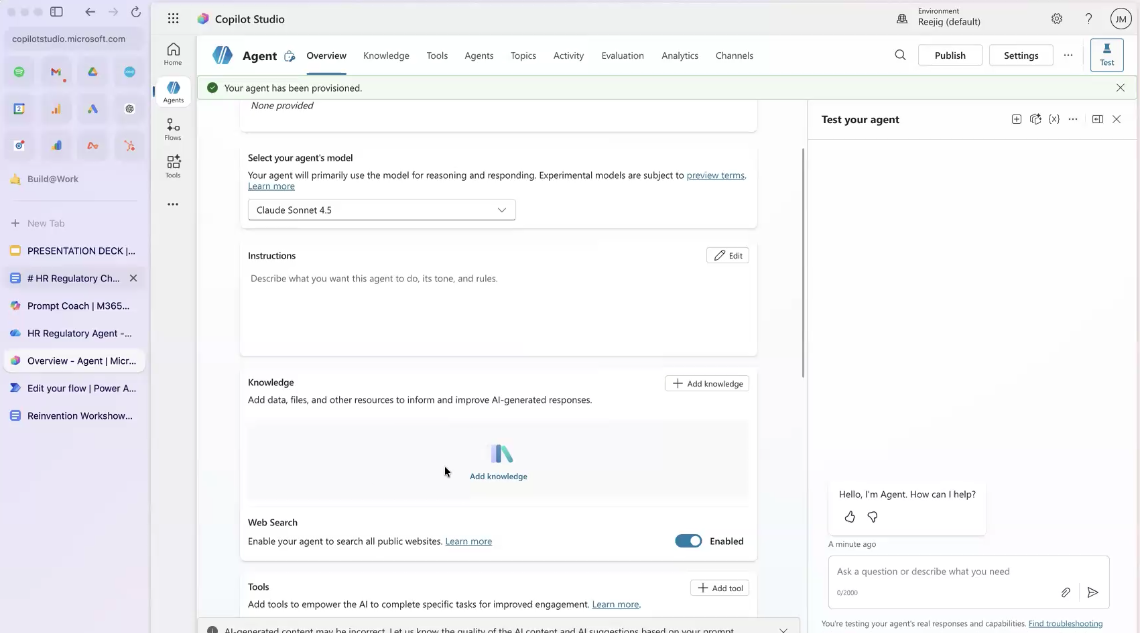
This agent can be built using low-code tools such as Microsoft Copilot Studio.
The session demonstrates that:
- No deep technical background is required
- The quality of the prompt is the most important factor
Required inputs
- Trusted source list (e.g. SHRM, DOL, CIPD, HBR)
- Time window (e.g. last 7 days)
- Example briefing documents
- Output format expectations
Outputs produced
- Weekly regulatory briefing
- Executive summary
- Categorised updates
- Source references
(As shown in the structured briefing example in the session output screen)
Step 5: Measure impact
Avoid pilot purgatory. Measure real outcomes.
Measure before
- Time spent on weekly monitoring
- Time to produce briefing
- Number of sources reviewed
Measure after
- Reduction in preparation time
- Consistency of outputs
- Speed of distribution
Example success criteria
|
Metric |
Before |
After |
Target |
|
Weekly monitoring time |
3–4 hours |
15 minutes |
−80% |
|
Time to distribute update |
1 day |
Same day |
−70% |
|
Consistency of briefing |
Variable |
Standardised |
High |
If impact is not measurable, redesign the workflow.
Step 6: Enable adoption
This is not a tool rollout. It is a workflow change.
What changes
- Humans stop gathering data manually
- Humans start reviewing structured outputs
- Work shifts from effort to judgment
Enablement checklist
- Define workflow before deploying the agent
- Train users on prompt limitations
- Reinforce human accountability
- Test outputs regularly
- Iterate based on performance
The session reinforces that this is a foundation, not a full blueprint.
Executive FAQ
Does this replace HR or compliance teams?
No. It removes repetitive monitoring work and supports faster decision-making. Humans retain accountability.
What is the primary ROI driver?
Time saved on manual monitoring and faster awareness of regulatory changes.
How long does implementation take?
With defined sources and format, a low-code build can be completed quickly and iterated over time.
What is the biggest risk?
Weak prompts or unclear sources. Output quality depends on input clarity.
How does this align with responsible AI?
It operates at the task level, includes clear guardrails, and requires human accountability for all outcomes.
Wrapping up
AI agents redesign work. They do not remove people.
The session makes this clear: success comes from understanding work first, then applying AI deliberately.
Workflow design matters more than tools.
Responsible AI requires:
- Clarity of task
- Defined guardrails
- Human accountability
- Measurable impact
- Iteration over time
This is not automation of jobs.
It is a redesign of subtasks inside workflows.
We will continue developing resources such as:
- A user flow playbook for building AI agents
- Future learning sessions to deepen technical and strategic skills
- Templates for common HR and business agent use cases
If your team needs support identifying the right work to reinvent, responsibly re-engineering workflows, and building AI agents that augment — not replace — human capability, get in touch to move from AI ideas to deployed, measurable outcomes.

Reejig
Reejig Marketing

AI Work Design Blueprint
The responsibilities every CHRO must own to lead AI Work Design and build internal capability.