How to build the “Offer Package” agent

Author: Reejig
Author

Reejig

Read Time
Read time

4 mins

Published Date
Published

Jan 23, 2026

Hero Thumbnail

Blog Post Body

Table of Contents

Talk to a Work Strategist

See the Work Operating System in action and start re-engineering work for AI.

Subscribe to our newsletter

The latest insights on re-engineering work for AI

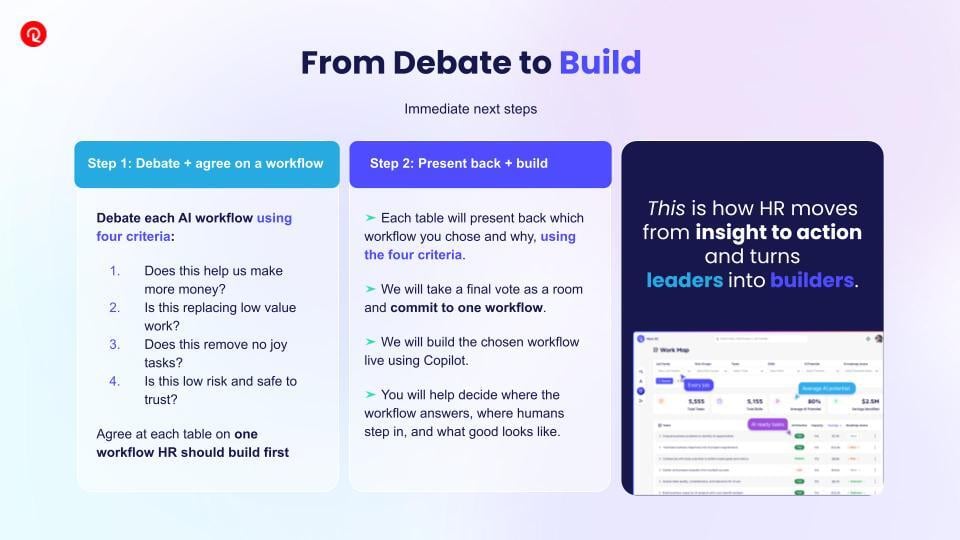
The Offer Package Agent was built live during a hands-on workshop hosted at Microsoft Garage, designed to help HR and business leaders move from AI insight to real deployment using Microsoft Copilot.

After evaluating multiple AI workflow options, the group selected the Offer Package Agent as the highest-impact starting point due to its direct connection to revenue, time-to-hire, and pay equity risk. This workflow consistently surfaced as a major bottleneck across organisations, slowing hiring decisions and causing candidate drop-off.

Agent Overview

Agent name: Offer Package Agent
Primary user: Recruiters, Hiring Managers, HR Business Partners
Task this agent supports: Creating and approving competitive compensation offers
Stage of work: Talent Acquisition – Offer Creation

What success looks like:

  • Reduced time-to-hire
  • Faster offer approvals
  • Improved pay equity and consistency
  • Fewer lost candidates due to delays

Step 1: Make the work visible

The first step is not building the agent — it’s understanding the work.

This agent supports a single task:

Determining and justifying an appropriate compensation offer for a role.

That task was broken down into clear subtasks.

Subtasks:

  • Review role details (level, location, business unit)
  • Assess internal and market compensation benchmarks
  • Validate alignment to pay bands and bell curves
  • Justify the offer against internal equity rules

This task-level clarity is critical. The agent does not replace a role — it supports a specific piece of work. 

Step 2: Redesign the workflow

Next, the workflow was redesigned before introducing AI.

Current workflow:
Recruiters request guidance from the rewards team, often via email or spreadsheets. Responses can take days or weeks due to limited team capacity, causing hiring delays and candidate drop-off.

AI-enabled workflow:
The Offer Package Agent sits directly inside the recruiter workflow, providing immediate guidance using approved compensation data.

Subtasks handled by the agent:

  • Ingest role and candidate inputs
  • Reference internal compensation benchmarks
  • Apply bell curve and pay band logic
  • Generate a recommended offer range

Subtasks remaining human-led:

  • Final approval on exceptions
  • High-risk or out-of-band decisions
  • Communication with candidates

Step 3: Define agent scope and guardrails

This agent operates at the subtask level, not end-to-end autonomy.

Agent responsibilities:

  • Recommend an offer package
  • Explain why the recommendation fits policy
  • Highlight equity or compliance risks

Guardrails:

  • Limited access to approved compensation data only
  • No authority to finalise offers
  • Automatic escalation for out-of-range or sensitive cases

Human-in-the-loop design was a deliberate choice to manage risk and build trust.

Step 4: Build the agent

The agent was built using Microsoft Copilot, leveraging tools most organisations already have.

Inputs required:

  • Role level
  • Location
  • Business unit
  • Candidate context (where applicable)

Outputs produced:

  • Recommended salary range
  • Justification aligned to internal benchmarks
  • Risk flags or escalation prompts

Sample agent instruction:

“Based on approved internal compensation data, recommend an offer package for this role. Ensure alignment with pay bands and equity rules. Flag any risks or exceptions and explain your reasoning.” 

Step 5: Measure impact

Success is not measured by Copilot usage or logins.

What to measure (before vs after):

  • Time-to-hire
  • Offer approval cycle time
  • Candidate acceptance rates
  • Pay equity variance

If the agent does not deliver measurable value, it should be adjusted or shut down. If it works, it should be scaled.

Step 6: Enable adoption

Agents fail when expectations don’t change.

This agent required a clear shift in how recruiters and managers work.

Enablement checklist:

  • Clear instructions on when to use the agent
  • Examples of approved and escalated scenarios
  • Explicit guidance: “This is how offers are created now”

Without expectation-setting, adoption typically stalls at around 20%.

Wrap & Close

AI agents are quickly becoming a foundational component of modern workforce strategy. This session reinforced that agents work best when they are built at the task and subtask level, supported by redesigned workflows and clear guardrails.

Workflow design matters more than the technology itself. Start small, prove value, and then scale.

If your team needs support identifying the right work to reinvent, redesigning workflows, and building AI agents that actually get adopted, we can help. 

Get in touch to learn how we partner with organisations to move from AI ideas to deployed, measurable outcomes.

Explore more Agent Building Guides

Speakers

Siobhan Savage
Siobhan Savage

Siobhan Savage

CEO & Co-Founder of Reejig

Mike Reed
Mike Reed

Mike Reed

Co-founder & Chief Product Officer at Reejig

Talk to a Work Strategist

See the Work Operating System in action and start re-engineering work for AI.

Subscribe to our newsletter

The latest insights on re-engineering work for AI