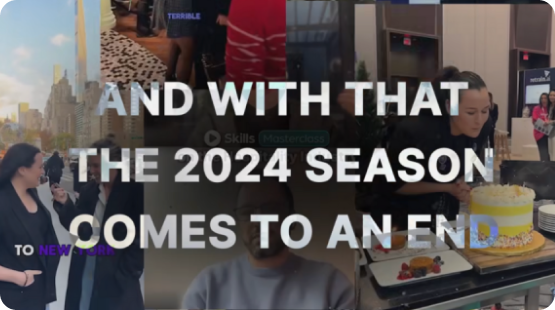
Welcome back, leaders. After some well-deserved time to pause and recharge, it feels like the right moment. Time to reflect on everything we've seen, learned, and achieved over the past year.
2024 was a whirlwind. From the rise of generative AI to nuanced conversations around workforce redesign, the pace was relentless. While the world grappled with big questions about AI-powered work, we at Reejig doubled down on one core belief. There is no wasted potential. Only untapped opportunities.
Let's look at the milestones, trends, and insights that shaped our journey and the industry this past year.
2024 in the technology and AI industry
The past year saw major developments that reshaped the landscape:
- The rise of task-based workforce strategies: Organizations started breaking roles into tasks. They aligned work more closely with specific skills and automation opportunities. This led to wide-scale adoption of Work Context and our 25 industry-specific Work Ontologies. (Reejig)
- Generative AI took center stage: Generative AI reshaped workforce strategies, from hiring to upskilling. It also raised critical questions about bias and ethical use. (Deloitte)
- The push for AI governance: As the EU's AI Act gained momentum, companies began adopting independent audits. These ensure transparency and accountability in AI systems. (Deloitte)
- A global reskilling imperative: With rapid advancements in automation, global companies invested heavily in reskilling. They prepared workforces for AI-driven change. (The Hans India)
- Independent Ethical AI audits became the norm: Businesses demanded clear proof of fairness, inclusivity, and ethical practices in their AI. This set a new industry standard. (Deloitte)
These shifts underscored one truth. AI is no longer just an addition. It's a driving force for how work gets done.
Every enterprise is deploying AI. Almost none can see the work they're deploying it into.
Reejig in 2024: pioneering Work Intelligence
At Reejig, we made significant strides in workforce redesign. We gave leaders the visibility to navigate the complexities of AI. Here's what we accomplished:
- Workforce Reinvention Blueprints: Drawing on 41 million unique data points, we released blueprints for 23 industries. These give leaders the structure to anticipate workforce shifts. They show task-level impacts and sustainable reskilling strategies.
- People Leader Summit with Forbes: Together with Forbes, we convened leading HR executives. We explored the balance between innovation and ethical responsibility in the AI era.
- Key senior appointments to accelerate US expansion: Reejig hired Lynne Oldham, Amy Wilson, and Nuno Gonçalves to advance workforce redesign, accelerate US expansion, and bring our mission to the global stage.
- Advanced Work Intelligence powered by Work Context and Ethical AI: Our Work Intelligence equips organizations to navigate this landscape. They adopt AI while ensuring everyone accesses meaningful work.
- The Beyond Skills event: In partnership with The Learning Forum and Brian Hackett, we brought together leaders from Microsoft, Estée Lauder, Mastercard, Cisco, Colgate-Palmolive, and more. The conversations in NYC redefined skills vs. tasks. They explored AI's true role in workforce strategy.
- Skills Masterclass Series: Alongside Mike Reed, we unbundled work across 7 industries: tech, healthcare, manufacturing, retail, finance, education, and hospitality. We broke roles into tasks and skills. We delivered actionable roadmaps for workforce redesign, AI implementation, and reskilling pathways.
- Podcast series: The podcast brought together bold and responsible change-makers. Jacinta Newman, Sally Elson, Lynne Oldham, Kay Smart, Nuno Gonçalves, Dr. Shujia Zhang, and Gordon Ritchie explored reinventing work, integrating AI, boosting productivity, tackling the reskilling crisis, and fostering a transformative mindset.
- Conferences: We attended the Gartner ReimagineHR Conference in Orlando. I spoke on the distinction between tasks and skills in workforce design for the AI era. I was a guest on the Capital H Podcast with Kyle Forrest from Deloitte. We also attended the Unleash Conference in Las Vegas. We hosted fireside chats at Camp Reejig and connected with global leaders.
2025 predictions: what lies ahead
Looking ahead, 2025 promises to be a defining year. The pace of change in AI, Work Intelligence, and business strategy demands bold leadership. Deep adaptability. And a commitment to ethics and equity. Here's where the industry is heading:
- Autonomous agents will lead the way: 2025 will mark the rise of true autonomous agents. Not just AI workflows mislabeled as agents. They will drive seamless experiences and reshape how employees engage with work. As front-end engagement declines, agents will handle entire workflows.
- The evolution of workforce DNA: Organizations will integrate fixed employees, flex workers, and digital workers into a unified workforce model. Tasks, not roles, will emerge as the most valuable data point. This drives decisions on automation and efficiency.
- Reskilling as a social imperative: The rapid pace of AI-driven change demands widespread reskilling initiatives. Governments and organizations alike face mounting pressure. They must address skill gaps and prepare workers for emerging industries.
- Ethical AI takes center stage: Companies will come under scrutiny for fairness, bias, and inclusivity in their AI. Boards and CEOs will face public accountability for the societal impacts of their AI implementations.
- Education systems will shift: The limitations of traditional education models will become more evident. This leads to a global push for learning systems that prioritize task-level skills. They must prepare students for AI-driven economies.
- Billion-dollar companies with lean workforces: AI-driven efficiency will let organizations achieve extraordinary financial success with fewer than 100 employees. This reshapes traditional notions of corporate size and scale.
- The rise of digital factories: Sectors such as manufacturing, consumer goods, and automotive will adopt digital factories. They will drive productivity and sustainability in unprecedented ways.
- A chaotic adoption landscape: 2025 will bring stark contrasts in performance. Companies will either adopt AI, experiment cautiously, or resist altogether. The gap between leaders and laggards will widen significantly.
- The AI bubble and workforce tensions: As AI hype peaks, companies will face backlash from workers left behind in the reskilling race. This creates resentment and societal challenges. Meanwhile, AI-savvy employees will see their value skyrocket. They will demand better pay and balance.
- Sustainability and ESG in focus: Sustainability and ESG priorities will become non-negotiable. Organizations will align AI initiatives with broader social and environmental goals.
- Governments and universal minimum wage: Policymakers will seriously consider universal minimum wages to address economic shifts spurred by AI adoption. This further highlights the societal impact of this change.
- Demand for new roles: Agent managers, AI operators, and trainers will emerge as critical roles. Businesses will learn to operate and optimize their new AI ecosystems.
These trends are not just challenges. They are opportunities for leaders to differentiate themselves. The bold will seize the moment. They will lead responsibly, adapt quickly, and create a future defined by equity, innovation, and meaningful work.
Siobhan 💜
 Platform Overview
The Work OS for AI-powered Work
Platform Overview
The Work OS for AI-powered Work
 Work Architecture
Live entity model of your enterprise
Work Architecture
Live entity model of your enterprise
 Map
Build the Work Context Graph
Map
Build the Work Context Graph
 Analyze
Your GPS for reinvention
Analyze
Your GPS for reinvention
 Build
Workflows + agents
Build
Workflows + agents
 Run
Deliver the new way of working
Run
Deliver the new way of working
 Measure
Track real, board ready ROI
Measure
Track real, board ready ROI
 Log
Source of truth · audit trail
Log
Source of truth · audit trail
 Update
Keep architecture current
Update
Keep architecture current