 Platform Overview
The Work OS for AI-powered Work
Platform Overview
The Work OS for AI-powered Work
 Work Architecture
Live entity model of your enterprise
Work Architecture
Live entity model of your enterprise
 Map
Build the Work Context Graph
Map
Build the Work Context Graph
 Analyze
Your GPS for reinvention
Analyze
Your GPS for reinvention
 Build
Workflows + agents
Build
Workflows + agents
 Run
Deliver the new way of working
Run
Deliver the new way of working
 Measure
Track real, board ready ROI
Measure
Track real, board ready ROI
 Log
Source of truth · audit trail
Log
Source of truth · audit trail
 Update
Keep architecture current
Update
Keep architecture current
Reejig x Workday
Unlock more value from Workday with AI Work Design.



Author
Siobhan Savage

Read time
3 mins

Published
Aug 4, 2025
Blog Post Body
AI Work Design Blueprint
The responsibilities every CHRO must own to lead AI Work Design and build internal capability.
Everyone's talking about AI. Most people still don't know what they mean.
You hear chatbots, agents, automation, machine learning, robotics. It all blurs together.
But if you're leading your organization into AI-powered work, you need clarity. You need to know what these categories are. You need to know how they work. And you need to know their real impact. Some will assist your people. Some will augment them. Others will replace entire workflows.
Understanding the type of AI in play changes everything. You can design your workforce strategy with confidence.
AI is not one thing. It's a spectrum.
It's not about job loss. It's about task shift.
Most AI today works at the sub-task level. It's not taking your whole job. It's taking small pieces. Summarizing a document. Generating a draft. Recommending next steps.
That's the now. Where we're going is where it gets interesting.
AI capability is compounding. Work visibility is not.
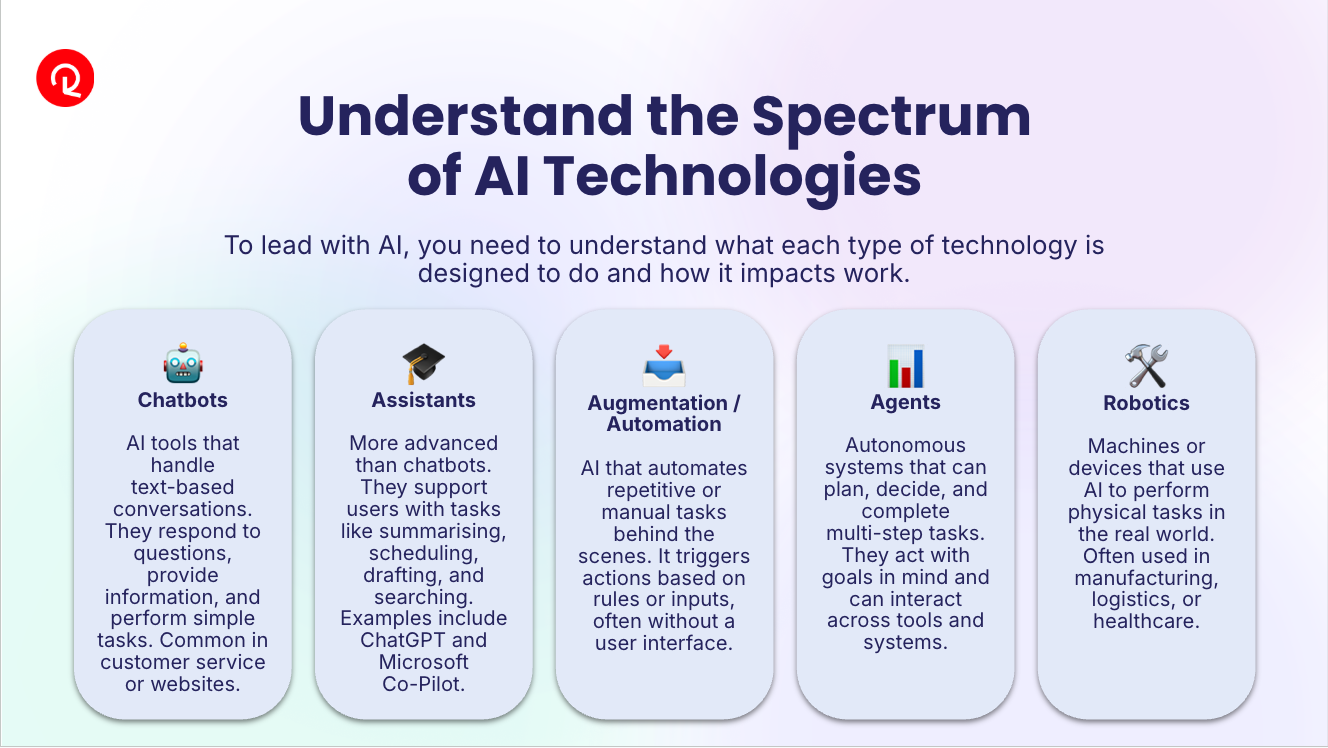
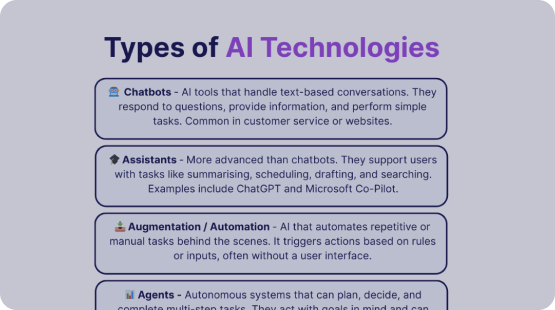
1. Chatbots: assist with repetitive conversations
These are scripted systems that handle text-based queries. They respond to questions and provide simple information. They route people to answers.
You've seen them in HR, IT, and customer service.
Used for: FAQs and common queries Doesn't: Solve complex problems Impact: Low. Reduces noise but doesn't change workflows.
2. Assistants: support tasks like summarizing and drafting
These are more advanced than chatbots. They support users with sub-tasks. Summarizing, drafting, searching, scheduling.
Examples include ChatGPT and Microsoft Copilot.
Used for: Knowledge work at the sub-task level Strength: Speeds up work and helps generate outputs Impact: Medium. Improves productivity but doesn't operate alone.
3. Augmentation and automation: execute repetitive or manual tasks
This is AI that runs behind the scenes. It triggers actions based on inputs or rules. No user needed.
Think of RPA, task triggers, and system-level automations.
Used for: Routine, rules-based processes Strength: Consistent and fast Impact: Medium. Replaces repetitive steps, not entire roles.
4. Agents: plan, decide, and act across systems
These are autonomous systems that handle multi-step tasks. They coordinate across platforms. They take initiative. They adapt to context.
An agent could extract data, make a decision, and notify the right person. No human input required.
Used for: End-to-end workflows across platforms Strength: Acts with intent and context Impact: High. Reshapes how work flows through systems.
5. Robotics: perform physical tasks in the real world
Machines that use AI to move, lift, package, and assemble. Robots have long supported physical labor. Now they're part of digital systems too.
Dark factories and automated warehouses show the direction.
Used for: Manufacturing, logistics, and healthcare Strength: Fast, safe, precise Impact: Massive. Reshapes how physical work gets done.
Why this matters
Without knowing what kind of AI you're dealing with, you risk two things. Overreacting. Or missing the moment.
Most work won't disappear overnight. It'll be rearranged. Tasks will shift between humans, agents, and automations.
Your role is to decide:
- What stays with people
- What shifts to digital workers
- How to match the right AI to the right kind of work
That's how you reduce waste and protect potential. That's how you build better.
Your next step: audit your world
Map the AI already inside your business.
- What's just a chatbot?
- What's true automation?
- Where are agents emerging? Where could you build one?
We're building something for leaders who ask these questions. If you want content like this, clear, tactical, built for people who design work, you'll want to see what's coming.
No noise. Just what matters to build the AI-powered workforce the right way.
Book a demo to see how the Work Operating System redesigns work at the task level.
Siobhan 💜


Siobhan Savage
CEO & Co-Founder of Reejig

AI Work Design Blueprint
The responsibilities every CHRO must own to lead AI Work Design and build internal capability.