 Platform Overview
The Work OS for AI-powered Work
Platform Overview
The Work OS for AI-powered Work
 Work Architecture
Live entity model of your enterprise
Work Architecture
Live entity model of your enterprise
 Map
Build the Work Context Graph
Map
Build the Work Context Graph
 Analyze
Your GPS for reinvention
Analyze
Your GPS for reinvention
 Build
Workflows + agents
Build
Workflows + agents
 Run
Deliver the new way of working
Run
Deliver the new way of working
 Measure
Track real, board ready ROI
Measure
Track real, board ready ROI
 Log
Source of truth · audit trail
Log
Source of truth · audit trail
 Update
Keep architecture current
Update
Keep architecture current
Reejig x Workday
Unlock more value from Workday with AI Work Design.



Author
Siobhan Savage

Read time
6 mins

Published
May 12, 2025
Blog Post Body
AI Work Design Blueprint
The responsibilities every CHRO must own to lead AI Work Design and build internal capability.
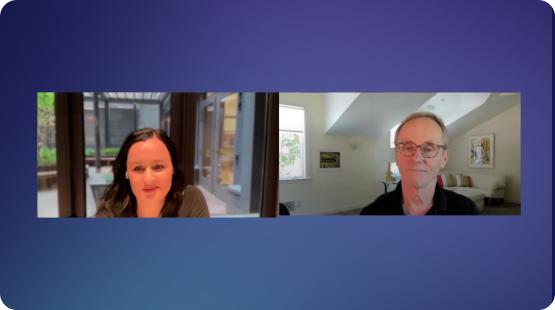
From my live broadcast with Josh Bersin last week. What to do, not just what to know.
"This isn't like buying Workday and hoping everyone becomes more productive. This is full business reinvention." Josh Bersin
Let us stop treating AI like a tech initiative. Let us start treating it like what it actually is. A total restructuring of how work gets done.
Here are 7 tactical shifts to redesign your workforce model. Built from my live session with Josh Bersin.
1. You need critical infrastructure for work, not a static org chart
Not a static job architecture. Not an org structure. Something dynamic that reflects the work being done.
The problem:
Org charts tell you who reports to whom. They tell you nothing about how work actually flows. What is broken. Where value gets stuck.
Josh shared an example. A company with 100,000 employees and 65,000 job titles. After we Mapped the work: just 3,000 unique jobs. The rest was redundant noise, legacy titles, and work no longer done.
You manage people by outdated roles. But people do not do roles. They do work. That work evolves daily. You need a live operating system. One that Maps tasks, capabilities, and outputs in real time.
What to do:
- Do not start from scratch. Start with real data. Reejig automatically delivers a live feed of tasks and capabilities.
- Use that data to update your outdated job architecture. Build Work Architecture. A dynamic system that reflects how work actually happens.
- This is not about removing structure. It is about redesigning it. To manage risk, regulatory requirements, and real-time change.
- Focus on what is getting done. Track how work moves across teams, roles, and systems. Regardless of titles.
- Choose one high-impact function to get started. Customer support, marketing, or claims.
This is your Work Operating System. A real-time map of how your organization runs. Where you find velocity, automation, and reinvention.
2. Use tasks as your source of truth
The problem:
You are trying to automate work based on roles and capabilities. AI does not work that way.
AI automates tasks. It needs granularity. Capability taxonomies do not tell you what the person is doing. Or how often. Roles are too vague. Job descriptions are often pure fiction.
"People have capabilities. Jobs and work have tasks." Siobhan Savage
What to do:
- For each job, list 10 to 20 repeatable tasks
- Tag each with effort level, business impact, and cost per task
- This gives you the basis to identify automation opportunities, spot task duplication across roles, and score AI readiness
Task-level visibility equals transformation visibility.
You will not need to do this manually. Reejig automatically gathers this data. Your only job is to validate what is already there.
3. Define what AI-ready work actually looks like
The problem:
Most "AI pilots" start with demos. Not with real use cases grounded in work.
Josh shared the story of a bank. Its biggest bottleneck was not in tech or headcount. It was in account opening. A process nobody had flagged.
Every enterprise is deploying AI. Almost none can see the work they're deploying it into.
What to do:
- Start with one problem domain. Onboarding, approvals, or reporting.
- Break it into tasks.
- Use this filter:
- Does this cost us money or cause pain?
- Is this task very repetitive?
- Is AI mature enough to take this task?
- What is the ROI when we reinvent this task?
Now you are not asking "Can we use AI?" You are asking "Where does AI deliver value today? What work do we redesign to make that happen?"
4. Advance beyond assistance by reengineering design
The problem:
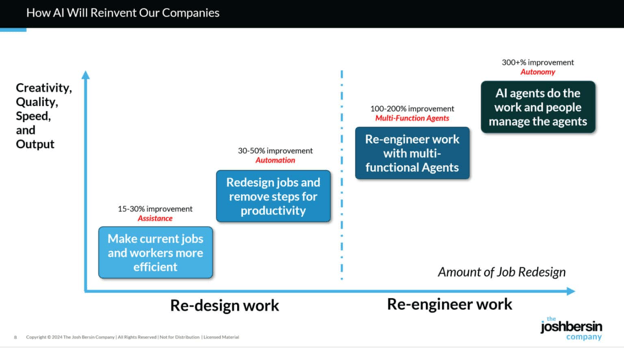
Most organizations are stuck at "AI as Copilot" (Level 1). They think they are innovating.
Josh's AI Maturity Model is clear:
- Personal Productivity
- Task Automation
- Workflow Reengineering
- Autonomous Agents
The real value, 100% to 300% gains, lives in Level 4. You cannot leap there with fragmented processes and siloed technology.
What to do:
- Reejig automatically Maps your workflows end to end. Sourcing to hiring to onboarding.
- It identifies all handoffs, delays, and duplicated tasks.
- Reejig tells you exactly where to eliminate friction. Not just speed up parts of the process.
AI maturity is not a technology investment. It is a design discipline.
5. Appoint someone to own the work
The problem:
CHROs own people. CIOs own systems. COOs own throughput. No one owns the work itself.
Without a single point of accountability, your AI efforts stay siloed and tactical.
What to do:
- Appoint a Work Design Lead (title optional for now)
- Their job:
- Own task-level design and governance
- Bridge workforce strategy, operations, and technology
- Run the AI-readiness map across the organization
- Plug them into your transformation office. Or report them to your CEO.
This is the start of the Chief Work Officer role. The organizations who create it first will lead the field.
6. Rethink career progression: from fixed paths to fluid pivots
The problem:
Traditional career ladders no longer reflect how work evolves.
Every time AI reshapes or removes a task, the role itself changes. Instead of mapping fixed career paths, we now look at building new capabilities or pivoting. Based on the changes to the role we just redesigned.
I used the "Jenga metaphor" in our call. Remove one task, and the entire structure changes.
What to do:
- Stop mapping roles. Start mapping task adjacencies.
- Example: A marketing coordinator does campaign tracking. AI automates that task. So what is next? Instead of climbing a traditional ladder, we pivot. Toward adjacent capabilities like campaign design or customer analytics.
- Every redundancy becomes an opportunity. Redeploy or redesign work in real time.
- Just-in-time readiness is not just efficient. It is how we build workforce adaptability.
7. Reinvention over efficiency
The problem:
Too many leaders still treat AI as a way to do the same work faster.
True reinvention happens when you redesign the work itself. And rebuild the system to continuously evolve.
As I said in the broadcast:
"If I were a CEO and you couldn't help me do this, I'd find someone who could."
If I automate chaos, I just scale the chaos.
What to do:
- For any AI use case, also ask:
- What tasks are being removed?
- What new tasks will emerge?
- What will this mean for team capacity, structure, and capabilities?
- Build a capability-building plan that aligns with that evolution. Not generic programs.
- Reward teams for removing work. Not just performing it.
AI does not just change productivity. It changes purpose.
Final word
Jobs still exist. They are no longer enough. We need new infrastructure built for the AI-powered workforce.
If you cannot see it, Map it, and orchestrate it:
- You cannot lead it
- AI will amplify your problems. Not solve them.
But if you can, you will reinvent how your business runs. On a foundation designed for now.
Map. Analyze. Build. Run. Measure. Log. Update. That's Reejig.
Book a demo to see the Work Operating System in action.
Siobhan 💜


Siobhan Savage
CEO & Co-Founder of Reejig

AI Work Design Blueprint
The responsibilities every CHRO must own to lead AI Work Design and build internal capability.