AI is not arriving in manufacturing as a single technology event. It is already changing how work gets done, task by task, workflow by workflow, across production lines, supply chains, and engineering functions.
The manufacturers who move fastest will not simply deploy more automation tools. They will redesign work itself by understanding which tasks AI can handle, which need human judgment, and which need to be rebuilt entirely.
Why this matters now
The global AI in manufacturing market is projected to grow at a CAGR of 57.2% through 2027 (Market Research Future). At the same time, 83% of manufacturing CEOs identify talent shortages as their top concern, while supply chain resilience and ESG compliance add further urgency. AI adoption is not a technology project. It is a workforce transformation challenge.
How AI is changing work in manufacturing
AI is not replacing manufacturing jobs wholesale. It is changing the composition of work within them.
Production operators are spending less time on manual inspection and more time monitoring automated systems. Supply chain specialists are shifting from spreadsheet-based planning to interpreting AI-generated forecasts. Engineers are using generative design tools to accelerate development rather than running calculations by hand.
Key AI-driven shifts:
- Routine assembly and inspection tasks are being automated at scale
- Quality control is moving from manual visual inspection to AI-powered computer vision
- Predictive maintenance is replacing reactive repair cycles
- Demand forecasting and logistics routing are being handled by machine learning models
- Sustainability monitoring is moving from manual data collection to automated tracking
Example tasks changing in manufacturing
|
Traditional task
|
AI-augmented task
|
Likely impact
|
|
Manual assembly line inspection
|
AI-powered visual defect detection
|
High automation potential
|
|
Reactive equipment maintenance
|
Predictive maintenance via IoT sensors
|
High automation potential
|
|
Manual demand and inventory forecasting
|
AI-driven predictive logistics
|
High automation potential
|
|
Engineering calculations and simulations
|
Generative design and AI simulation
|
AI-assisted, human-led decisions
|
|
ESG and emissions data collection
|
Automated monitoring and reporting
|
Moderate automation potential
|
|
Supplier risk assessment
|
AI-flagged risk signals with human review
|
AI-assisted
|
The implication for leaders is simple: the operating model is changing because the work is changing.
The workforce transformation challenge in manufacturing
Most manufacturing organizations struggle with AI transformation for the same reason: they are trying to manage a task-level problem with job-level tools.
AI does not affect roles uniformly. It affects specific tasks within roles, and those tasks vary by function, site, and workflow maturity. A production operator in a highly automated facility faces a fundamentally different AI transition than one in a legacy plant.
Common barriers:
- No visibility into work at the task and subtask level
- Workforce planning built around headcount and job titles rather than skills and activities
- Siloed transformation programs where IT, HR, and operations are misaligned
- Reskilling programs that lag behind automation rollout
- Governance gaps that slow responsible AI deployment
Production operations will see the fastest AI impact. Supply chain and logistics are close behind. Engineering and design roles will transform more gradually, with AI augmenting rather than replacing human judgment in the near term.
Why AI workforce strategy must start with tasks
Job titles do not tell you where AI will have an impact. Tasks do.
A single production technician role might contain 40 distinct tasks. Some are highly automatable, while others require physical dexterity or contextual judgment that AI cannot reliably replicate. Treating the entire role as either “at risk” or “safe” misses what is actually happening inside the work.
Task-level visibility enables leaders to:
- Identify which workflows are ready for automation or AI augmentation
- Redesign roles around remaining and emerging work
- Target reskilling at real skills gaps, not broad capability frameworks
- Match displaced workers to adjacent roles based on transferable tasks
Example: task-level AI impact in a manufacturing role
|
Role
|
Task
|
AI impact
|
|
Production Operator
|
Manual defect inspection
|
Automatable
|
|
Production Operator
|
Machine monitoring and exception response
|
AI-assisted
|
|
Production Operator
|
Equipment setup and calibration
|
Human-led with AI support
|
|
Supply Chain Specialist
|
Demand forecasting
|
Automatable
|
|
Supply Chain Specialist
|
Supplier negotiation and relationship management
|
Human
|
|
Maintenance Technician
|
Scheduled preventive maintenance
|
AI-assisted
|
|
Process Engineer
|
Running simulation calculations
|
AI-assisted
|
|
Process Engineer
|
Process design and innovation decisions
|
Human
|
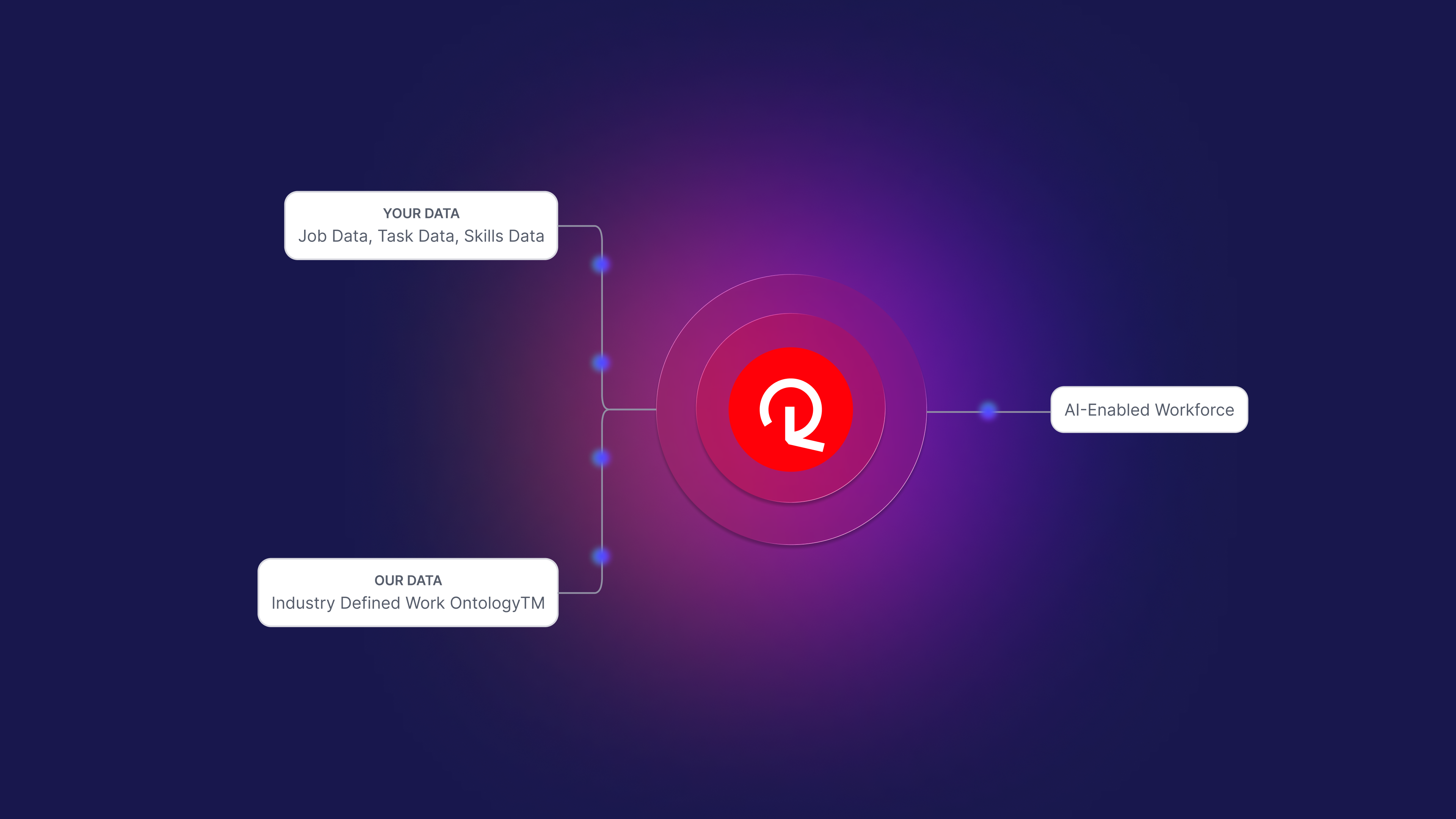
Reejig maps the actual tasks and subtasks that make up work across functions, then overlays AI impact analysis to identify which workflows are best suited for automation, augmentation, or human-led redesign. That analysis drives job redesign, reskilling investment, and internal mobility decisions.
Framework: building the AI-powered workforce in manufacturing
Building an AI-powered workforce in manufacturing requires five steps: understand work, assess AI impact, redesign roles, reskill talent, and track outcomes.
This is not a one-time transformation program. It is a repeatable operating discipline.
Step 1: Map work at the task level
Build a dynamic picture of what work is actually happening across production, engineering, supply chain, and support functions, beyond job descriptions.
Step 2: Analyze AI impact
Assess which tasks are automatable, which benefit from augmentation, and which remain human-led. Prioritize functions where AI impact is highest and operational urgency is greatest.
Step 3: Redesign jobs and workflows
Restructure roles around the work that remains after AI takes on automatable tasks. New workflows, new task combinations, new role boundaries.
Step 4: Reskill and redeploy employees
Build reskilling pathways, including short-form programs of three to six months, to move workers into AI oversight, robotics maintenance, digital logistics, and sustainability monitoring roles.
Step 5: Measure transformation outcomes
Track operational efficiency gains, redeployment rates, and AI adoption quality together. Initial AI implementations can show benefits within six to 12 months. Full integration typically delivers longer-term gains over 18 to 24 months.
Workforce transformation checklist:
- Task-level visibility across key manufacturing functions
- High-priority workflows identified for AI
- Roles most affected by task displacement mapped
- Reskilling pathways tied to specific workflow changes
- CHRO, CIO, and operations aligned on the roadmap
- Governance framework for responsible AI deployment in place
- Workforce and business outcomes tracked together
Metrics that matter:
- Percentage of production tasks automated or AI-augmented
- Operational cost reduction from predictive maintenance and supply chain AI (target: 20–25%)
- Internal redeployment rate of at-risk workers
- Time-to-productivity in redesigned roles
What the AI-powered workforce looks like in cmanufacturing
In AI-powered manufacturing organizations, people focus on work that requires judgment, coordination, and adaptability, and less on work that is repetitive or data-intensive.
People focus on more: exception handling, interpreting AI-generated insights, supplier and stakeholder management, sustainability oversight, and continuous improvement.
AI handles more: defect detection, predictive maintenance scheduling, demand forecasting, emissions tracking, and standard logistics routing.
Emerging roles:
|
Emerging role
|
Description
|
|
Automation Oversight Technician
|
Monitors automated production systems, manages exceptions, coordinates maintenance
|
|
AI Maintenance Engineer
|
Manages predictive maintenance platforms, interprets sensor data, prioritizes interventions
|
|
Digital Supply Chain Analyst
|
Works with AI forecasting tools to optimize inventory, logistics, and supplier performance
|
|
Sustainability Data Specialist
|
Manages automated ESG monitoring and prepares compliance reporting
|
|
Human-AI Workflow Designer
|
Redesigns production and operations workflows as AI capabilities evolve
|
Where manufacturing leaders should prioritize first
|
Function
|
AI potential
|
Operational efficiency impact
|
Likely time to value
|
|
Production operations
|
High
|
High — reduced labor cost, improved throughput
|
6–12 months
|
|
Predictive maintenance
|
High
|
High — reduced downtime, extended asset life
|
6–18 months
|
|
Supply chain and logistics
|
High
|
High — cost reduction, improved resilience
|
12–18 months
|
|
Engineering and design
|
Moderate
|
Moderate — faster development cycles
|
18–36 months
|
|
Sustainability and ESG
|
Moderate
|
Moderate — compliance efficiency
|
12–24 months
|
Production operations carry the largest volume of automatable work. An estimated 60–70% of routine production tasks have automation potential. Predictive maintenance delivers clear, measurable ROI quickly. Supply chain and logistics address the resilience pressures cited by more than 80% of manufacturing CEOs (Deloitte 2023). Sustainability and ESG is becoming a compliance requirement, with nearly 70% of global manufacturers investing in sustainable technologies (McKinsey).
How leading manufacturing organizations are preparing today
The most mature organizations are building the data, governance, and workforce capability infrastructure now, before AI deployment reaches scale.
What they are doing:
- Conducting task-level work mapping across priority functions
- Building cross-functional AI governance teams spanning HR, operations, IT, and legal
- Piloting AI tools in contained workflow areas before scaling
- Running reskilling programs tied to specific workflow redesign, not generic digital skills
- Tracking workforce and productivity outcomes together
|
Leader
|
Primary focus
|
|
CHRO
|
Workforce redesign, reskilling, internal mobility, responsible transition
|
|
CIO / CAIO
|
AI infrastructure, data quality, tool selection, OT integration
|
|
Operations
|
Workflow redesign, productivity outcomes, floor-level governance
|
|
Finance
|
ROI measurement, investment prioritization, workforce cost modeling
|
Governance is not optional. Manufacturing workforces are often covered by enterprise agreements, and AI deployment without workforce engagement creates friction that slows adoption and increases risk.
How manufacturing leaders can redesign work and create new career pathways
An estimated 40% of manual assembly and quality control roles face significant task displacement by 2030. But many of those workers have transferable skills, systems awareness, process knowledge, physical dexterity, that map directly to emerging automation and technical roles.
|
Current role
|
Work evolution
|
Possible next role
|
Capability focus
|
|
Manual assembly operator
|
Routine tasks automated; shift to oversight
|
Automation Oversight Technician
|
Systems monitoring, robotics basics
|
|
Quality control inspector
|
Visual inspection replaced; shift to exception review
|
AI Quality Analyst
|
AI tool interpretation, root cause analysis
|
|
Reactive maintenance technician
|
Scheduled repairs shift to predictive monitoring
|
Predictive Maintenance Specialist
|
IoT platforms, data literacy
|
|
Logistics coordinator
|
Manual routing replaced; shift to supplier strategy
|
Digital Supply Chain Analyst
|
AI forecasting tools, analytics
|
|
Production line supervisor
|
Task management shifts to workflow design
|
Human-AI Workflow Designer
|
Process design, AI governance
|
Short-term reskilling programs of three to six months focused on automation platforms, basic data literacy, and AI tool operation can facilitate these transitions without requiring workers to start from zero.
FAQ: AI workforce transformation in manufacturing
Will AI replace jobs in manufacturing?
AI will automate specific tasks within manufacturing roles, not eliminate entire jobs wholesale. Routine inspection, data collection, and repetitive assembly tasks face the highest automation risk. But most roles will evolve rather than disappear, shifting toward oversight, exception handling, and work that requires human judgment.
Which functions should manufacturing companies prioritize first?
Production operations and predictive maintenance offer the highest AI potential with the shortest time to value. Supply chain and logistics are close behind. Leaders should sequence investment based on where operational urgency and AI readiness overlap.
Why is task-level visibility so important in manufacturing?
Job titles do not tell you where AI will have an impact. A single production technician role can contain dozens of tasks with very different automation potential. Without task-level visibility, workforce planning is guesswork.
What skills will matter most in manufacturing's AI era?
The fastest-growing skill needs are in automation oversight, data literacy, AI tool operation, robotics maintenance, and digital supply chain management. Demand for these capabilities is expected to grow by 20–35% over the next three to five years.
What should CHROs do now?
Start with work visibility. Understand which roles and tasks face the most significant AI impact. Build reskilling pathways tied to specific workflow changes and establish internal mobility programs based on task and skills data, not just job titles.
What should CIOs and CAIOs do now?
Align AI tool selection to workforce readiness, not just technical capability. Build governance frameworks that include HR, operations, and legal. Measure AI impact on work quality and workforce outcomes, not just system uptime.
How should manufacturing leaders think about responsible transition?
Plan for the human impact of AI before deployment, not after. Map at-risk tasks, build reskilling pathways in advance, communicate transparently with workers and unions, and measure redeployment outcomes alongside productivity gains.
How long does AI workforce transformation take in manufacturing?
Initial implementations can show benefits within six to 12 months. Full workforce transformation typically takes 18 to 36 months depending on organizational complexity and starting maturity.
Conclusion
AI is already changing how manufacturing work gets done. The question for leaders is whether to respond with the precision the moment requires.
Deploying AI tools without understanding work at the task level leads to missed opportunities, workforce friction, and transformation programs that underdeliver. The manufacturers building competitive advantage right now are gaining visibility into their actual workflows, identifying where AI delivers real value, and redesigning roles before displacement creates a crisis.
The opportunity is not just productivity improvement, it is a better-designed workforce. That outcome requires deliberate planning, cross-functional alignment, and the right intelligence to make informed decisions.
About the data & methodology
Reejig’s workforce insights are built on independently audited Ethical AI and Work Ontology™, designed to map how work is actually performed at the task and subtask level.
The methodology analyzes 130M+ job records spanning the last 5–7 years, representing 41 million unique proprietary and public data points across 100+ countries and 23 global industry sectors.
Key elements of the methodology
Data integrity
The dataset consolidates insights from proprietary data, leading labor market platforms, and publicly available datasets. Reejig workforce strategists validate work structures and apply domain expertise to refine the analysis.
Unparalleled scale
More than 130 million job records were processed and deduplicated into 41 million unique job and role data points.
Global and industry coverage
The dataset covers workforce activity across 100+ countries and 23 industry sectors, providing a dynamic and current view of how work is evolving globally.
Validated outputs
Data is structured and verified to support reliable insights into task-level workforce transformation, automation opportunities, and reskilling pathways.
Disclaimer: The information in this article is general in nature and does not take into account an organization’s specific circumstances, operating model, or location. Workforce transformation priorities may vary by organization, sector, and regulatory environment. For tailored insights, consult a workforce transformation expert.

 Platform Overview
The Work OS for AI-powered Work
Platform Overview
The Work OS for AI-powered Work
 Work Architecture
Live entity model of your enterprise
Work Architecture
Live entity model of your enterprise
 Map
Build the Work Context Graph
Map
Build the Work Context Graph
 Analyze
Your GPS for reinvention
Analyze
Your GPS for reinvention
 Build
Workflows + agents
Build
Workflows + agents
 Run
Deliver the new way of working
Run
Deliver the new way of working
 Measure
Track real, board ready ROI
Measure
Track real, board ready ROI
 Log
Source of truth · audit trail
Log
Source of truth · audit trail
 Update
Keep architecture current
Update
Keep architecture current