Platform

Platform Overview
The Work Operating System for AI-powered work
The Work Map
A live log of every job, task, subtask, and workflow inside the enterprise.
Work Intelligence
Find wasted potential, unlock hours, and know exactly where agents deliver impact.
Agent Navigator
Connect all agents, recommend the right one for each task, and capture the context to build new agents.
Agent ROI
Measure ROI based on actual work changes, not agent promises.
Work Architecture
Replaces static job architecture with a dynamic model for humans and agents that updates as roles shift.
Work Impacts
Shows how AI will change jobs and what skills your workforce needs.
Work Flow
Redesigns how work gets done and tracks every change automatically.



Reejig

6 mins

Feb 6, 2026
.jpg)

Blog Post Body
Key takeaway
Skills show what people can do. Tasks show what work is actually being done and where AI changes it.
Introduction
This module builds on why job architecture breaks down in AI-enabled operating models and explains the primitives leaders must use instead.
Over the past several years, enterprises have invested heavily in skills. Skills taxonomies, skills platforms, and skills-based strategies have become central to workforce transformation efforts. That focus was necessary, but it is no longer sufficient.
Skills describe capability. They do not show how work is actually being performed.
As AI enters everyday workflows, this gap becomes visible. AI does not automate skills like communication or problem solving. It automates tasks embedded inside roles. Without task-level visibility, leaders cannot see:
- Where AI fits
- How work is changing
- Who is affected
This module explains why tasks and skills must be used together to understand work with precision. Connecting the two creates the clarity leaders need to:
- Redesign work responsibly
- Align AI investment with reality
- Build a shared language of work across the enterprise
Why skills alone cannot explain how work actually happens
Skills describe capability, not reality.
Skills indicate what someone could do. They do not show what work is actually happening inside the organization today.
Two employees with similar skill profiles can spend their time on very different activities. Job titles and role descriptions widen this gap further. When leaders plan using skills alone, decisions are based on inference rather than evidence.
This creates structural blind spots:
- Workforce plans assume work that may no longer exist
- Reskilling targets abstract capabilities instead of real demand
- AI impact is estimated rather than understood
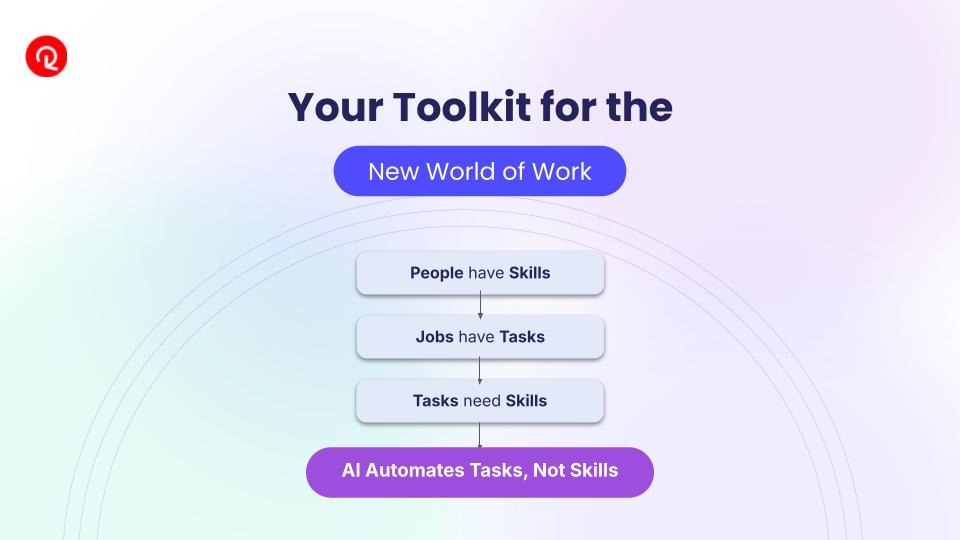
Without task-level visibility, skills strategies rest on assumptions about how work operates.
Why tasks reveal the true structure of work
Tasks are the atomic unit of work where value is created.
Tasks show what people, systems, and AI agents actually do to produce outcomes. They make work observable and measurable in a way jobs and skills cannot.
Task-level visibility exposes:
- How work differs inside the same role
- Where duplication, bottlenecks, and inefficiencies exist
- Which activities consume the most time and effort
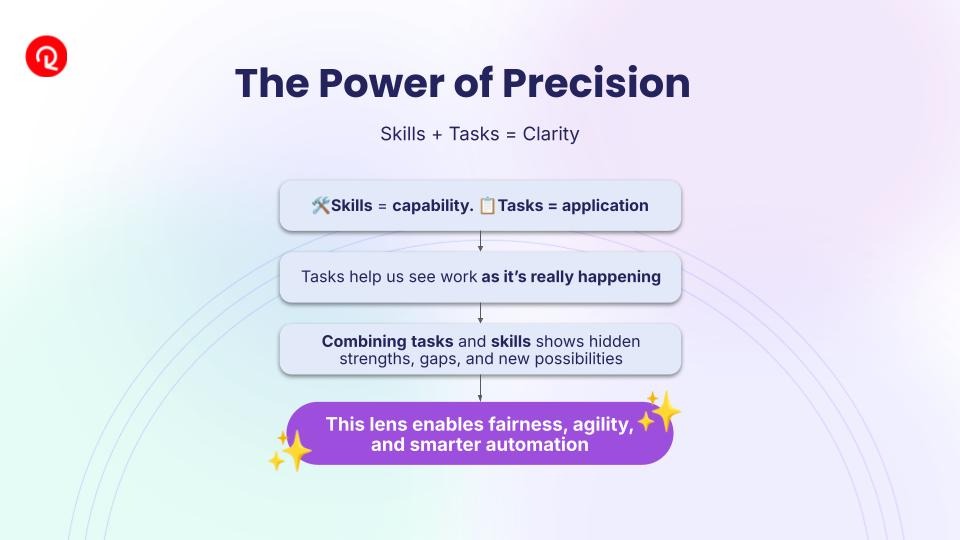
When leaders understand work at the task level, workforce strategy shifts from abstraction to evidence. Planning reflects how work truly operates, not how it is documented.
Where AI actually changes work
AI affects tasks long before it affects roles or skills.
AI does not automate skills such as communication or problem solving. It automates discrete activities embedded inside roles.
Common examples include:
- Drafting and summarizing documents
- Classifying and reconciling data
- Routing requests or decisions
- Responding to routine queries
When leaders skip the task layer, they either overestimate AI’s impact or fail to see it altogether.
Task-level visibility enables three critical decisions:
- Which tasks can be automated, augmented, or supported by AI
- Which tasks must remain human due to judgment, context, or risk
- How work should be redistributed as automation increases
This clarity is foundational for responsible AI adoption.
Why tasks and skills must be designed together
Tasks define what needs to be done. Skills define how work is performed.
Tasks and skills are complementary, not competing frameworks. Used together, they provide the precision leaders need to redesign work as it evolves.
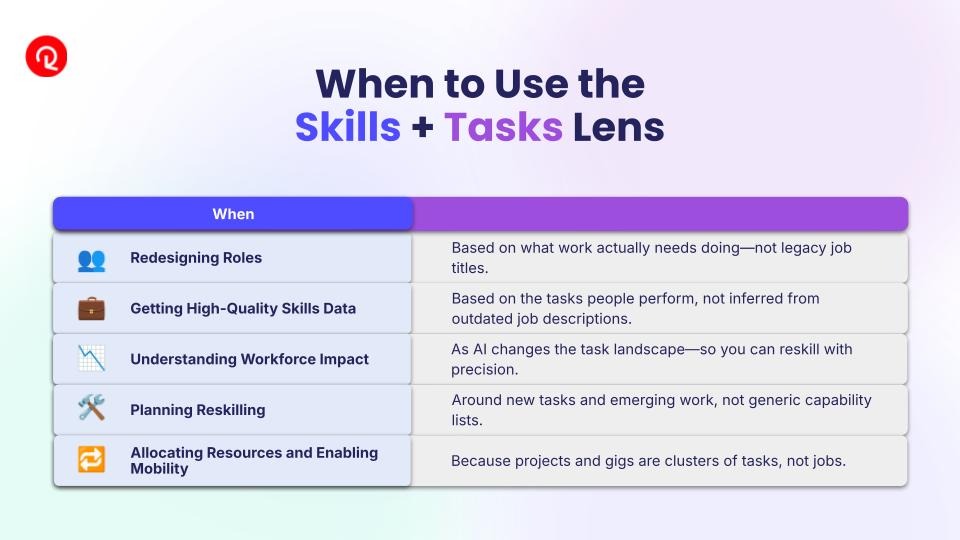
Connecting tasks and skills allows organizations to:
- Redesign roles based on current and future work rather than legacy titles
- Ground skills data in observed work rather than inferred profiles
- Analyze workforce impact as AI changes the task landscape
- Align reskilling investments to new and emerging tasks
- Enable mobility and allocation based on clusters of work, not jobs
Fairness improves as well. Decisions about opportunity, pay, and progression reflect real contribution instead of static role definitions.
Why a shared language of work is required at scale
Workforce transformation breaks down without a shared work architecture supported by a common language of work.
At enterprise scale, task and skill visibility cannot live in isolated tools. It must be embedded into how work is designed, governed, and evolved. This requires moving beyond static job catalogs to a true work architecture built on tasks, subtasks, and the skills required to perform them.
Work architecture defines how work is structured and deployed across the organization.
A shared work ontology ensures that structure is consistent, comparable, and usable across functions and systems.
Together, they enable organizations to:
- Maintain a consistent view of work across HR, IT, and the business
- Keep that view dynamic as tasks and workflows change
- Integrate work data into HCMs, workforce planning, and AI initiatives
- Anchor strategy, automation, reskilling, and mobility decisions to the same source of truth
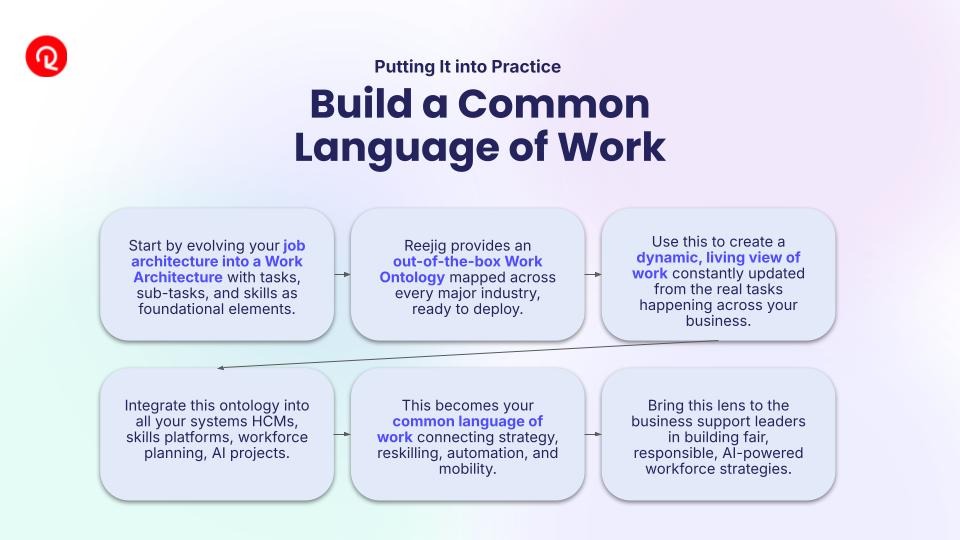
In practice, this means shifting from documenting jobs to continuously understanding and governing work as it actually happens. Reejig supports this by embedding a Work Ontology™ and Work Architecture together, enabling a dynamic, enterprise-wide view of tasks, skills, and outcomes that connects strategy, automation, reskilling, and mobility.
What leaders should take away from Module 3
This module defines the primitives required to understand and redesign work.
-
Skills strategies fail without task-level visibility into how work actually happens.
-
AI changes work at the task layer, making that level essential for responsible design.
-
Connecting tasks and skills creates precision for planning, reskilling, and automation.
-
A shared language of work is required to align decisions across the enterprise.
These foundations enable execution, which is the focus of the next module.
Executive FAQ
Why are skills alone insufficient for workforce transformation?
Because skills describe potential capability, not the work people actually perform. Decisions made without task visibility rely on assumptions.
Where does AI really affect work?
AI automates and augments tasks embedded inside roles, not entire jobs or skills in isolation.
How do tasks improve responsible AI adoption?
They make it clear which activities are automated, who is affected, and where governance is required.
Do tasks replace jobs and skills?
No. Tasks complement jobs and skills by revealing how work operates in practice.
Who benefits most from combining tasks and skills?
CHROs, CIOs, and business leaders benefit because planning, automation, and reskilling decisions align to real work.
Get the Full Course Materials
This module is part of the Building the AI-Powered Workforce executive course.
👉 Download the Module 3 slide deck and course materials to:
- Understand how tasks and skills work together in a modern workforce model
- Align HR, IT, and business leaders around a shared language of work
- Prepare for deeper work design and AI impact analysis in upcoming modules
Continue to the Next Module
Module 4: Breaking Down Work and Why It Matters
In the next module, you will learn:
- How to break work down into tasks and subtasks systematically
- Why granularity matters for AI impact, workforce planning, and governance
- How work decomposition enables visibility, redesign, and automation decisions
👉 Read or watch Module 4 to continue the course.