 Platform Overview
The Work OS for AI-powered Work
Platform Overview
The Work OS for AI-powered Work
 Work Architecture
Live entity model of your enterprise
Work Architecture
Live entity model of your enterprise
 Map
Build the Work Context Graph
Map
Build the Work Context Graph
 Analyze
Your GPS for reinvention
Analyze
Your GPS for reinvention
 Build
Workflows + agents
Build
Workflows + agents
 Run
Deliver the new way of working
Run
Deliver the new way of working
 Measure
Track real, board ready ROI
Measure
Track real, board ready ROI
 Log
Source of truth · audit trail
Log
Source of truth · audit trail
 Update
Keep architecture current
Update
Keep architecture current
Reejig x Workday
Unlock more value from Workday with AI Work Design.



Author
Reejig

Read time
4 mins

Published
Feb 18, 2026
.png)
Blog Post Body
AI Work Design Blueprint
The responsibilities every CHRO must own to lead AI Work Design and build internal capability.
Most enterprise AI failures are not model failures. They are instruction failures.
Download the definitive guide to prompt engineering. A practical, non-technical blueprint for enterprise teams that want reliable results from AI.
AI systems are rolling out quickly across large organizations. Budgets are approved. Pilots are launched. Teams are encouraged to experiment.
Yet many leaders try AI once or twice. They receive vague or generic outputs. They conclude the technology is not ready.
AI feels unreliable because instructions are unclear
AI produces weak outputs when instructions lack clarity, context, or structure.
Most employees interact with AI like a search engine. They enter short, loosely framed questions. They expect precise, business-ready answers.
This approach almost guarantees inconsistent results.
AI systems do not understand:
- Your organization's strategy
- Your workforce constraints
- Your risk tolerance
- Your decision context
Unless that information is explicitly provided, output defaults to generic responses.
In enterprise environments, this leads to a predictable pattern:
- AI is labeled inconsistent
- Trust erodes across teams
- Adoption stalls
The technology is not unreliable. The interaction model is.
Prompting is a core enterprise capability
Prompting is the skill of translating human intent into clear, structured direction for AI systems.
Despite the term "prompt engineering," this is not a technical discipline. It is a communication discipline.
Strong prompts consistently do four things:
- Provide context about the organization, problem, or audience
- Assign a role or perspective for the AI to operate from
- Define a specific task with a clear objective
- Specify the desired output format or constraints
When these elements are present, AI outputs become:
- More predictable
- More relevant
- Easier to validate and reuse
When they are missing, AI feels like a novelty rather than a capability.
Why prompting matters for enterprise leaders
Weak prompts create operational risk in enterprise environments.
AI outputs increasingly influence:
- Workforce and skills strategies
- Investment and prioritization decisions
- Executive communications
- Policy drafts and internal guidance
Poorly directed AI does not just waste time. It increases rework. It creates confusion. It undermines confidence in human-AI collaboration.
Strong prompting allows leaders to:
- Improve decision visibility
- Reduce output variance
- Scale AI usage safely across teams
- Move from experimentation to managed transformation
Despite this, most organizations have not trained their workforce on how to prompt effectively.
AI capability is compounding. Work visibility is not. Prompting is where that gap shows up first.
The four-part prompt checklist
Use this checklist to improve any AI prompt used at work.
Before submitting a prompt, confirm it includes:
- Context: What does the AI need to know about the organization, goal, or situation?
- Role: Who should the AI act as (for example, HR advisor, strategy analyst, communications lead)?
- Task: What specific outcome are you asking for?
- Output: What format, length, tone, or constraints should the response follow?
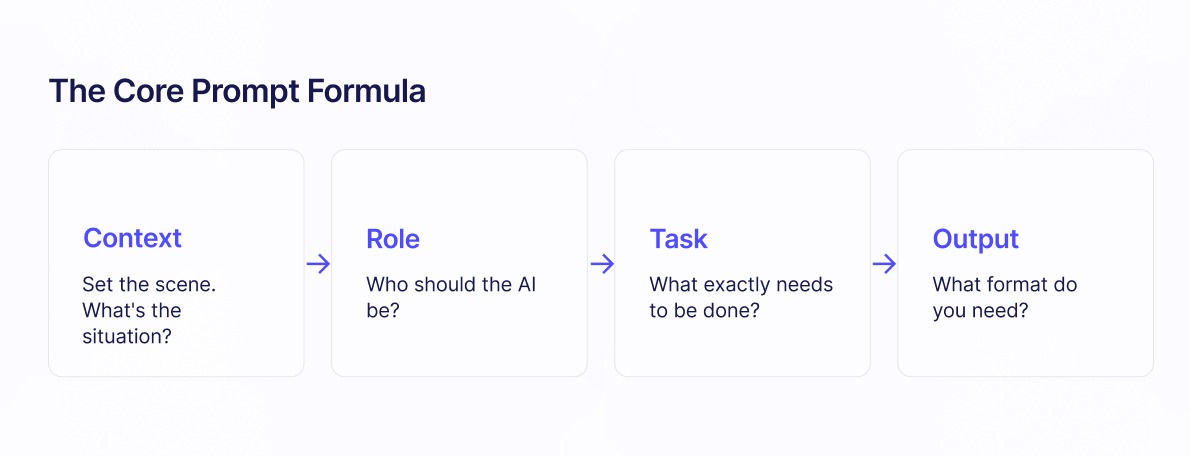
This structure works across systems including ChatGPT, Claude, Gemini, and Copilot.
What enterprise teams learn in the definitive guide
The guide teaches leaders how to make AI reliable in real enterprise conditions.
Inside the guide, readers learn:
- Why AI outputs vary and how to control that variance
- The mental model leaders should use when working with AI
- A repeatable prompt blueprint for enterprise use cases
- Real examples tied to workforce and organizational scenarios
- How to scale AI usage with confidence and governance
The guide also includes a one-page Prompt Cheat Sheet. Teams reference it while working.
Frequently asked questions for enterprise leaders
Prompt engineering is not only for technical teams. Prompting is a leadership and communication skill. It is not a technical one.
Better prompts do improve AI accuracy. Clear context and constraints significantly improve relevance and consistency of outputs.
One prompt structure works across different AI systems. While systems differ, structured prompts consistently improve outcomes across all of them.
AI Reflects the Direction It Is Given
Organizations getting value from AI are not using better models. They are giving better instructions.
They treat prompting as a core capability. Not an experiment.
If your teams struggle to trust AI outputs, the issue is likely not the technology. It is the direction.
Book a demo to see how Reejig's Work Operating System makes work visible at the task level.

Reejig

AI Work Design Blueprint
The responsibilities every CHRO must own to lead AI Work Design and build internal capability.