


 Platform Overview
The Work OS for AI-powered Work
Platform Overview
The Work OS for AI-powered Work
 Work Architecture
Live entity model of your enterprise
Work Architecture
Live entity model of your enterprise
 Map
Build the Work Context Graph
Map
Build the Work Context Graph
 Analyze
Your GPS for reinvention
Analyze
Your GPS for reinvention
 Build
Builder Studio · Workflows + agents
Build
Builder Studio · Workflows + agents
 Run
Deliver the new way of working
Run
Deliver the new way of working
 Measure
Track real, board ready ROI
Measure
Track real, board ready ROI
 Log
Source of truth · audit trail
Log
Source of truth · audit trail
 Update
Keep architecture current
Update
Keep architecture current

Author
Siobhan Savage

Read time
5 mins

Published
Feb 3, 2026

Blog Post Body
AI Work Design Blueprint
The responsibilities every CHRO must own to lead AI Work Design and build internal capability.
AI pressure is rising because work has not changed
AI is not failing because leaders lack vision. It is failing because work has not been redesigned.
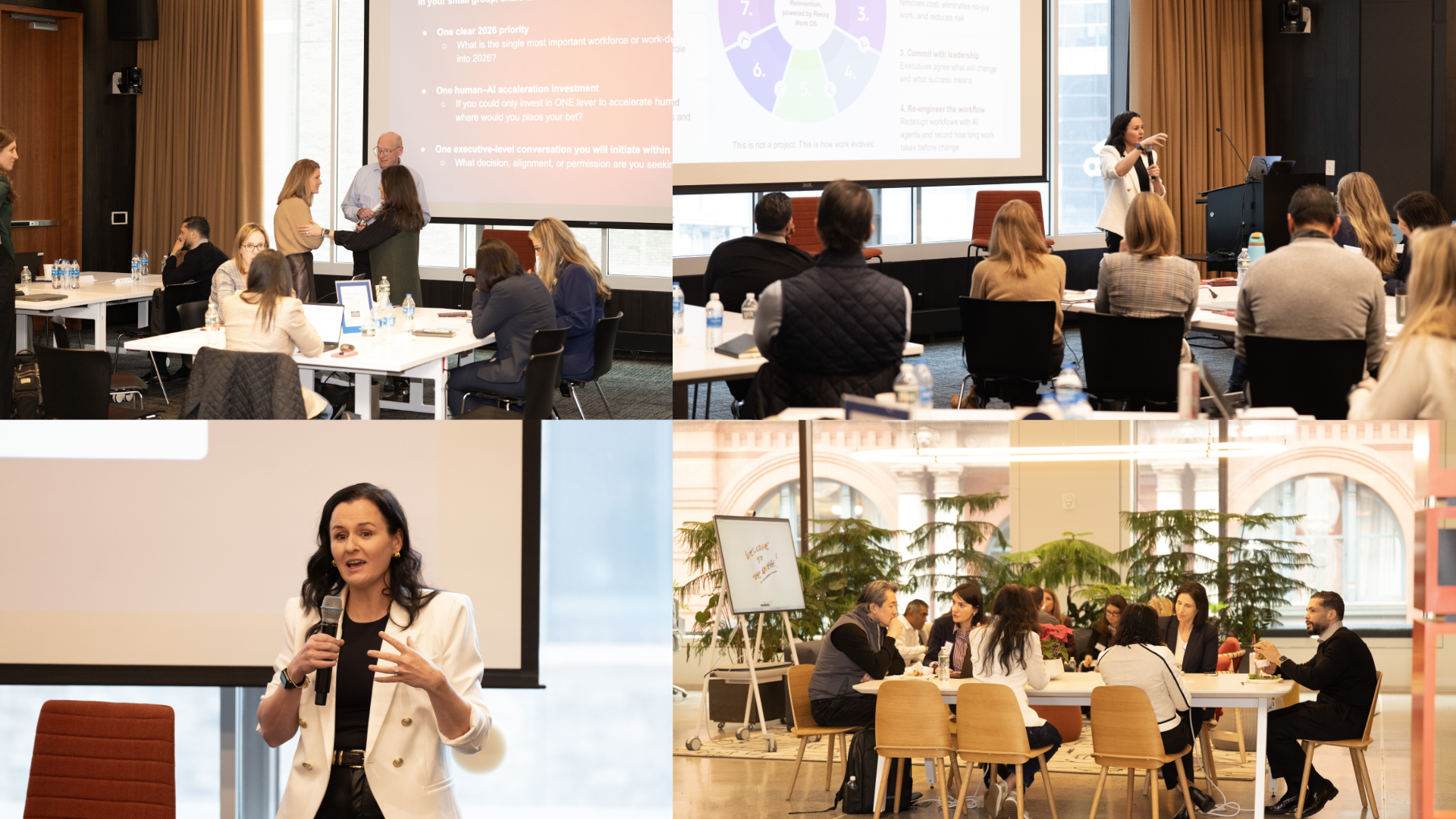
I walked into the Microsoft Garage in January for our Work Design Collaborative meetup with a very specific goal. Reduce the pressure enterprise leaders carry from their CEOs and boards.
Not with reassurance. With something they could actually execute.
Every organization in that room is being pushed to redesign for AI, fast. Yet they are all blocked on the same question.
What exactly do we redesign first?
There are no credible enterprise benchmarks. No shared examples of AI changing work at scale. No agreed unit of progress.
Not because leaders are not trying. But because almost no one has actually reinvented work yet.
Until tasks, workflows, and roles are explicit, AI has nothing to attach to. It floats above the organization as pilots and intent. Never hardening into production reality.
Every enterprise is deploying AI. Almost none can see the work they're deploying it into.
That is what leaves executives exposed in boardrooms. And operators stuck in the middle.
AI is already here. Ownership is not.
AI adoption is not the problem. Accountability is.
AI is already in inboxes, workflows, and meetings. Most organizations are still studying work instead of changing it. Insight accumulates. Execution stalls.
What is missing is not data or ambition. It is ownership.
And this is where I will be direct.
HR has to go first.
Not because HR owns people. Because HR understands work.
- Tasks and effort
- Risk and dependencies
- Human impact and absorption
If AI is going to scale responsibly, it starts where work is designed and governed. Anything else becomes IT theater or shadow AI.
Pilots do not scale. Systems do.
If AI is not changing live workflows, it is not transformation.
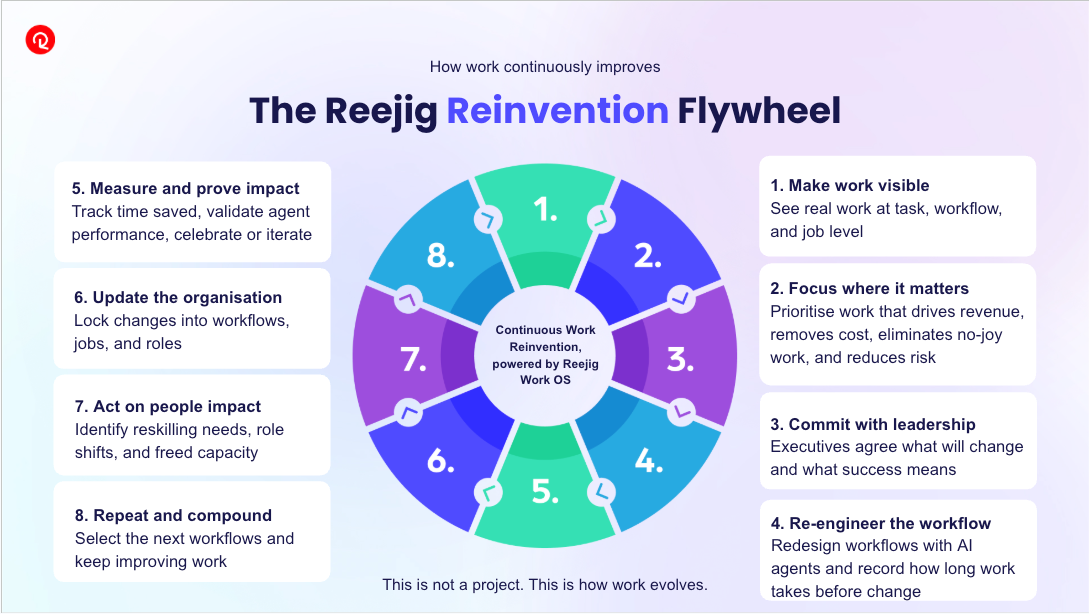
That is why we shared the Reinvention Flywheel. This is the operating model we use to take AI from experimentation into execution.
The Reinvention Flywheel
- Make work visible at the task level
- Focus only on work that matters
- Secure leadership commitment, not observation
- Redesign the workflow. Do not bolt on AI.
- Measure impact in time, value, and capacity
- Lock changes into roles and systems
- Act on the people impact
- Repeat and compound
This is not transformation theater. It is how work actually evolves. Map. Analyze. Build. Run. Measure. Log. Update. That's Reejig.
Not all work is worth reinventing
Trying to AI everything is how teams lose credibility.
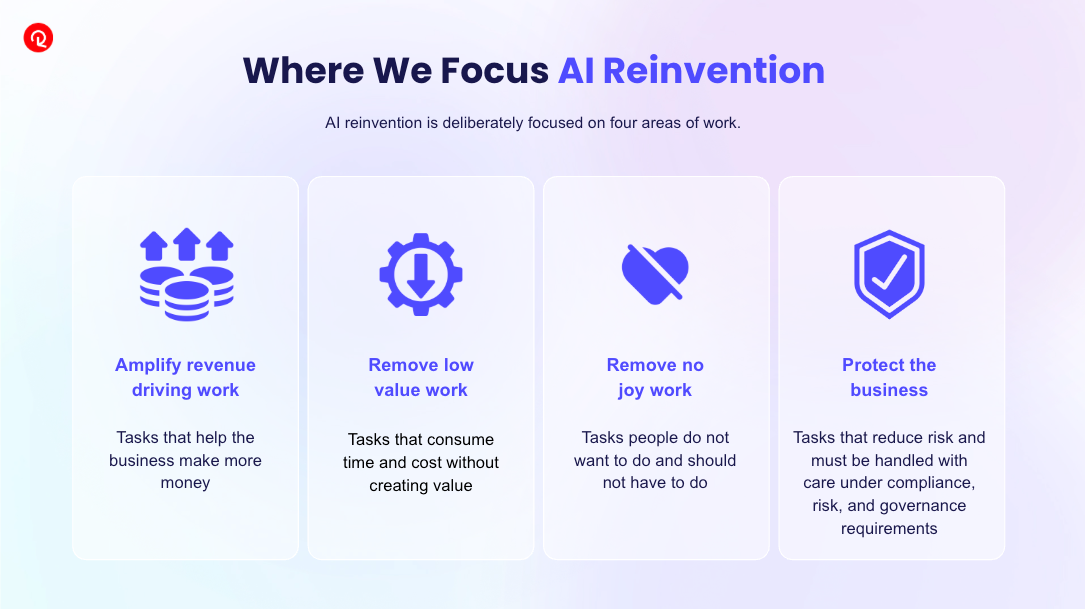
We only reinvent four categories of work:
- Work that drives revenue
- Work that wastes time
- Work people actively dislike doing
- Work that carries material risk
If it does not fit one of these, it is noise.
This filter alone removes most AI ideas. That is a feature, not a bug.
What we built at Microsoft Garage
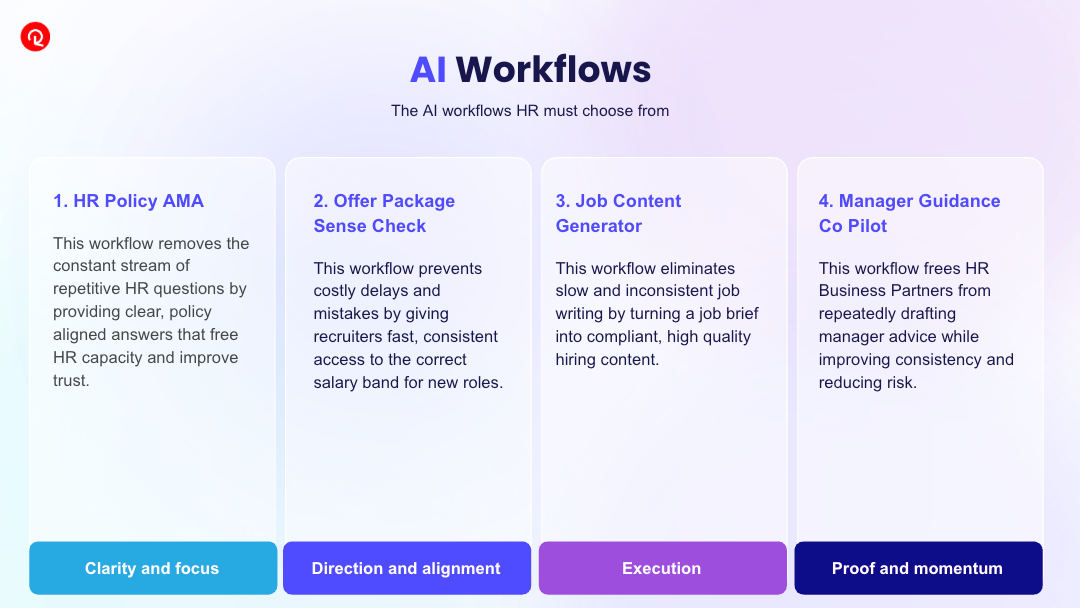
This was not a discussion. We built a real workflow.
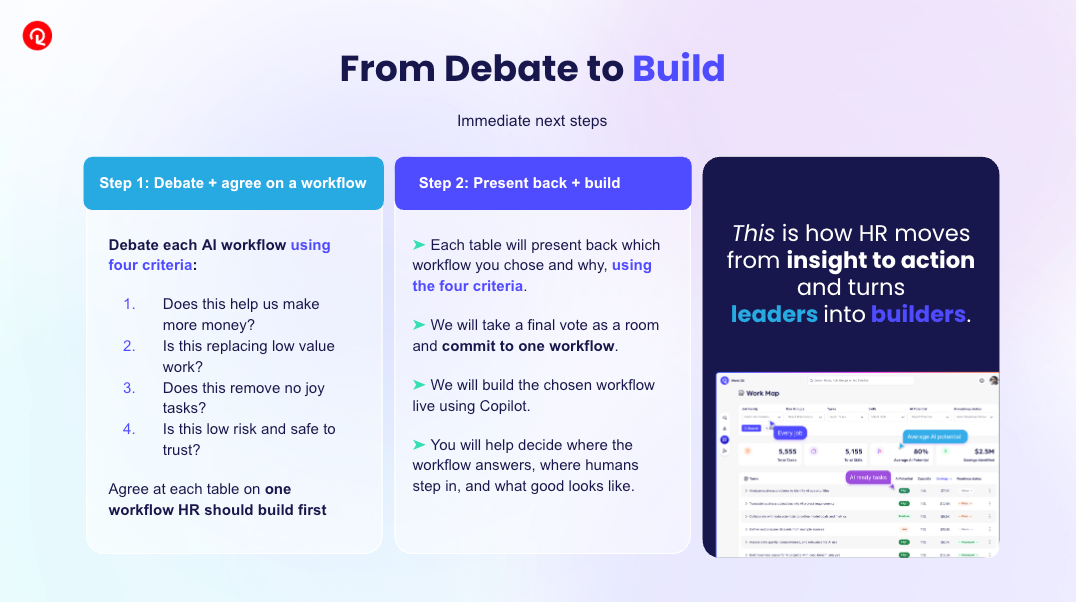
Every table received real AI workflow options and one rule.
Pick something you could actually deploy.
The clear winner was an Offer Package Sense Check. An AI agent that provides instant guidance on compensation offers.
It won because:
- It removes delays
- It reduces risk
- It fixes a real operational pain point
We built it live in Microsoft Copilot Studio. End to end.
No someday. No slideware. Builder Studio is where these workflows are designed at scale. Builder Studio is the Build stage.
How we measure whether AI is actually working
If you cannot prove impact, it does not matter.
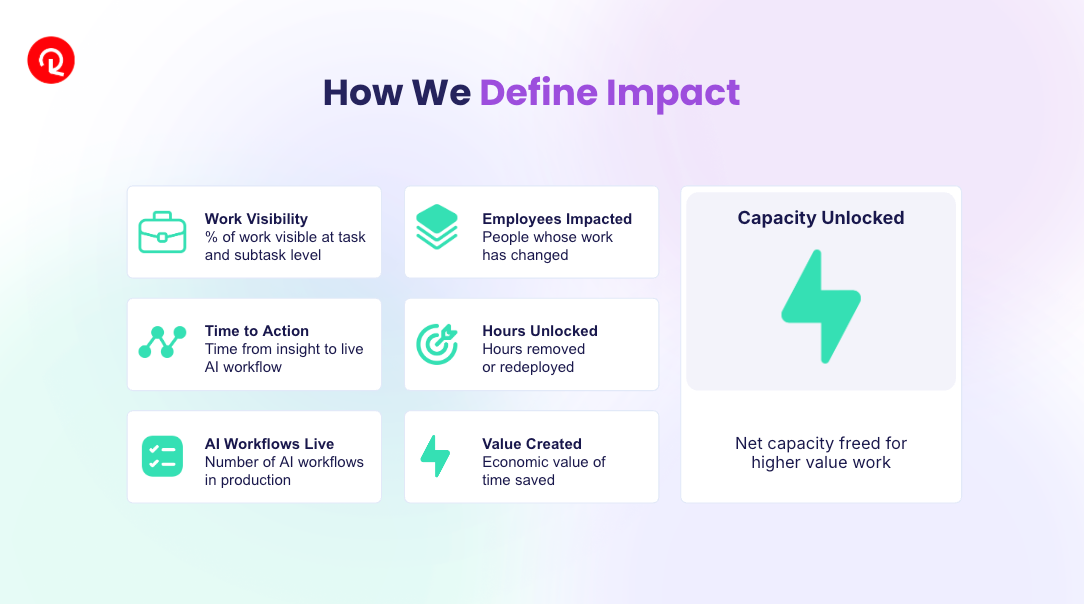
We measure AI by what changes in work.
Our core execution metrics:
- Percentage of work visible at task level
- Time from idea to live workflow
- Number of workflows in production
- Hours freed or repurposed
- Economic value of that time
- Employees impacted
- Net new capacity created
This is the language executives understand. It is how reinvention gets funded. The Work Operating System tracks these metrics continuously. Not as an annual review. As a live operating signal.
What HR needs to do differently to lead AI
Technology does not change behavior. Design does.
The strongest HR-led AI transformations follow the same pattern:
- Start with workflows people already resent
- Focus on work that creates friction or risk
- Deploy inside systems employees already use
- Build governance in from day one
- Make outcomes visible and measurable
If you cannot point to what changed, it did not.
This is Stealth Change Management in practice. The new way of working becomes the default before anyone has to "adopt" it.
Executive FAQ
HR should lead AI work redesign for a specific reason. HR understands how work is structured, governed, and absorbed into roles. AI cannot scale without that foundation.
Enterprises should start AI execution at the task level. Inside real workflows. Not at the job title level.
Boards measure AI progress by changes in work. Time freed. Risk reduced. Capacity created.
Final thought
In 2026, most organizations will still be talking about AI.
A few will be quietly redesigning work.
The difference will not be technology. It will be ownership.
When HR leads through work design, AI stops being a side project. It becomes a capability.
That is when things finally move.
Book a demo to identify which workflows to redesign first. See how the Work Operating System proves impact fast.
Author


Siobhan Savage
CEO & Co-Founder of Reejig

AI Work Design Blueprint
The responsibilities every CHRO must own to lead AI Work Design and build internal capability.