 Platform Overview
The Work OS for AI-powered Work
Platform Overview
The Work OS for AI-powered Work
 Work Architecture
Live entity model of your enterprise
Work Architecture
Live entity model of your enterprise
 Map
Build the Work Context Graph
Map
Build the Work Context Graph
 Analyze
Your GPS for reinvention
Analyze
Your GPS for reinvention
 Build
Workflows + agents
Build
Workflows + agents
 Run
Deliver the new way of working
Run
Deliver the new way of working
 Measure
Track real, board ready ROI
Measure
Track real, board ready ROI
 Log
Source of truth · audit trail
Log
Source of truth · audit trail
 Update
Keep architecture current
Update
Keep architecture current
Reejig x Workday
Unlock more value from Workday with AI Work Design.



Author
Reejig

Read time
3 mins

Published
Mar 13, 2025
.png)

Blog Post Body

AI Work Design Blueprint
The responsibilities every CHRO must own to lead AI Work Design and build internal capability.
At our recent Sydney and New York events with The Josh Bersin Company, we gathered top HR and business leaders. They tackled one of the most pressing workforce challenges: re-engineering work in the AI era.
The key message: there is an urgent need to rethink work. Not just layer AI onto outdated job structures. Fundamentally redesign how work gets done.
This was the central theme of discussions with Josh Bersin, Alec Bashinsky, Deb Yates, Reejig’s Siobhan Savage, and Jacinta Newman. They explored what's working, what's not, and where organizations need to focus next.
Top 4 takeaways
1. "AI doesn't automate skills. It automates tasks." (Siobhan Savage, Reejig Founder and CEO)
The first step in AI transformation is understanding the work itself. Work is made up of tasks, not just roles. AI adoption should start by mapping work at the task level. Not just focusing on skills.
Organizations need a common language for work. Work Context, built on industry-specific Work Ontologies, includes:
- A harmonized, AI-ready job architecture that integrates work data
- Task intelligence to inform AI adoption
- Skills data mapped to real work, not just job titles
2. Static job architectures are holding you back
Most job architectures are outdated the moment they're built. They were designed for old work structures. They don't reflect how work actually happens.
From Job Architecture to Work Architecture.
In an AI-driven world, static job architectures fail fast. They lead to misaligned workforce planning. AI adoption stalls because work isn't structured for it. Outdated roles don't match reality.
Organizations need a dynamic Work Architecture that continuously evolves. It integrates tasks, skills, and work data.
3. Know your AI maturity level before you start
Understanding where your organization stands today is critical. Without that, you can't chart the path forward.
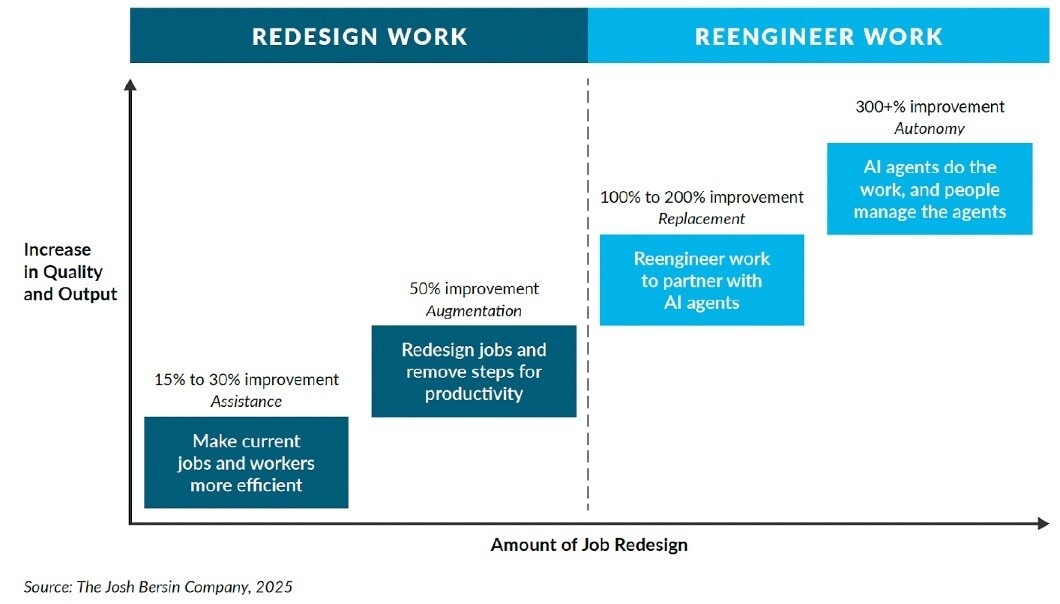
Organizations must first assess their phase. Are they in the assistance (efficiency), augmentation (productivity), or full reengineering phase? Using the Josh Bersin Evolving Job Redesign model, companies determine their readiness. They build a roadmap for AI adoption.
4. Be bold and responsible
The companies leading in AI-driven redesign don't just adopt technology. They boldly reimagine work while ensuring responsible implementation.
- Bold: AI should be a catalyst for reinvention, not just optimization. The most successful organizations redesign work. They move beyond outdated job structures. They fully integrate AI as a strategic collaborator.
- Responsible: AI must be governed with transparency and ethics. It must benefit both businesses and their people. This means ensuring fairness, accountability, and workforce inclusion. AI drives opportunity, not displacement.
AI capability is compounding. Work visibility is not.
What's next
Companies that adopt AI-driven work design now will lead the next decade of workforce redesign. Want to dive deeper into these insights? Book a demo. We'd love to share real-world examples and explore how this applies to your workforce.
For more from the event, check out the Bold and Responsible Transformation Guide. This guide shows leaders where they sit in Josh Bersin's AI Maturity Model. It provides actionable steps to redesign your workforce for the AI era using Reejig's Work Context. Scan the QR code on the back to book time with a strategist and take this data deeper.
Speakers


Josh Bersin
Founder & CEO at The Josh Bersin Company



Deborah Yates
Chief People Officer at Coles Group

Alec Bashinsky
APAC Leader at The Josh Bersin Company

Jacinta Newman
Global Head of Customer Transformation at Reejig
AI Work Design Blueprint
The responsibilities every CHRO must own to lead AI Work Design and build internal capability.