 Platform Overview
The Work OS for AI-powered Work
Platform Overview
The Work OS for AI-powered Work
 Work Architecture
Live entity model of your enterprise
Work Architecture
Live entity model of your enterprise
 Map
Build the Work Context Graph
Map
Build the Work Context Graph
 Analyze
Your GPS for reinvention
Analyze
Your GPS for reinvention
 Build
Workflows + agents
Build
Workflows + agents
 Run
Deliver the new way of working
Run
Deliver the new way of working
 Measure
Track real, board ready ROI
Measure
Track real, board ready ROI
 Log
Source of truth · audit trail
Log
Source of truth · audit trail
 Update
Keep architecture current
Update
Keep architecture current
Reejig x Workday
Unlock more value from Workday with AI Work Design.



Author
Jacinta Newman

Read time
5 mins

Published
Feb 12, 2026

Blog Post Body
AI Work Design Blueprint
The responsibilities every CHRO must own to lead AI Work Design and build internal capability.
A quiet shift is underway. Not just in how organizations use AI. In how they structure and lead work itself.
CIOs, CTOs, and CDOs are stepping into a broader responsibility. Their role is evolving from managing systems to shaping how work flows, scales, and improves. They are becoming what we call Work Engineers.
This is not about a new job title. It is about a new operating responsibility.
Key takeaway: In 2026, leading CIOs no longer just manage systems. They actively design work.
CIOs are moving from systems of record to systems of execution
AI forces technology leaders to influence how work actually happens.
Technology teams have always built infrastructure. They maintained applications. They ensured uptime. That remains critical.
What has changed: AI is now embedded directly into workflows. It influences how tasks are completed. How decisions are made. How time is spent.
The boundary between technology and work design is dissolving.
Every system decision now affects:
- Task sequencing
- Workflow friction
- Human versus agent contribution
- Decision velocity
The shift is no longer about observing work through dashboards. It is about shaping work in motion.
If I automate chaos, I just scale the chaos.
The Work Operating System becomes core infrastructure
A Work Operating System provides visibility into how work truly operates.
For many organizations, the Work Operating System is emerging as a new layer of Enterprise AI infrastructure. Not another system. A structural lens into execution.
It provides visibility into:
- Tasks within roles
- Skills actively being used
- Points of duplication
- Areas of underutilized capacity
- Opportunities for safe automation
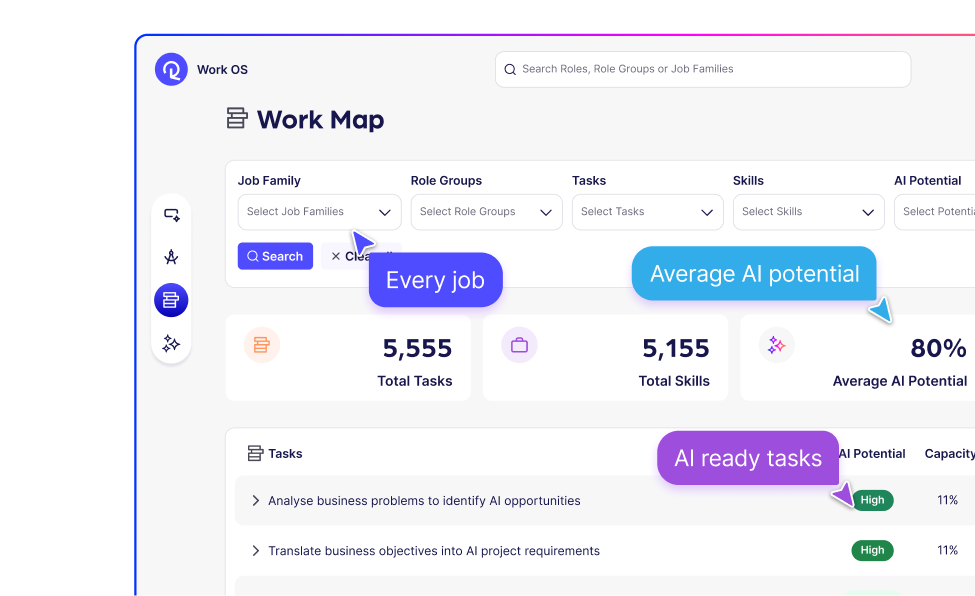
This intelligence moves organizations beyond awareness. It produces action.
Instead of launching broad transformation programs, leaders make targeted, workflow-level adjustments. Based on real activity.
The Work OS becomes an execution layer. Not theoretical insight. Operational leverage.
Work Engineers act at the workflow level
Work Engineers focus on live workflows. Not transformation cycles.
The leaders stepping into this role do not wait for enterprise-wide programs. They operate with precision and immediacy.
They ask:
- Which workflows are under strain?
- Where are manual handoffs slowing progress?
- What automation or agent support could remove friction?
They focus on:
- What is already visible
- What is already live
- What can be adjusted now
They act early. They test in production. They measure impact where it happens.
Because visibility spans systems and functions, impact is seen in real time. Not months later in retrospective reviews.
Collaboration becomes the accelerator
Designing work requires shared visibility across functions.
Work Engineers do not operate in isolation. They collaborate across HR, operations, finance, and transformation teams.
Work design becomes cross-functional by necessity.
A shared view of task-level activity produces:
- Faster alignment
- Reduced misinterpretation
- Coordinated action
When everyone sees the same operational truth, decisions move faster. With greater precision.
Insight becomes shared. Execution becomes coordinated.
2026 marks the shift from experimentation to operation
AI is no longer in pilot mode. It is embedded.
In 2025, many organizations were still exploring. Pilots and proofs of concept dominated the agenda. Those efforts generated learning. They did not always change work itself.
In 2026, the context has shifted.
AI is already embedded in systems, workflows, and expectations. The challenge is no longer adoption. It is governance, optimization, and redesign.
Now the work is about:
- Managing AI's operational impact
- Reinforcing what improves performance
- Adjusting what introduces risk or friction
Work Engineers do not redesign everything from scratch. They make deliberate, continuous adjustments. Work Intelligence surfaces where those adjustments matter most.
Momentum comes from action, not certainty.
What this means for CHROs and CIOs
The design of work is now shared territory.
As CIOs move closer to execution, collaboration with HR becomes structural. Not optional.
Technology decisions affect:
- Skills demand
- Role boundaries
- Workforce capacity
- Work movement pathways
HR decisions affect:
- How change is supported
- How skills are developed
- How contribution is recognized
The Work Engineer operates at this intersection.
The question is no longer who owns the system. The question is who is designing the work. Work Architecture gives both CIOs and CHROs a shared foundation to design from.
Looking ahead
The most impactful shifts do not begin with a new system. They begin with visibility and the willingness to act on what is visible.
Every enterprise is deploying AI. Almost none can see the work they're deploying it into.
If this shift is showing up in your organization, the real question is not whether AI will change work.
It already has.
The question is whether you are actively designing that change. Or simply reacting to it.
Executive FAQ
"Work Engineer" is not necessarily a formal role. It describes a capability and operating mindset emerging within CIO, CTO, and data leadership roles.
This does not replace traditional IT responsibilities. Infrastructure and systems management remain critical. The scope is expanding to include workflow design and AI integration.
2026 differs from 2025 in a specific way. AI is embedded into live workflows. The focus has shifted from experimentation to operational governance.
Visibility into task-level work produces this shift. The ability to act on that visibility across systems is what separates Work Engineers from traditional technology leaders.
→ Work Engineers design from visibility and data, not instinct. Claim your complimentary AI Impact Analysis to identify where AI can create the most value across your workforce at the task and subtask level.
Author


Jacinta Newman
Global Head of Customer Transformation at Reejig

AI Work Design Blueprint
The responsibilities every CHRO must own to lead AI Work Design and build internal capability.