


 Platform Overview
The Work OS for AI-powered Work
Platform Overview
The Work OS for AI-powered Work
 Work Architecture
Live entity model of your enterprise
Work Architecture
Live entity model of your enterprise
 Map
Build the Work Context Graph
Map
Build the Work Context Graph
 Analyze
Your GPS for reinvention
Analyze
Your GPS for reinvention
 Build
Builder Studio · Workflows + agents
Build
Builder Studio · Workflows + agents
 Run
Deliver the new way of working
Run
Deliver the new way of working
 Measure
Track real, board ready ROI
Measure
Track real, board ready ROI
 Log
Source of truth · audit trail
Log
Source of truth · audit trail
 Update
Keep architecture current
Update
Keep architecture current

Author
Siobhan Savage

Read time
7 mins

Published
Feb 10, 2026
Blog Post Body
AI Work Design Blueprint
The responsibilities every CHRO must own to lead AI Work Design and build internal capability.
A Work Architecture is the structured blueprint of every job, task, sub-task, and workflow in an enterprise. It replaces job architecture as the operational foundation for AI-powered work. Without it, AI gets deployed into work no one can see, and ROI stays at zero.
AI capability is compounding. Work visibility is not.
The problem: job architecture describes structure, not work
Job architectures were built for stability. They classify roles, support pay bands, and satisfy compliance. They were never designed to describe how work actually runs.
Today that gap is a material risk.
Job architectures tell you which roles exist. They tell you how roles are leveled. They tell you how roles map to pay frameworks.
They cannot tell you what people actually do. They cannot show how work flows across teams. They cannot reveal which tasks have already shifted to agents.
AI changes tasks first. Then workflows. Then roles. Job architecture operates above that layer entirely. It sees titles, not tasks. It sees intent, not execution.
Every enterprise is deploying AI. Almost none can see the work they're deploying it into.
The shift: From Job Architecture to Work Architecture
Job architecture answers administrative questions. Work Architecture answers operational ones.
Job architecture defines structure without execution. It describes intent without behavior. It captures design without evidence. This worked when work changed slowly.
Work changes continuously now. AI accelerates that change daily. The architecture must keep pace.
Skills frameworks do not solve this. Skills layered onto job architectures are rarely grounded in tasks. They are scraped from titles, inferred from market data, and normalized at the role level. They look plausible. They remain abstract. They stall because they are disconnected from execution.
The real shift is structural. From role-level to task-level. From static snapshots to living systems. From classification to visibility.
From Job Architecture to Work Architecture.
The Reejig answer: Work Architecture inside the Work Operating System
Reejig's Work Operating System is the critical infrastructure for humans and agents in the AI era. Work Architecture is its structural foundation.
The Work Operating System is what Reejig is. Work Context is what it is built on. The Seven-stage loop is how it runs.
Work Context is the live, always-updating reality of how work runs. It is formed by 25 industry-specific Work Ontologies. Work Architecture is the structured entity model within it. Work Record is the governance and audit trail.
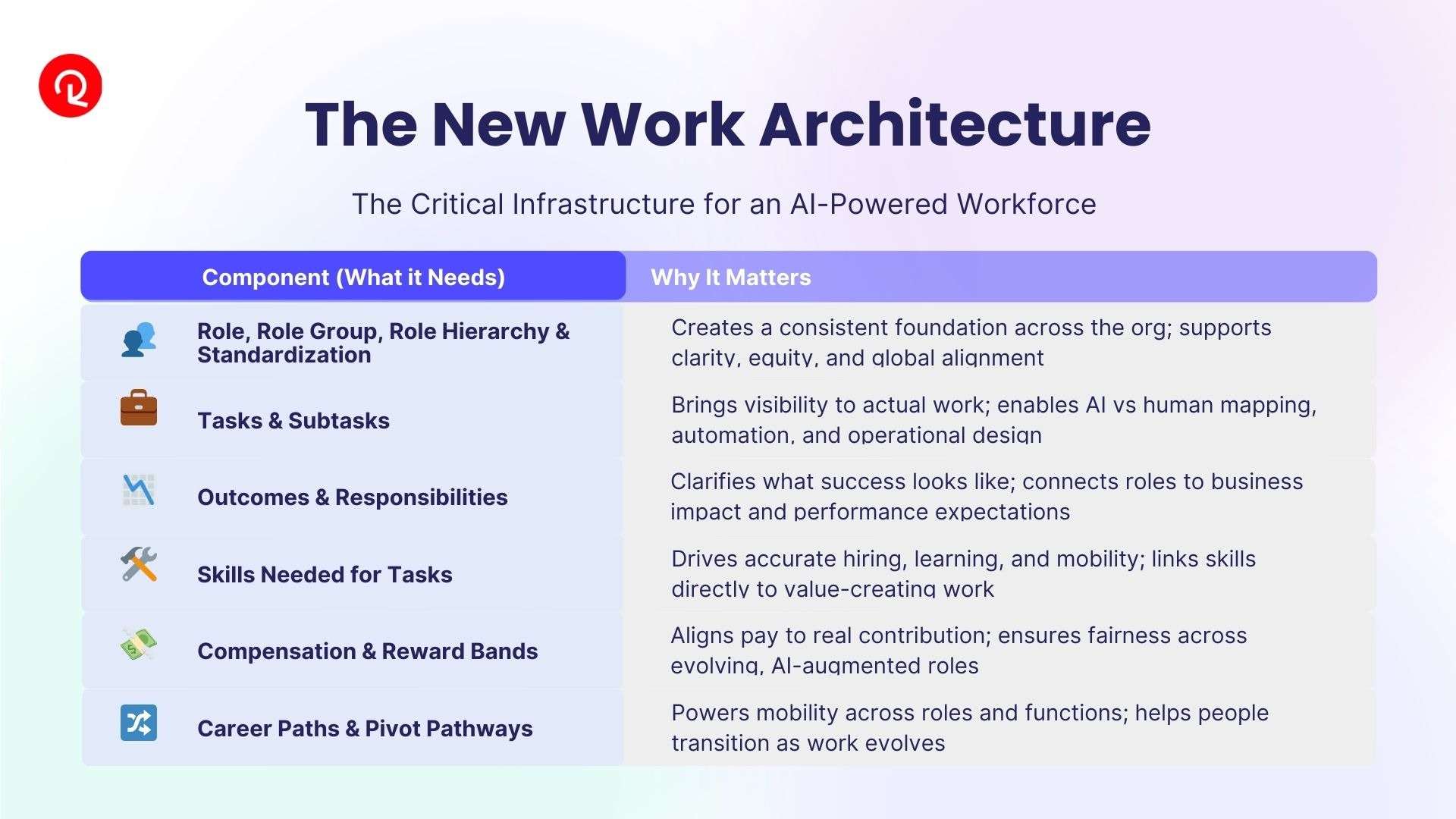
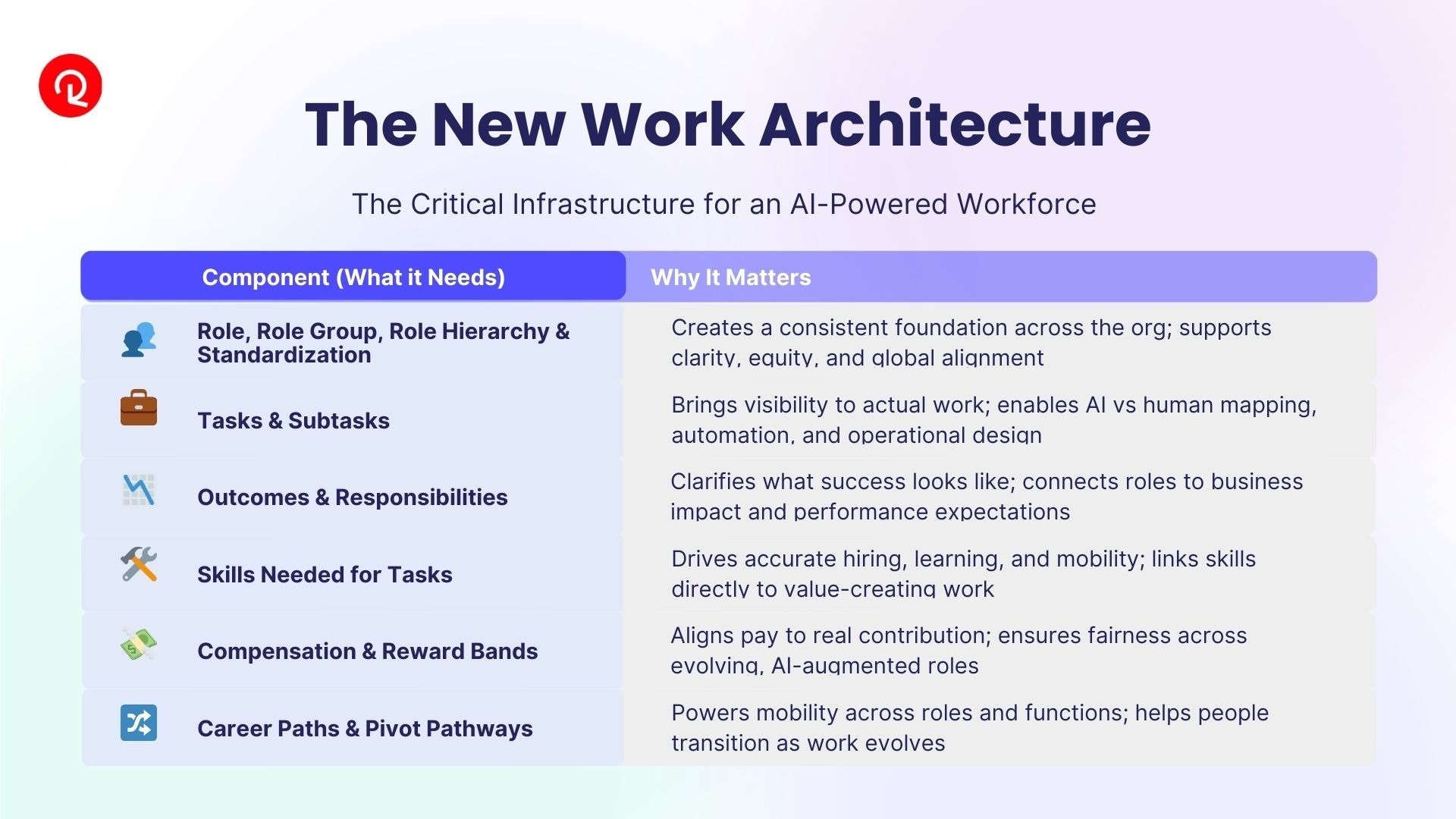
Work Architecture makes several elements explicit and connected:
- Roles and role groups. Global alignment and standardization across the organization.
- Tasks and sub-tasks. Where real work becomes visible. Task-level clarity maps human versus AI work.
- Outcomes and responsibilities. What success looks like. Connected to business impact.
- Skills required for tasks. Grounded in value-creating work, not abstract role descriptions.
- Compensation and reward bands. Pay aligned to real contribution as work changes.
- Career paths and pivot pathways. Mobility designed into the system, not retrofitted after roles go obsolete.
Not a framework. The critical infrastructure layer for AI-powered work.
How it works: the Seven-stage loop
Reejig runs as a continuous loop. One loop. Seven stages. Always on.
Map. Reejig auto-generates the Work Architecture from existing systems. 80% accuracy from day one. Every role, task, and sub-task mapped before any customer calibration.
Analyze. Work Intelligence identifies AI potential, wasted effort, and efficiency signals at the task level. The AI Impact Analysis shows which tasks to automate, augment, or keep human.
Build. Builder Studio is the design surface. Teams create Agent Blueprints, AI Workflows, and Runbooks for redesigned work. This is where job redesign becomes operational.
Run. Reejig connects agents across any provider. Microsoft, Google, AWS, OpenAI, Workday, Salesforce. Agent-agnostic by design. Stealth Change Management is the philosophy here. The new way of working becomes the default before anyone has to "adopt" it.
Measure. ROI is proved through actual changes to work. Not consumption dashboards. Not license counts. Board-ready evidence that work runs differently.
Log. Every AI-powered workflow is captured. What worked. What did not. Where humans stepped in. This creates a living record of how work operates.
Update. Work Context and the Work Architecture refresh continuously. The system stays current. It is never a snapshot.
Map. Analyze. Build. Run. Measure. Log. Update. That's Reejig.
Proof: what task-level visibility produces
Reejig's Work Architecture delivers 80% accuracy from day one. After customer calibration across 25 industries, task-visibility accuracy reaches 92%.
One enterprise customer consolidated 7,000 jobs to 3,000 through work redesign. No restructuring program. No consulting engagement. Work Architecture made the duplication visible. Leaders acted on evidence.
95% of organizations report zero return on AI investments (MIT, 2025). The cause is not the AI. The cause is deploying AI into work no one has mapped.
Only 20% of organizations have rebuilt work processes around AI (McKinsey, 2025). The rest are stuck in pilot purgatory. Work Architecture is the exit.
Executive FAQ
What is Work Architecture?
Work Architecture is the structured blueprint of every job, task, sub-task, and workflow in an enterprise. It sits inside the Work Operating System and is built on Work Context, the live data layer formed by 25 industry-specific Work Ontologies. It replaces static job architecture as the foundation for AI-era decisions about roles, skills, pay, and workforce planning.
How is Work Architecture different from job architecture?
Job architecture classifies roles for pay, compliance, and reporting. Work Architecture maps tasks, sub-tasks, and workflows. It connects them to skills, outcomes, and AI potential. Job architecture is static and role-level. Work Architecture is live, task-level, and updates continuously as work changes.
What is a Work Operating System?
A Work Operating System is the system of record for tasks, workflows, and work outcomes. Reejig's Work Operating System sits across HR, IT, and the business. It makes work visible, redesigns how it flows, connects agents, and proves ROI based on actual changes to work. It is not an HR system. It is Enterprise AI infrastructure.
What is Builder Studio?
Builder Studio is the Build stage of the Seven-stage loop. It is the design surface where teams create Agent Blueprints, AI Workflows, and Runbooks for redesigned work. Builder Studio turns task-level insight from the Analyze stage into production-ready workflows.
What is the Seven-stage loop?
The Seven-stage loop is how the Work Operating System runs. The stages are Map, Analyze, Build, Run, Measure, Log, and Update. They run continuously. Each stage feeds the next. This is not a project. It is a permanent operating rhythm for AI-powered work.
Why do AI pilots stall?
AI pilots stall because AI is deployed into work no one can see. Without task-level visibility, teams automate broken or duplicated workflows. ROI is zero. Boards lose confidence. Programs die in pilot purgatory. Work Architecture gives leaders the visibility to move past pilots and into continuous, measurable programs.
Is Reejig HR software?
Reejig is not HR software. It is a Work Operating System that sits across HR, IT, and the business. It reads from systems like Workday, SuccessFactors, and Oracle HCM. It orchestrates agents from Microsoft, Google, AWS, OpenAI, and others. It is Enterprise AI infrastructure, not an HRIS or ATS.
What leaders should do next
Stop treating job architecture as a source of truth for work. Invest in task-level visibility before scaling AI. Align HR, IT, and business leaders around a shared Work Architecture.
Author


Siobhan Savage
CEO & Co-Founder of Reejig

AI Work Design Blueprint
The responsibilities every CHRO must own to lead AI Work Design and build internal capability.