Customer Story Healthcare & Life Sciences

5.3 hours back, on every task.

A global Fortune 50 healthcare and life sciences enterprise used the Reejig Work Ontology® to reinvent how HR work gets done, mapped to the task, across seven HR functions.

5 min read • Results verified with the customer
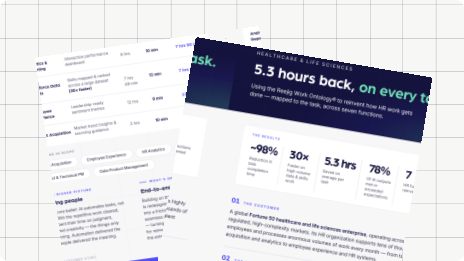
Hero Thumbnail
The results

~98%

Reduction in task completion time

30x

Faster on high-volume data & skills work

5.3 hrs

Saved on average per task

78%

Of AI outputs met or exceeded expectations

7

HR functions reinvented

Customer Story Post Body

01 tHE CUSTOMER

A global Fortune 50 healthcare and life sciences enterprise, operating across highly regulated, high-complexity markets. Its HR organization supports tens of thousands of employees and processes enormous volumes of work every month, from talent acquisition and analytics to employee experience and HR systems.

There is significant improvement to the efficiency and quality compared to the manual process.


Technical Product Manager, Fortune 50 Healthcare

02 THE CHallenge
The HR team knew AI could transform how they work. What they lacked was a reliable way to answer the harder question: where, exactly, to apply it, and how to prove the value. Reporting, data cleaning, and reading open-text feedback were absorbing hours of manual effort every week.

03 THE Approach
A GPS for AI

Reejig translated the organization’s job data into its Work Ontology® — breaking every role into tasks, mapping required skills, and scoring AI potential. Instead of guessing, teams got a precise map of where to apply automation, paired with purpose-built prompts in Copilot. 04 The outcome Hours back, function by function Across seven HR functions the same work now takes a fraction of the time — an average of 5.3 hours saved per task, with 78% of AI outputs meeting or exceeding what the practitioners expected. The map, not the tooling, was the unlock.

Keep reading — the capability they built and kept.

How they redesigned the work in-house, and what it unlocked.

Inside the story

What you’ll get

Icon
The task-level method for finding where AI actually pays off
Container (18)
How seven HR functions were re-scoped without cutting headcount
Container-2
The prompt patterns that produced usable output first time
3-4
How the hours saved were measured and defended to the board

READ THE FULL STORY

5.3 hours back, on every task

Unlocks the story on this page and emails you the PDF. We’ll send occasional work-intelligence research — unsubscribe any time.

How we measured this

Task completion times were captured as a baseline before deployment, then re-measured on the same task set. Output quality was rated by the HR practitioners doing the work.

How it works

One loop, seven stages, no dead ends.

Every engagement runs the same loop. Map the work, analyze it, build against it, run it, measure it, log it, and keep it current as the work moves.

Map

Build the Work Context Graph

Analyze

Your GPS for reinvention

Build

Workflows and agents

Run

Deliver the new way of working

Measure

Track board-ready ROl

Log

Source of truth and audit trail

Update

Keep the architecture current

The loop never stops. As roles, tasks and agents change, the architecture updates itself — which is why the numbers in this story kept holding after go-live.

See the platform

Explore more customer stories

thumbnail

WPP redesigns jobs and roles to power Al transformation

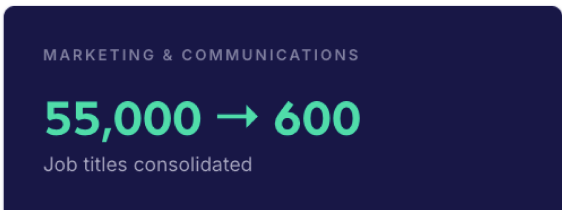
Turning 55,000 scattered job titles into 600 AI-ready roles

Read the story
Screenshot 2026-08-13 at 4.13.34 PM

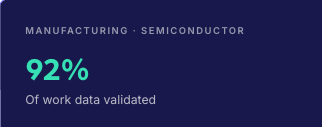
The AI investment plan a CEO could stand behind

Validating how 53,000 people really work — no consultants

Read the story

Screenshot 2026-08-13 at 4.09.19 PM

A GPS for AI across seven HR functions

Turning hours of manual HR work into minutes

Read the story

See what your work data

would say.

Thirty minutes, your org, your tasks. We'll show you where the hours are hiding.

Book a demo