Customer Story Manufacturing · Semiconductor

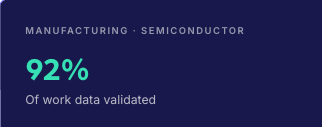
92% of work data, validated. Millions in consulting, saved.

How HR mapped 53,000 people's real work in-house — and built an AI investment plan the CEO backed.

5 min read • Results verified with the customer
Hero Thumbnail
The results

~92%

Of work data validated — gold-standard quality

53,000 

Employees mapped at task level

Millions

Saved in consulting fees

3

Regions: Asia, North America, Europe

Customer Story Post Body

01 THE CUSTOMER

A global semiconductor manufacturer, with around 53,000 employees across Asia, North America and Europe. Its HR organization set out to build an AI investment plan on work data the executive team could actually trust — and to do it in-house, without a consulting engagement.

02 THE CHallenge
The company had plenty of workforce data and little workforce truth. Roles, capabilities, and responsibilities were fragmented and out of date, not clean enough to trust. No one builds an AI strategy on data they do not believe.

03 THE APPROACH
Using Reejig's Work Operating System, work, people, and AI agents were mapped as one connected Work Context Graph. Every role, task, and workflow was validated with leaders and subject matter experts against how work actually happened, not how the org chart said it happened.

04 THE OUTCOME
Trusted work data, put to work

92% validation gave the executive team a task-level source of truth that stays current — replacing thousands of manual hours and millions in consulting fees. Leaders could see the business through an AI lens: where to reinvent, where AI returns most, and where to hold. Work was matched to approved AI agents, with a clear view of workforce impact at task level.

Keep reading — the capability they built and kept.

How they redesigned the work in-house, and what it unlocked.

Inside the story

What you’ll get

Icon
How a task-level source of truth was validated to 92% in-house, with no consultants
Container (18)
The AI lens leaders used to decide where to reinvent, where to invest, and where to hold
Container-2
How validated work was matched to approved AI agents — and which tasks stayed with people
3-4
How workforce impact was read at task level to plan a people-first transition

READ THE FULL STORY

92% of work data, validated

Unlocks the story on this page and emails you the PDF. We’ll send occasional work-intelligence research — unsubscribe any time.

How we measured this

The validation rate is the share of mapped work confirmed by leaders and subject-matter experts against how work actually happens. Consulting savings are the customer’s own comparison against the quoted external alternative.

How it works

One loop, seven stages, no dead ends.

Every engagement runs the same loop. Map the work, analyze it, build against it, run it, measure it, log it, and keep it current as the work moves.

Map

Build the Work Context Graph

Analyze

Your GPS for reinvention

Build

Workflows and agents

Run

Deliver the new way of working

Measure

Track board-ready ROl

Log

Source of truth and audit trail

Update

Keep the architecture current

The loop never stops. As roles, tasks and agents change, the architecture updates itself — which is why the numbers in this story kept holding after go-live.

See the platform

Explore more customer stories

thumbnail

WPP redesigns jobs and roles to power Al transformation

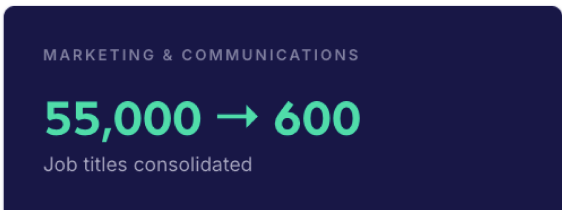
Turning 55,000 scattered job titles into 600 AI-ready roles

Read the story
Screenshot 2026-08-13 at 4.13.34 PM

The AI investment plan a CEO could stand behind

Validating how 53,000 people really work — no consultants

Read the story

Screenshot 2026-08-13 at 4.09.19 PM

A GPS for AI across seven HR functions

Turning hours of manual HR work into minutes

Read the story

See what your work data

would say.

Thirty minutes, your org, your tasks. We'll show you where the hours are hiding.

Book a demo