AI is reshaping insurance at the task level. Not the job title level.
Claims handling, underwriting, customer service, and fraud detection are all changing. AI automates routine work and accelerates analysis. The insurers that move fastest will not simply adopt AI. They will redesign work itself.
That means understanding tasks inside roles. Identifying what AI automates or assists. Redeploying people into higher-value work. Measuring workforce and business outcomes together.
Why this matters now
Insurance leaders face simultaneous pressure. Climate risk, cyber threats, regulatory scrutiny, and rising operational costs. The global insurance market is valued at roughly USD 6.1 trillion. It continues to grow steadily. Insurers invest heavily in digital redesign and AI. They improve operational efficiency. (Source: IBISWorld; Statista global insurance market analysis)
AI adoption across claims processing, underwriting, and customer service already delivers measurable gains. In many insurance operations, AI-driven automation reduces operational costs by up to 30 to 40%. It accelerates decisions and improves consistency. (Source: IBISWorld; industry digital reports)
Every enterprise is deploying AI. Almost none can see the work they are deploying it into.
How AI changes work in insurance
AI shifts insurance work away from repetitive processing. It moves toward judgment, oversight, and complex customer outcomes.
Key industry shifts:
- Claims triage and document review increasingly automated
- AI-assisted underwriting risk assessment
- Virtual assistants handling routine policy inquiries
- Fraud detection using anomaly and pattern recognition
- Faster actuarial modeling and scenario analysis
- Hybrid digital and human sales support
Task-level shifts:
|
Traditional task
|
AI-augmented task
|
Impact
|
|
Manual claim verification
|
AI triages and extracts claim data
|
Faster processing
|
|
Data gathering for underwriting
|
AI compiles risk inputs
|
Reduced turnaround
|
|
Routine customer queries
|
Chatbots and assistants
|
Lower service load
|
|
Fraud scanning
|
AI anomaly detection
|
Higher detection rates
|
|
Actuarial data preparation
|
AI model preparation
|
More time for strategy
|
AI-powered claims platforms reduce manual claims handling by 20 to 30%. They speed payouts and lower operational costs. (Source: IBISWorld; Allianz operational reporting)
The workforce redesign challenge in insurance
Most insurers struggle because workforce planning focuses on jobs. AI changes tasks inside jobs.
Different functions redesign at different speeds. Claims and service move first because work is highly repeatable. Underwriting and actuarial work require stronger oversight and governance.
Common barriers:
- Workforce planning based on roles, not tasks
- AI programs disconnected from workforce strategy and operations
- Limited visibility into workflow bottlenecks
- Generic capability-building programs not tied to real work changes
- Difficulty measuring workforce ROI
AI capability is compounding. Work visibility is not.
Executive concern areas:
- Balancing automation with customer trust
- Maintaining human judgment in risk decisions
- Managing regulatory compliance and model oversight
- Addressing shortages in AI and analytics capabilities
Why AI workforce strategy must start with tasks
Task-level visibility means understanding the actual work performed inside roles and workflows.
Without this visibility, leaders risk automating the wrong activities. Or missing capability-building opportunities.
Role-task AI impact example:
|
Role
|
Task
|
AI impact
|
|
Claims examiner
|
Routine claims triage
|
Automatable
|
|
Claims examiner
|
Complex claim review
|
Human + AI
|
|
Underwriter
|
Initial risk screening
|
AI-assisted
|
|
Customer service rep
|
Policy inquiries
|
Automatable
|
|
Fraud investigator
|
Pattern detection
|
AI-assisted
|
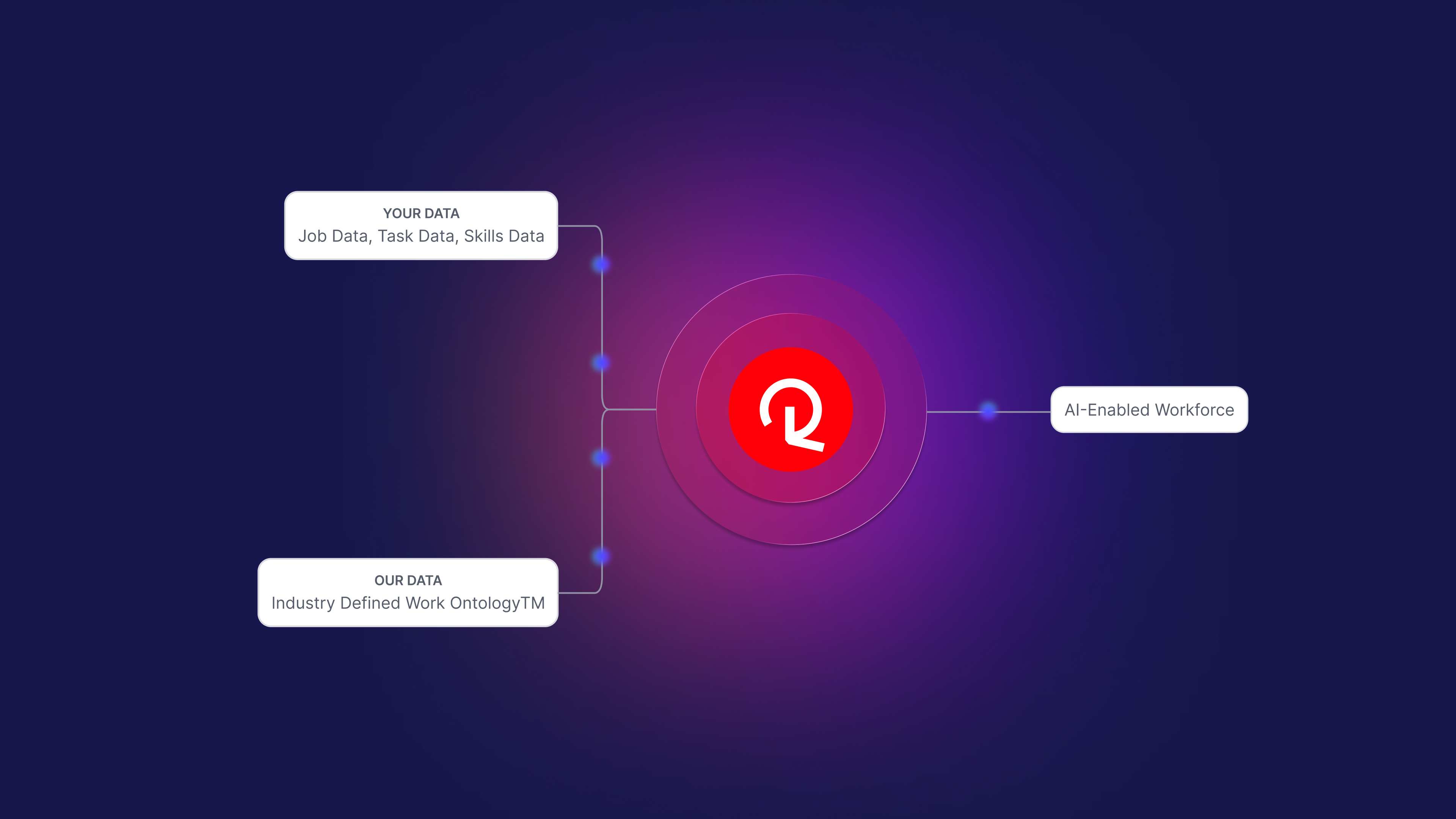
Reejig helps insurance organizations:
- Map work at the task and subtask level
- Identify automation opportunities
- Redesign roles and workflows
- Create capability-building pathways and work movement
- Track workforce and business ROI together
From Job Architecture to Work Architecture.
Framework: building the AI-powered insurance workforce
The most effective workforce redesigns follow a structured approach.
- Map work at the task level. Break critical workflows into tasks and subtasks. Cover claims intake, underwriting, and policy servicing.
- Analyze AI impact. Assess where automation or AI assistance safely improves efficiency.
- Redesign jobs and workflows. Remove manual work. Refocus employees on judgment, exceptions, and customer outcomes.
- Build new capabilities and redeploy employees. Develop targeted pathways into adjacent roles.
- Measure redesign outcomes. Track productivity, quality, workforce movement, and ROI together.
Workforce redesign checklist:
- Identify priority workflows
- Break workflows into tasks
- Classify automation potential
- Redesign roles and handoffs
- Launch targeted capability-building
- Track business and workforce outcomes
Metrics that matter:
- Claims cycle time
- Underwriting turnaround
- Service resolution speed
- Fraud detection rate
- Work movement rate
- Realized AI ROI
Where insurance leaders should prioritize first
Early redesign success depends on prioritizing functions with clear AI potential. Measurable operational impact.
|
Function
|
AI potential
|
Operational impact
|
Time to value
|
|
Customer service
|
High
|
High efficiency gains
|
Short
|
|
Claims processing
|
High
|
Faster cycle times
|
Short to medium
|
|
Underwriting
|
High
|
Improved risk analysis
|
Medium
|
|
Fraud analytics
|
Medium
|
Strong risk reduction
|
Medium
|
Customer service and claims often deliver the fastest returns. Work is high-volume and structured. Underwriting redesign typically follows. Governance and data maturity increase.
Creating new career pathways in insurance
Successful AI redesigns redeploy people into adjacent roles. They don't remove expertise.
Insurance employees already hold valuable domain knowledge. They understand policies, risk, and workflows. The goal: augment that expertise with digital and AI capabilities.
The Work Operating System. Critical infrastructure for humans and agents in the AI era.
FAQ
Will AI replace jobs in insurance?
AI will primarily change tasks inside roles rather than eliminate entire jobs. Routine work will automate fastest, while complex decisions and customer interactions remain human-led.
Which functions should insurers prioritize first?
Customer service, claims processing, and underwriting workflows usually offer the strongest early value.
Why is task-level visibility important?
It reveals where AI can improve work and where employees can move into higher-value tasks.
What capabilities will matter most?
Data literacy, AI fluency, risk interpretation, workflow redesign, and customer problem-solving.
What should CHROs do now?
Partner with business and technology leaders to map changing work, design career pathways, and enable internal mobility.
What should CIOs and CAIOs do now?
Ensure data readiness, AI governance, and integration into real operational workflows.
Conclusion
AI is changing how work gets done across insurance.
The opportunity is not simply deploying AI tools. It is redesigning work, developing workforce capabilities, and building a workforce that can use AI responsibly and effectively.
The insurers that succeed will start with task-level visibility, redesign jobs around AI capabilities, and track workforce and business outcomes together.
About the data & methodology
Reejig’s workforce insights are built on independently audited Ethical AI and Work Ontology™, designed to map how work is actually performed at the task and subtask level.
The methodology analyzes 130M+ job records spanning the last 5–7 years, representing 41 million unique proprietary and public data points across 100+ countries and 23 global industry sectors.
Key elements of the methodology
Data integrity
The dataset consolidates insights from proprietary data, leading labor market platforms, and publicly available datasets. Reejig workforce strategists validate work structures and apply domain expertise to refine the analysis.
Unparalleled scale
More than 130 million job records were processed and deduplicated into 41 million unique job and role data points.
Global and industry coverage
The dataset covers workforce activity across 100+ countries and 23 industry sectors, providing a dynamic and current view of how work is evolving globally.
Validated outputs
Data is structured and verified to support reliable insights into task-level workforce transformation, automation opportunities, and career pathways.
Disclaimer: The information in this article is general in nature and does not take into account an organization’s specific circumstances, operating model, or location. Workforce transformation priorities may vary by organization, sector, and regulatory environment. For tailored insights, consult a workforce transformation expert.
 Platform Overview
The Work OS for AI-powered Work
Platform Overview
The Work OS for AI-powered Work
 Work Architecture
Live entity model of your enterprise
Work Architecture
Live entity model of your enterprise
 Map
Build the Work Context Graph
Map
Build the Work Context Graph
 Analyze
Your GPS for reinvention
Analyze
Your GPS for reinvention
 Build
Workflows + agents
Build
Workflows + agents
 Run
Deliver the new way of working
Run
Deliver the new way of working
 Measure
Track real, board ready ROI
Measure
Track real, board ready ROI
 Log
Source of truth · audit trail
Log
Source of truth · audit trail
 Update
Keep architecture current
Update
Keep architecture current