-
Platform
-
Resources
-
Company
- Work Architect Course
- Contact us
 Platform Overview
The Work OS for AI-powered Work
Platform Overview
The Work OS for AI-powered Work
 Work Architecture
Live entity model of your enterprise
Work Architecture
Live entity model of your enterprise
 Map
Build the Work Context Graph
Map
Build the Work Context Graph
 Analyze
Your GPS for reinvention
Analyze
Your GPS for reinvention
 Build
Workflows + agents
Build
Workflows + agents
 Run
Deliver the new way of working
Run
Deliver the new way of working
 Measure
Track real, board ready ROI
Measure
Track real, board ready ROI
 Log
Source of truth · audit trail
Log
Source of truth · audit trail
 Update
Keep architecture current
Update
Keep architecture current
PARTNERSHIPS
View
Reejig x Workday
Unlock more value from Workday with AI Work Design.
 All Resources
Content for AI-powered work
All Resources
Content for AI-powered work
 Certified AI Workflows
Proven builds you can copy
Certified AI Workflows
Proven builds you can copy
 Articles
AI work design thought leadership
Articles
AI work design thought leadership
 Events
Roundtables, webinars, dinners
Events
Roundtables, webinars, dinners
 Webinar Recaps
What we learned, from the people building
Webinar Recaps
What we learned, from the people building
 Playbooks & Guides
How to build capability in your team
Playbooks & Guides
How to build capability in your team
CUSTOMER STORIES
View
Robyn Tombacher on employee-led work redesign at Warner Bros. Discovery

Author
Reejig

Read time
5 mins

Published
Jul 15, 2026
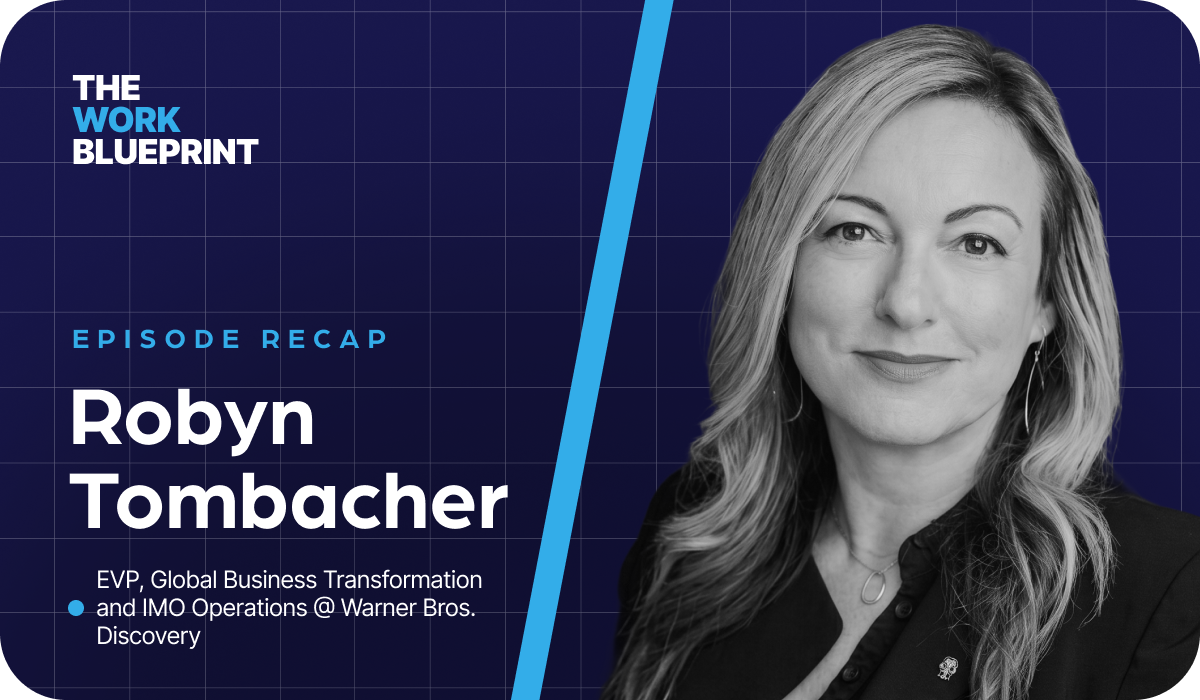

Robyn Tombacher on employee-led work redesign at Warner Bros. Discovery
{height=150, max_height=150, max_width=200, oembed_response={provider_url=https://www.youtube.com/, width=200, height=150, html=, thumbnail_width=480, version=1.0, title=The Work Blueprint with Robyn Tombacher, provider_name=YouTube, type=video, thumbnail_height=360, author_url=https://www.youtube.com/@reejig, thumbnail_url=https://i.ytimg.com/vi/MNcFqYsGWDU/hqdefault.jpg, author_name=Reejig}, oembed_url=https://youtu.be/MNcFqYsGWDU, size_type=auto, source_type=oembed, width=200, supported_oembed_types=[video, link]}
Blog Post Body
Table of contents
Catch The Work Blueprint live
Hear how leaders are redesigning work across people and AI. Join us for the next episode.
Buying AI technology is one decision. Changing how people work with it requires many more:
Which tasks should change? What people will become responsible for? How they will learn to work differently?
For Robyn Tombacher, EVP Global Business Transformation & IMO Operations at Warner Bros. Discovery, connecting those decisions is central to the job. Her career has moved from digital production through operations and into the people function, before returning to business transformation. She understands change from the perspective of both the person designing it and the person expected to make it work.
In her conversation on The Work Blueprint with Siobhan Savage, CEO and Co-Founder of Reejig, Robyn described an approach that brings employees into work redesign itself - and connects changes in workflows to the skills, expectations and support people need.
Focus on where AI can improve the work
Robyn sees a familiar challenge in large organizations: companies buy AI tools, but don’t always rethink how people will use them in their day-to-day work.
For her, the starting point is understanding where AI could make a meaningful difference. Which processes could work better? How would people’s responsibilities change? And what would a better result look like for the business?
That focus drew her to Reejig: the ability to understand where AI could help and what that would mean for the work and the people doing it.
The next step is redesigning those workflows with clear roles and responsibilities, so people know how to put the technology to use. Success depends on whether it helps them deliver better results.
Bring employees into the design
Across mergers, integrations and technology deployments, Robyn has learned that a strong strategy still depends on people helping to put it into practice.
Her approach is to involve the people whose work will change. They bring knowledge of requirements, exceptions and everyday realities that a central team may otherwise miss.
As she puts it: “we’re going to start workshopping it and we’re going to design it together.”
For changes at a global scale, she describes bringing different voices into a task force to shape the approach. Participants can then explain to colleagues how their needs were considered and why particular decisions were made.
That gives participation a purpose beyond consultation. Employees help shape the work, and their involvement can build trust in the resulting changes. Drawing on her career, Robyn sees that trust as part of what allows an organization to deliver on its plans.
Bring the right expertise together
Asked how she would structure an internal team for AI work design, Robyn recommends bringing together technology specialists, HR professionals who understand roles and skills, and people experienced in redesigning processes.
That team would work directly with employees and leaders across the business to understand how work gets done and design changes together.
She recommends testing those changes in short cycles, reviewing what works and adjusting along the way. The team’s responsibility would extend into helping people put the new ways of working into practice.
Make changing responsibilities clear
Robyn’s spreadsheet example captures what this could mean for an employee. If producing a spreadsheet is handled for them, their contribution could shift toward checking the output, developing insights and anticipating what comes next.
That is a change in responsibility requiring expertise, judgment and clear expectations.
She anticipates more people managing outputs, even when they do not manage other employees. Performance conversations would consequently need to focus more on what someone helped achieve than on the tasks they completed.
Leaders and managers have a role in explaining the new way of working. HR can help clarify the changed role, the skills someone already has and the skills they need to develop.
For Robyn, investment in a new process needs to be accompanied by investment in the employee expected to use it. People need resources and support to take on those responsibilities - not simply a revised expectation.
Keep reviewing the work and supporting the people
Robyn’s test for progress is whether redesigned work improves business performance. The ambition is to connect investment to results, with enough visibility to understand what is changing and adjust what is not working.
She sees particular promise in better, more timely insights: helping leaders anticipate problems instead of only reviewing what happened last month. She also argues for an ongoing approach to redesign, drawing on her experience of digital development moving from fixed delivery stages toward continuous iteration.
Building that approach requires sustained leadership support, people and funding. It also gives HR business partners and talent advisors an important role, because they understand employees, development needs and how work happens.
Robyn’s leadership implication is specific: when a workflow changes, the conversation about someone’s role, contribution and development needs to happen with it. Bringing employees into the design helps connect those decisions from the beginning.
Explore more pioneer stories and practical guides to help you redesign work across people and AI.
Speakers

Siobhan Savage
CEO & Co-Founder of Reejig

.png)

Robyn Tombacher
EVP, Global Business Transformation and IMO Operations at Warner Bros. Discovery
Siobhan Savage: I am so excited to welcome you all to the Work Blueprint. This kind of show is all about like talking to the best, most incredible thinkers within the space. Today, I am so grateful to be joined by Robin and a little bit of back on text for everyone. So Robin and I first met at WPP and then we followed over into the water side as well.
Siobhan Savage: So Robin, I'm going to give you some context on her background. But Robin, you're going to have to tell the story about your background because it is amazing. So Robin has spent over 25 years helping some of the world's biggest companies navigate moments that essentially redesign the future of that company. She has led transformations at the intersection of people,
Siobhan Savage: operations, and technology, from modernizing workforce strategy at WPP to orchestrating major agency integrations. And now she's right at the forefront of leading the integration management at Warner Brothers. So, folks. And not sure if anyone's not reading the news, but it seems to be in the news everywhere I look.
Siobhan Savage: With Warner Brothers and Discovery merging together, Paramount, Skydance to build the next generation of media. So she's become a really trusted partner at the CEO level, right from board and executive, and we are so grateful Robin has joined us to share some of the learning that she's had along the way. So, Robin, welcome. Thank you for joining us. Thank you.
Robyn Tombacher: Yeah, I think you got my story pretty, pretty well said. But I think as you and I talked about, you know, when we first met, my, my background and my, my career is really taking some interesting turns. You know, I really did start out early days in that
Siobhan Savage: era of being a digital producer and creating at the time, you know, first ever websites, first ever digital advertising campaigns, mobile campaigns, social campaigns.
Robyn Tombacher: So my early career was really spent doing the work itself. And then over time, I transitioned into more of an operational management role. I traveled the world, helping to integrate new companies and establish operations and ways of working. And then ultimately, you know, continued on that path
Robyn Tombacher: of operational excellence and leading companies. And, you know, probably about 5 or 6 years ago, I took a little bit of a turn, like you said, during the pandemic at WPP, when I sort of stepped out of, you know, having come off a very large merger
Robyn Tombacher: with Wunderman and Walter Thompson into thinking about, like, what is that workforce management strategy globally for WPP? It was at a time when we were so used to always hiring externally and bringing in people as needed, and now as a time for us to think about how do you tap into the people that you have? How do you cast the right team members?
Robyn Tombacher: And for me, it felt like a moment to kind of come into a specialty, knowing that I'd really come come up as a producer, someone who had to think about how to build the right teams, get the right skill sets and experiences and put them together to deliver great work. So I took that turn. For the last several years I've been in the people function,
Robyn Tombacher: thinking about their people operations, their transformation strategy. And only in the last several months have I kind of taken that turn back towards the business to really focus on, like you said, what I'm doing now, which is the Integration Management office and leading the global business transformation team for Warner Brothers Discovery.
Robyn Tombacher: So it's kind of full circle. But yeah, but as but as you know, you know, I am a huge proponent of the future of work, of where AI is really going to make an impact. Again, as someone who's like a player coach, I really do understand
Robyn Tombacher: what it takes to to do this at scale and in complex organizations. And I think oftentimes that gets missed. Like there's there's often sort of this perspective that like you could just force something in or dabble your way in, and it really needs a much more like methodical and thoughtful approach. Yeah.
Siobhan Savage: And I think the thing that's really awesome about your background is you understand the technology, you understand the actual business where we're going to be making those changes. And then you also now understand on the people in the HR side, I think that's a very rare breed. And one of the things that I'm kind of seeing in market,
Siobhan Savage: you know, globally as well, there's this like new formation, this new team. So I think the way I kind of describe it is that, you know, companies have had to borrow capability to figure out how to build the AI powered workforce. Right. But really, what's not happening is that customers are not realizing
Siobhan Savage: that they need to build this capability inside of their own company. So think of like the important work. The consultants do great work and they come in. But essentially think of them as the bridge, not the destination. The destination is driving this inside of your own organization. And if I was to like sketch up on your whiteboard right now, I would say
Siobhan Savage: you need someone who understands tech, someone who understands the business, and someone who's actually within the HR team, who understands how that works. Who cares why people like tick tick tick tick tick. You got it all going on. And this is why this conversation, you know, for folks listening is going to be so exciting. Because to have that like empathy while also understanding
Siobhan Savage: structurally how to make that change at a big scale is incredible. So before we kind of jump into like, I got lots of things I want to ask you, where do you see the market at? Like, you know, I've got a view of like everyone is kind of hurtling towards AI without a kind of fun. What's your take on AI
Siobhan Savage: and what the world is looking like and where we're going to go?
Robyn Tombacher: I mean, I think it's certainly starting to feel like it's getting embraced by more of, we'll call it like those who are deeply rooted in the business that they do. I think, you know, for the last few years, it's really been a focus for a lot of the people who are on the emerging side of understanding AI and now is really starting to take hold in organizations
Robyn Tombacher: where people are grasping that this is not something that you can look away from or not be curious about. It really is going to become sort of that currency for career advancement, for business advancement. And those who are who are like, you know, ready to go after going to,
Robyn Tombacher: you know, certainly be the ones, you know, sort of thriving in this new world. Right? But the ones that are still sort of like thinking they're going to get it done just by like, hey, dabble in copilot or use ChatGPT. It's not going to drive material impact. Yeah. Which is why, as you know, you know, we started working together because I
Robyn Tombacher: really loved what Reejig had to offer, which is really about like, for me. And coming back to that coup mentality that that, like person who's connecting the business in the financials and sort of performance, it's really about knowing where you're going to get the most impact
Robyn Tombacher: in the use of AI versus just using in dabbling for AI sake. Yeah, and I think that where we've seen the dabbling, that doesn't go well, dabbling costs a lot of money. You know what I mean? Like with not a lot of I come right or right, I mean and again, I have so many friends who are CIOs and who really understand this space.
Robyn Tombacher: I think many of them are like on the forefront of embracing it. And then it kind of gets stuck at, okay, we've gone we've, you know, we've paid a lot of money for these large enterprise platforms, but we haven't thought about how to pull that through into actually
Robyn Tombacher: re-engineering work as roles, people's responsibilities. Those are the things that are going to make this take hold. Yeah.
Siobhan Savage: And I think that's where I think when you and I are thinking about understanding all your work at the task and it's class level, no was even valuable to go after because like, some things are too expensive or not even worth automating and bringing in AI for getting really clear and then reinventing the work itself, that's kind of where we see.
Siobhan Savage: And to be fair, like you are right. Like, I think there is definitely a maturity shift where most customers were in like POC territory and neither kind of over that.
Robyn Tombacher: There's fatigue around POCs. It's like getting into production and like, let's start seeing the ROI return on this stuff fast. Absolutely. It has to be.
Siobhan Savage: It has to become something that's sort of like built into the way of working into the way of operating.
Robyn Tombacher: And that means removing current state ways of doing work or manual workarounds. And that's the piece that we have to get everybody comfortable about. And like it's it's up and down the organization.
Siobhan Savage: Yeah, I think as well. Like we're seeing a collective view of CIO, CRO, CFO coming together. So like we had Mike Caro on a couple of weeks ago on the show and he's X Mastercard. And he said it was like a Covid moment where suddenly these teams have to work together in a way that they probably didn't
Siobhan Savage: have to work together since Covid because, you know, they're starting to see this like view of like CO2 obviously needs to help with driving the change and the work design and all of that. CIO owns the tooling. And then CFO was like, how much money are you spending on what and what is my return?
Siobhan Savage: And like bodily not people capacity versus agent capacity. So we we I mean we used to when we first started, we sold predominantly with HR, I would say 60% of my buyer, Di, CIO and CFO was floating around. CFO is the next tier because they're the ones with the pressure.
Siobhan Savage: They're the ones with like, how are you going to manage costs? Are you going to get efficiency? How are you going to actually free up cash to invest in new capability and investments? And it's a cycle, right? So the folks that are really starting to get this and understand this, I think are much more engaged than they were before.
Siobhan Savage: And the companies that are going to really like, you know, take off are the ones where all three of them come together. To your point in that moment of saying like, we have to all own this, it's really interesting because, you know, when folks typically do business cases, a lot of the times do feel more like vitamins than painkillers.
Siobhan Savage: So to your point, it's like, how do you like there are so many people that join this show who all want to build this practice. They are so excited about the future. They want to build whatever you want to call this team like work, innovation, work, architecture, whatever. They are the folks that are excited about seeing the opportunity in their company,
Siobhan Savage: building the capability in the business, and then creating like a Co that can sit and feed the business, you know, and help them. So to your point, you kind of have to think about how, why would my CIO care about this? Why would I care about this? And also why I want to see it flow. Care. So the case for this has to be relevant to those three personas, Nai.
Robyn Tombacher: It absolutely does. And then honestly, like you have to see the pull through to the PNL, right? With any big investment of this scale that's actually needed to deliver, you have to see the pull through. You have to start to model that out and see when is this going to start landing in my performance, I think up until
Robyn Tombacher: this point, companies have been okay just testing and possible and trying. But, you know, certainly boards are looking for impact. You know, there's just so much more pressure, especially on the public companies to deliver, you know, that level of margin efficiency. So you can see that really becoming the next phase
Robyn Tombacher: of where I think your platform and tool could really be interesting.
Siobhan Savage: It's, you know, it's funny as well. Like your point about the board. We have started getting requests from our customer base. Now I can use your can you give me like intelligence that we can send up to the board. Not because there's a whole part of that happening. So it's interesting. I wonder what's happening in those boardrooms.
Siobhan Savage: Are they looking at like all the tech companies and going, you know, these folks are like changing the head by like, I wonder what's happening in those rooms. But we're definitely seeing this like conversation where and I'll tell you something that's very good. It's not just like, how do we cut headcount? It's actually like,
Siobhan Savage: what is the AI opportunity that exists across all of our work in our company? What will be the impact of workforce? So actually, I would say that's the good story that like if that's what they're caring about, they don't just want to be about Cat. It's like, okay, how do I think about the next phase of my people?
Robyn Tombacher: Yeah, I mean, I recently participated in a training for future board of directors, and one of the areas that they talked about that more boards are interested in are board members who know and understand AI in the future work, and what kind of impact that can drive for the workforce for obviously leapfrogging in,
Robyn Tombacher: you know, capability and offering, but also in the products that are delivered. So so I think it's definitely resonating beyond sort of the boards who are just looking at it in the past for just like, okay, now I can get more cost out of the company. And it's funny because most of the conversations
Robyn Tombacher: nor are like so as you know, when we tell you the task, the subtask, we give you the new workflow, we tell you how to build the agent, and then they want to track what's the actual changes to the work, not how many people are logging into an agent. They want to know, like how many hours? What's the velocity on the lock? Like have we actually achieved?
Robyn Tombacher: If not, shut it on? So that's kind of new.
Siobhan Savage: And one of the other things I haven't shown you yet, but we've got we can tell you the cost per task, which is based on like how much this is typically cost for people to do. We know you also have the models of like what's the token cost? So to your point about the CFO, the reason that we built that was because we were getting a lot of pressure, because you would have seen in the news everyone's freaking on it
Siobhan Savage: because like the cost of agents. So customers are saying like, how do we think about like balancing and projecting? Like, sure, I'm going to like model like this. But everyone forgot to model in how much what was costing them. You know what I mean? Like they can I can tell you somebody up front. And then there's the part that comes underneath it,
Siobhan Savage: which is like everything that you're paying. I had to in my team this week and we are AI first like we are like design from like I got no legacy. We have blown I don't clawed. So all of our forecasts are completely wrong.
Siobhan Savage: And so a lot of what I was looking at with my team was like, hold on, what is this AI usage that's valuable versus what's just someone doing something that could have been done on a cheaper model or like just Google it, you know what I mean? Like it's like literally nothing, right? And that's where it kind of becomes like, you know,
Siobhan Savage: it starts to like erode from the bottom of the business. Right. But hopefully to your point, like you start to create that blueprint for like what, what and where do you use each one of these really powerful platforms and tools?
Robyn Tombacher: And where can you just, you know, go with the way that things have been done the last ten years? Yeah. And it's really funny because, like, I've got to drink my own champagne, right? So I'm looking at this and I'm like, well, hold on a second. Like, we got to get across this. And it really does come down to part of where we went wrong was, I don't know if you've seen cloud design cloud designs.
Robyn Tombacher: Amazing, right? So what we've all got is so overly excited that not everything we create in the company has to be designed as a if like we were given a to do, you know what I mean? Like everything is so over the top like produced for some for an email that's coming to me.
Siobhan Savage: I'm like, guys like, we don't need to do that, right? Right. Like place for sure. Yeah. Because it's just so easy to take. Like, hey, we do these rapid docs, which are like, you know, rapid decision making and like it has to go up for an approval. Neither getting completely branded with like, beautiful things and like
Siobhan Savage: they're turned into like digital make decisions like I love it. So I've always wanted to get that. Like, right. It's all about like presentation that matters every day, all day. But to your point, like it can become a quick coffee. Ten bucks. Yeah, exactly.
Siobhan Savage: So that's and that's kind of where like this is everybody's kind of new. Everything's new like, you know, we're building \$1 billion company with under 100 people. Right. And I feel like I'm a sponsor to be really open about where I'm making all my mistakes, because if I'm making them, imagine what's happening in a company with 200,000 people.
Siobhan Savage: Oh, yeah, can imagine the scale of stuff.
Robyn Tombacher: So like for me, like part of this is like just saying, hey, like, I let go of this for three months and it blew out like massively. And that's happening everywhere. And I think like given you have led I mean, you've done mergers, you've done restructures, you're pushing towards AI first given like I'm all in for like sharing the lessons.
Siobhan Savage: Like what are some of the lessons that you have learned on that journey like that you can share with folks here? Because there's going to be a whole pile of like things that have went on during that journey, right?
Robyn Tombacher: Yeah, there's a lot of scars laughing and smiling, right? I mean, sure, like all of these big, massive disruptions always have like they're, you know, they're fallouts, right? I would say, you know, in the past
Robyn Tombacher: you could have gotten by by like a top down, eat it. This is what's going to happen. I would say no longer is that true, especially over the last few years, you know, organizations and the people within them have opinions they have with doing things.
Robyn Tombacher: And, you know, they need to be brought along. They need to be engaged as you go through this change. So for me, like the big things that I've learned in any of these mergers or even deploying new platforms and new technology is like, bring people along with you, get them involved,
Robyn Tombacher: get them to start to see for themselves how this is going to make their lives better, perhaps, and or just do things in different ways. And every time I think when you do that, you build trust. You create a culture that that sort of like identifies, okay,
Robyn Tombacher: my voice matters and then those things actually do deliver, right? Like when people feel good, when people feel engaged, when they're learning new skills, you're going to get a higher return. Anytime that I've seen organizations like push these things forward
Robyn Tombacher: and focus on the logistics or focus on even just like and again, like, I know I have operations in my title, many, many companies, as you just focus on the operations, you're just you're not going to be able to deliver success. And most companies right there, focus is like driving
Robyn Tombacher: revenue, retaining clients, seeing growth. All of that is part of this like whole ecosystem that I do think if you if you ultimately miss that piece, I guarantee you I can plot for you. Over my career, over the last like 25 plus years, the companies
Robyn Tombacher: that didn't get it who have fallen down or fallen out of even like top tier, and the ones that did get it continue to thrive, continue to build, continue to succeed. So, you know, again, back to like all of the things that I have, you know,
Robyn Tombacher: have had responsibility for, I think, you know, those hard leadership lessons are like, you can have a you can have a vision, you can have a strategy, but you have to bring the organization with you. And there's a lot of levers that you could pull along the way. It's interesting, like when you're saying that my brain is triggering me
Robyn Tombacher: to be like, there's this debate that I've been having with the customers where they're saying, oh, but like, the agent will do it end to end.
Siobhan Savage: And I'm looking at all the biggest companies in the world. They're not going to automate by with no human in the loop. There is no way you're going to like five code insurance companies, banks, hospitals. So there's always going to be people involved in doing the thing. And if the people don't do the work,
Siobhan Savage: then you are not going to make money and you will have a problem. So to your point, it's not even just the right thing to do. It's actually like critical for your business to bring your people on this journey properly or they will not adopt the new way of working, and then you have a problem. Or even worse, like, I've had this like I've been kind of watching the media a little bit. I mean,
Siobhan Savage: American media is like intense to watch because you kind of get full on rabbit holes. But the one thing I've watched is the kind of sentiment shift pretty aggressively in America against AI. There is like a pretty decent. And the assumption is that the young kids are going to adopt this stuff. They're not. They're the ones that are bullying. They're the ones that hate it.
Siobhan Savage: Like it's so there's like a really interesting when you think about companies and if most of the population is anti something and you still require them to complete work, what happens to leadership to people listen like like that's going to be a really interesting thing really is. Yeah I think it's definitely going to be an interesting thing.
Siobhan Savage: I would say the role of the human right becomes even more important in this moment, as we've talked about, you know, people go from being doers.
Robyn Tombacher: You know, a lot of times over my career, early days, like I did, the hard work, I paid my dues, I did very tactical work. And a lot of times, right, like we bring in, you know, sort of entry level, you know, employees who don't want to necessarily do that work. They want to get engaged more quickly.
Robyn Tombacher: I think this is going to ramp what we used to think of as our doers, to be very quickly become managers. And they may not be a manager of a human, but they're a manager of the output. And I think that will drive a different skill set, a different level of accountability.
Robyn Tombacher: And, you know, I hope that gives people a little bit more like pride in what they do per se. So like so like I think they're more right, more pride in their outcomes versus like I did this task check. Yeah. Now it's like I can really say here's what I did.
Robyn Tombacher: Like when I do my performance review at the end of the year, here are the things that we actually did do as outcomes and deliver. So I think if we could start to shift it more towards that. And again, I keep coming back to that, that people side of things, which is like any way you're going to incentivize people is tied to performance
Robyn Tombacher: and certainly obviously always pay. But those are the things that I think ultimately are going to need to start converging in this space to get the real pull through.
Siobhan Savage: It will be interesting that pay point as well. Like, what's the if I if I have a sales person and I'm targeted to book five meetings a week and I book seven, like what happens in that world like is the expectation shift. And I see a lot of European customers that have workers councils that they're very strict on.
Siobhan Savage: Like if you go and change someone's job with AI, the resetting of expectations is critically important because you know you're measuring someone against a new criteria.
Robyn Tombacher: And if you don't communicate that, and that's one of the things that's been really interesting, like we've built into the data to be kind of like, here's a predictive view of how fast we could make this or how the outcome will shift with the workflow.
Siobhan Savage: But someone needs to have the conversation with the people to say, by the way, like we're now seeing that like our expectation for our team is this. Because if no one says it and then you start performance managing people based on the old like, no one's reset. Like that's going to be a this is why HR is important, right? Yeah, exactly. That's why the role of HR is critical.
Siobhan Savage: I mean, it's really about a reset of role expectation.
Robyn Tombacher: You know, instead of measuring meetings you're measuring output. Yeah. And you're measuring potentially I would hope more more sales and you know, actual revenue commitments. But you know, I think to your point, like the old way of, of managing people's work product is going to change and become much more outcome based.
Siobhan Savage: I know those workers councils. Well, yeah. Yeah. And they're going to have to be managed through all of this change, you know, because the big, you know, I'll call it the more agile, the more tech companies, companies like Reejig like you guys are just going and doing. Right.
Siobhan Savage: It's the bigger organizations where it's going to take a real effort to go out and make this material change and get the. Yeah. And it's funny because, like, I've worked across really complex, I'm building a startup. Plus I've worked in the tech side as well.
Siobhan Savage: And I think there is also like a little bit of over exaggeration, even in how well that's going in some instances. Like I'm a completely different because I've been able to like whiteboard a completely new thing in a different way. If you're a company in any, even the tech companies that are you no more. So you're still like, what do you do? For 100 people,
Siobhan Savage: changing anything is actually like pretty challenging because you've got core infrastructure that exists. You've got a bull pilot, customers that are there, stuff just happens. You don't want to break too much stuff because you don't want to impact like revenue flow as well. So I also think like there's a little bit of folks are selling us products as well. In the storylines that we read.
Siobhan Savage: I actually would much prefer in some instances to be on the enterprise side because they've got governance and structure, which means they're not going to just throw it at a wall. They're actually going to have to be pretty intentional about like the redesign. Whereas like we've done intentional redesign. Well, it wasn't even redesign.
Siobhan Savage: It was intentional design of the company. Like, should we hit 100 people doing the billion dollar company thing? I don't know, but like the whole the whole test is to see how can you redesign a company. And if you look at like traditional industries, like look at the media, anything that has like people fronted businesses, like media,
Siobhan Savage: the professional services, these companies are being completely disrupted. Their value position now is so different. Yeah. In terms of like versus me selling a product like what's your like, where do you see the world of like all of the different kind of like structures of companies going like when you look at like the different way that they're even going to have to work.
Siobhan Savage: Well, you know, the one good thing, right? Is that the reason that all of those companies in particular, that are people based, are where they are, is that they've always had the most talented people doing the work. They that talented group, you know, is probably driving a lot of what you see on the forefront of those organizations.
Siobhan Savage: And then there's the middle to call them, like the back office layer that is fairly consistent across the board at any organization that I've been a part of. And I think it's in those areas where you're definitely going to see more, more need to really like drive AI implementation,
Siobhan Savage: more need to get changed through ways of working.
Robyn Tombacher: You know, over the last several years, we've gone from like near shoring to offshoring to automation. Now, AI is that next frontier, and that's going to disrupt all three of those big sort of levers that have been used around operating models and efficiencies. So I would say like the professional services groups,
Robyn Tombacher: they're definitely feeling it because a lot of what they were doing, at least in those parts of the organization, can now be really unlocked and leveraged, you know, and leveraging AI. Whereas I still honestly believe, like the people that are doing a lot of the work that we see,
Robyn Tombacher: you know, in on TV or, you know, on an advertising spot, whatever that might be, that comes from creative thought and thinking. You might use AI as a sort of like a thought starter and accompaniment. But, you know, that's the part of like the humanity that I don't think will change.
Robyn Tombacher: It's like, that's the superpower that humans have in this moment. I'm your live case study on that. Literally this week I had a conversation with my marketing team. We're like, I just think all the floor design is great, but it all looks the same and everyone's starting to look the same and brilliant.
Siobhan Savage: Design and creative is like, you cannot like you cannot beat that. That can't be created with an AI model. And like, we get our first work with RGA and we'll pretty much be going on and doing like a whole brand. And we were debating like, do we even need to do like a new creative or do we just skill?
Siobhan Savage: And I was like, no, we're like the thing that we want to have is that quality that takes that creativity. And some of the stuff like on like the wording, the verbal creative, the written, creative, like we could never have come up with that. In terms of AI, there is just no way.
Robyn Tombacher: But the thing that I think is exciting, right, because I've been in those organizations, is that most of the time, like companies will create your brand sort of tone, your playbook, your your ethos. Right? And then they would do all of the work to create all of the assets and all of the ways in which you can leverage that brand. That's where AI is interesting
Robyn Tombacher: to a platform where Tom boom spit out, you know, and I becomes the playbook for how you sell your playbook, like everything.
Siobhan Savage: That's exactly. So we're pretty much now, like locked in on that next phase, which is like build this. Like I don't know what you call it, like build this. The brand, the creativity toolkit, create me all of the asset like an animation designs. And then what we will do is. That's our IP. And then we own that. And then we scale that through like a cloud design or something like that.
Robyn Tombacher: That's that's basically but I think to the point of like I'm probably right at the front of like use AI for everything. I'm very clear on where you need the taste.
Siobhan Savage: The person like, you just cannot beat that. Like no matter how much you like, play one prompt off against and use all of them. You will still never get to a point. And that I think, is going to be common across a lot of work. You know, not just like the creative work as well. Yeah.
Robyn Tombacher: And I think that's where, you know, companies are going to need to make choices like in those, you know, we'll call it like mid-tier or tactical layer channel executions. You can absolutely use AI. And that is disrupting for, you know, a lot of the communications businesses that have existed to date.
Robyn Tombacher: But there are other areas where you absolutely cannot, like rely on an agent and or you start to know that, like, okay, this definitely doesn't look right, it doesn't feel right. And it's it's going to create like a lack of confidence with your customer, with your clients, what have you.
Robyn Tombacher: So those are the choices that I think we're going to have to find ourselves in. And you know, most people are learning their way through it. And certainly, you know, the organizations that are advising should advise a little bit unlike here's where you can pull that lever.
Robyn Tombacher: And here's where I really would say, just don't do it. And in the world where product is so easy to ship now compared to what it used to be, brand is the point where the feeling of your company, like if everyone looks the same and product is going to get to the point where there's pretty much cloning of everything,
Robyn Tombacher: then that big brand and like how you show up and how you communicate and the experience you give to your customers.
Siobhan Savage: And this is not just me talking about Reejig. I'm talking about like whether you sell tens of beans or whether you are like across the board, like everything is going to be able to be built so much easier. Like even look, forget even just AI, look at all the robotics. I've got a little bit of a obsession right now watching on social media like in China,
Siobhan Savage: the minor robotics stuff that's happening and these robots on the street wearing like little skirts and backpacks, it's like hilariously funny, but like, imagine what's going to happen when you kick in robotics and AI at the same time.
Robyn Tombacher: That's when it becomes like a big thing, right? Oh, totally. Right. Like they make movies about this. Yeah, exactly. And we're here. We're almost here. Right. And and here's me watching them on TikTok. Yeah. Okay. This is real. Is this.
Robyn Tombacher: Is this really happening? And it's closer than we think. And, you know, it's certainly becoming a real shift for everybody in that I don't think I think when you watch those movies or you saw, okay, that was the future, you thought, okay, like that's 50 years. It's probably like five years from now.
Robyn Tombacher: Yeah. And you know what's really great to see?
Siobhan Savage: I mean, I get a lucky position where I get to see across the board in multi industries, especially customers who like if you sell something to the consumer and they also could be an employee. They're very protective of not doing the wrong thing. So which is a great thing. So like I don't go and work for companies that basically want to cut x percent.
Siobhan Savage: The companies that I work with are like, I want to be really bold. I want to keep my head on flat, and I want to increase our revenue profile. And I want to be really bold and like, redesign how we're doing this. But I also want to make sure that I build the capability in my business, within my people, and make sure I don't leave them behind, because the reality will be
Siobhan Savage: that the job evolution is going to happen so rapidly, especially when, you know, I got like, who worked with Microsoft and things like that are starting to get into enterprise. That's when you go from subtask to like, I'm doing a task and I think that's where you're going to see a lot of the impact. I think it's not going to happen as fast this year.
Siobhan Savage: I think next year is really when I'm starting to like model and look at, okay, because most companies are not allowing that to happen at scale yet. It's really like when that becomes like an approved governance thing in a big company, that you'll start to see that. But I think that's where that's the good thing I'm seeing in market
Siobhan Savage: is that, like the folks that work with me are generally the folks that want to do both, like they are ambitious and they want to make as much money as they can. Of course, who doesn't? But they also have their people at the heart of it and recognize that there is going to be a some talent shortage. What we got to figure out what that shortage looks like.
Siobhan Savage: And then how do you rebuild those people? I mean, bridging is like designed as a name for exactly that moment, right? It's like that whole continuous loop. No.
Robyn Tombacher: And I mean, again, back to, you know, why your story and your business really resonated with me as I, as I looked at, you know, where do we go when it comes to like defining the future of AI and work is because you're thinking about, like the impact to the work, but really about helping to reskill, helping to re-engineer
Robyn Tombacher: the work product itself and give the people the tools to continue to like, okay, if I'm not okay now, I no longer need to do this Excel spreadsheet because that's already done for me. What I do need to do is check it, build the insights, and start to see what's going to come next.
Robyn Tombacher: It almost to me was really important because otherwise, you know, I've been in organizations where it's just like, okay, AI is the new cost lever. And, you know, that's a long road to the bottom, I think, as well. Like when you when you start going down that path and if you don't
Robyn Tombacher: even have visibility of what's changed, it's also chaotic. So like there's also like a view of you want to you want to look at the AI opportunity, predict where to go, have a map that sends you in like a direction, but then like you don't want, you know, shot, by the way, you don't want like all of this like chaotic mess.
Robyn Tombacher: And if stuff is not work and you have to have a visibility layer to be able to shut stuff down. Yeah, that's mission critical.
Siobhan Savage: Otherwise you're just, you know, putting things into the work process and not evaluating whether they're actually delivering impact.
Robyn Tombacher: You know, as I think about work, that's again, back to like the levers that we've used over the last few years, you know, is really about like move to a distributed model. Used teams all over the world use low cost locations as much as possible. And while work was pushed to those locations, the work
Robyn Tombacher: process itself never truly evolved to make real impact in, you know, cost management in changing people's roles per se. So I do think, like this is going to force people to to think differently about how they're going to do that and having a
Robyn Tombacher: platform like Reejig to see that and to get that real, like real time transparency and visibility is actually like if as the CEO and mindset, like, that's the holy grail, right? Otherwise you're just, you know, presuming you're going to get some sort of an uptick. Yeah.
Siobhan Savage: I've got like a little bit of like a reaction to like the word transformation at the moment because it feels like a one time thing. It feels like a project. And I think that the world and this work is a forever not, you know, like you're not going to do this once and then, okay, we're done.
Siobhan Savage: Like, like to work like this is this is where it's like a forever, right? Right. Continue to iterate. Continue to iterate.
Robyn Tombacher: Which is also if you think about like the world of when I think about my early days in like web design, you know, we were using that waterfall methodology. It was like, okay, we did the, you know, we did the design blueprint, we did the wireframes, and we locked it and then we built it and then we like, pushed it live and we were done. And then over the years it became more about agile
Robyn Tombacher: and, you know, incremental and continuation. Right. And I think the companies that can start to move past those old sort of phase gates and move more towards agile and iterative. To your point, the transformation becomes ongoing
Robyn Tombacher: and ever evolving as opposed to, you know, a one and done. Yeah, yeah. And there's another scenario that I've seen play like someone will take a workflow and then they want to bake AI in for the sake of having AI.
Siobhan Savage: So then they're looking at all the subtask level. And in some instances it takes longer than what it was before for the person. So part of this is like where is it even valuable to go after number one? What is the cost of doing this? Because to your point, like I design my workforce strategy where I've got folks in Manila, I've got folks in Sydney,
Siobhan Savage: I've got folks in New York, and then I have like a lot of agent capacity across my team. And some instances it's easier for me and cheaper for me to put something in Manila versus agent, which sounds kind of crazy, but that's just true. So I think that's the that's the that's the business. Right. Of like, okay. And then you go to like redesign it.
Siobhan Savage: So it's not just like AI for the sake of AI, right. Like is this even worthwhile? Like, do we even do this enough. Like if I am doing this task, but once every week, is this enough for us even to care about? Right. Like I agree, and that's where it's that's where it's for me again, it's like, where are we going to get the most bang for the buck?
Robyn Tombacher: Where are we really going to make a material impact? Where is this, you know, going to be something that is going to drive a real, you know, a real improvement in ways of working versus, yeah, like we could dabble here or we could do this little thing here. Okay, great. Fine.
Siobhan Savage: But like, does that really have any material change. Yeah. And so I think, you know, to your point, like AI, even though what you're talking about is design at the task of subcaste level, there's there's multiple layers of it, right?
Robyn Tombacher: Like that's the underlying layer that sits in the workflow itself. But then there's big level thinking that is coming out of like the use of AI. I mean, I've always for many years, the teams that work for me know, like my holy grail, is to get a dashboard with real time insights and start to see predicting insights.
Robyn Tombacher: Yeah, when I have to look at like, oh, let's let's look at how we did last month. Okay. Last month like that already happened. Know how are we going to do in the next few months. Right. And how do we get ahead of that and how do we start to course what are the key things and tell us we're about to head down that cliff again? Like totally agree.
Robyn Tombacher: I mean, and I've worked with incredible engineers and technologists over the years who always wanted to get to that point. But now with AI, like they can get there tomorrow. Yeah, like, here's my idea. Like tomorrow, they're like, oh, we already created something for you that's exciting. As a business leader, that's super exciting given
Robyn Tombacher: like you've got that view looking forward like three years.
Siobhan Savage: Like, what do you hope organizations have figured out? Like what are the kind of key pillars that, like, need to be true for this moment to be as good as it could be?
Robyn Tombacher: I think those who are going to hold on to the past are going to get left behind. And, you know, working in big, large global organizations, there's multiple agendas, there's multiple
Robyn Tombacher: aspects to these businesses that are, you know, important and critical. And I think it's really going to require, you know, the leadership at the top to come together from across all these different groups to align on understanding the importance of embracing this moment and bracing this change. I think those that you know, have carried us to
Robyn Tombacher: this point are going to start to say like, okay, wait a minute. Like I now I start to I need to be curious and I need to start thinking about like, what is the future look like? So the companies that that can like release that going to be great. Going to continue to evolve and deliver. And those that aren't
Robyn Tombacher: willing to do that or adopt change, I think will become obsolete. They'll, you know, they'll have had their moments. Right. So I know three years from now I'm sure work will look completely different. Operating models will look completely different.
Robyn Tombacher: And again, I think that's only as good as to your point, what you were saying before, as the companies that think about building those AI CEOs, building the connections into the businesses and the leaders and the managers who are doing the work, and then driving the accountability
Robyn Tombacher: and driving, sort of the the incentive for performance. Yeah. Where do you think exists? So like you've got like IT involvement, you've got HR that are kind of the work design kind of gurus as much as there is the guru, you know, in that because it's like kind of new.
Robyn Tombacher: Where do you think like where would you prefer to sit if you're building like this team?
Siobhan Savage: Like where does it sit? Like, I mean, I, I'm a big proponent of cross-functional teams. Like, I think if it's sitting in one group, you're not going to get the the actual pull through that you need.
Robyn Tombacher: I believe that you probably need to have it come together where it's, you know, either one tied into a transformation lead for some sort of CFO or operating strategy. And then it's a cross-section of technology and information,
Robyn Tombacher: you know, information officers groups within them. I think HR, anybody who understands roles and skills. But then I think, you know, again, I'll come with my, my background where for many years I led like program and project management where I understood like process,
Robyn Tombacher: work, product, how to flow things through. You know, you used to you used to get like a a lean Six Sigma. Yeah. Qualification. People understand how to re-engineer work. Yeah. Need to be part of it. So to me it's really like this
Robyn Tombacher: cross-section of like athletes who come from these various backgrounds that come together into that ACO and then having those like I'll call like maybe that's the hub and having the nodes that sit in the business groups in the, in the business units, in the, you know, in the functions
Robyn Tombacher: that exist in the organization who are really going to go up and down the chain of like what's happening in that group to build out that strategy and see it all the way through. Yeah, we do see like across a lot of our customers actually, we see this kind of new team that's forming under the.
Siobhan Savage: So it's like a work innovation team. And it's it's kind of like there's kind of I don't know what to call them yet, but like think of them as one as the work architects. They're the folks that are kind of doing the wiring of the company, and they understand the job architecture, the task rules. That part, you said. And then you have these like work engineers, work designers.
Siobhan Savage: They are the ones that are kind of doing that process redesign, workflow redesign. And then they buddy up with the tech builders like whoever the builder is. Some customers are putting the builders in this team. Some are like putting them into business, some again in the it doesn't matter, but they're working towards that. That's becoming a pretty common thing
Siobhan Savage: that I'm seeing and even starting to see, like CIO reporting The Crow. Not where there's like this view of capability is like agent on people. So it's definitely I think a lot of people are trying to figure out where it goes. But to your point, it's cross-functional like it's it's doesn't really matter where
Siobhan Savage: it sits as long as it's got the expertise and capability to do those parts. Right. Yeah. Correct. And as long as you're it's cross-functional. So you're getting that like athlete sort of player in that group who can think through all those, those three components. And then it's also to your point and they'll go back to like the agile scrum model.
Robyn Tombacher: It's like working and sitting with the teams and doing it together in real time, and then doing sprints and seeing where you are at the end of a few weeks. So it's really, I think, you know, starting to go from like just creating something in a centralized function
Robyn Tombacher: to really sitting and doing the actual change within the day to day, the way the word the world works and the business is working. Yeah. The one part I haven't kind of figured out in my head yet is so to your point about the bringing the people on the journey. So if we go and we reinvent a new way of working, let's say a new
Robyn Tombacher: AI workflow to pay the invoice, you've got 100 people doing that. Who's responsible for making sure the hundred people know how to work? So we have built in the product, I think like an SOP. It's the step by step guide for folks to kind of be brought on the journey, and they get to collaborate with the SOP and they get the chat to it. If you're like, hey, like, what part do I do? What?
Robyn Tombacher: So that's like new. Yeah.
Siobhan Savage: But I'm trying to figure out, like, who's responsible for making sure that folks one do that to know the new expectations. Because that's the part we talked about at the start of the show. Right, was how do you tell Jane that? Jane, did you know that we're expecting X9, more invoices paid, or let's say we're not going to bring in more invoices?
Siobhan Savage: Where does Jane I spend the time. Like who? Like where does that part sit?
Robyn Tombacher: I mean, well, one, I think the leaders need to be the ones, you know, reiterating that, like, we are going to change the way that we operate and work, that doesn't necessarily mean that you are going to lose your your role. You're just going to work and do things differently. And I think having the right leaders, right, change agents who know how to drive
Robyn Tombacher: that into the to the groups, it's going to be super important. The role of HR becomes super important, right? It's like helping people understand, okay, now my job function change. What is my new job description? What are the skills that I have? What are the skills that I need. So it's I think it's all of the above right.
Robyn Tombacher: It's like getting the people function, HR function to help recast that role for that individual. Yeah. The leader and the recasting. Yeah. It's the leader in the manager really saying like we're looking to adopt a new way of working where, you know,
Robyn Tombacher: we're asking you to be accountable to help delivering that. And then we're going to make sure to to also not just invest in the new ways of working, but invest in you as our employee, any of the skills giving you the resources to bring you along. Again. That's why I always say it's like people who I want to change the way that they're working, I'm going to get them in a room
Robyn Tombacher: or we're going to start workshopping it and we're going to design it together. You know, whenever I've had to do something at like a global scale will always think about, like, how do I bring in that global team and voices create a task force and group that can bring different points of view,
Robyn Tombacher: but shape something together and get to that like 8020 role. Yeah. When you when you do that I think you also create the people become your advocate as you go back out into the organization and they can say, oh, well, you know what? Like I brought them our special needs and requirements
Robyn Tombacher: and they thought about that through the flow or this is how this is being addressed. So there's there's more like stakeholders, there's more collective design that's happening. And you know, hopefully and again, I think people start to feel like excited when they become part of it.
Robyn Tombacher: So it feels like a reward versus like something's being taken away.
Siobhan Savage: Do you think and I don't know what to do about this. So like let's say I have all the visibility of all the work that happens in your company. I know the impact of AI and the short, medium, long term. Do you think, like we should give that? Like how do you do? We should be tell the employees that, like, what's the how much do you be honest
Siobhan Savage: and like what what would we like because I kind of struggle with like how much do you freak people out versus how much do you know? How much do you know that something is about like on our plan to change and then communicate. And this is again why HR, I think the two things built in together. One, we're going to redesign the work, but also we're going
Siobhan Savage: to redesign your path forward or what did you call it, recasting I love that that's the that's the at that. At what point, you know, do you have that conversation with people? Because I remember when I first started, my furry first product was so like
Siobhan Savage: interestingly scary to me was even when people were being made redundant and there was a low chance of redeployment and a very low chance. And these were probably, you know, 45 year old plus folks where they're would have in Australia. They've got laws around age protection as well for career.
Siobhan Savage: And like there's certain levels of scrutiny that happened around that. So like we were very much so paying attention. And what actually was really interesting was that even when folks were being made redundant, they weren't taking action to go in and actually complete profiles and do these things,
Siobhan Savage: which I used to look at and think, I think someone's just being like, genuinely like rabbit in the headlights, scared of like. Like what? Like, you know, when someone gets completely like, just like. Because I couldn't understand why, you know, like what happens in that next phase. And how do you make sure that
Siobhan Savage: people are able to move into that next iteration of their career? And if folks are not engaging because they they're afraid or I don't know the reason, that was my assumption. That's kind of like where I sit and go, do I give my daughter, would that freak everybody? I do? I tell them at the moment that they need it or like like I'm trying
Siobhan Savage: to figure out, like, how do I need and what you know what?
Robyn Tombacher: Like I've always felt better about transparency versus like withholding. But at the same time, you know, it depends on like the time horizon for a lot of the change. You know, I do think there's been fear every time there's something new. Like I remember, you know, in my early career,
Robyn Tombacher: I was working for the digital agency and we were part of a, you know, a conglomerate and a traditional agency. And we were treated like, you know, the like, you know, stepchild who was not important. Right? Like, digital is nothing. We own the brand. We own, you know, the traditional advertising.
Robyn Tombacher: We own the client relationship. And over those years, like we started to see, okay, wait a minute. Digital starting to become more important. Digital is becoming the lead. Traditional like branding is less right. And the people
Robyn Tombacher: that that I had as friends who had come from that world, either one, they embraced it and they said, you're right, I've got to learn it. It's here now. Or the ones who are just like, I don't want to learn. I love the what, I love what I do like, I love print, you know, I love print advertising. Okay, great.
Robyn Tombacher: But if you don't start to learn in this space, you are going to be obsolete. And so sort of similarly, like I think people need to understand that this is where things are going, have that transparency, but also make sure that like you're bringing people along with you and you're going to help them get to a place where they can start to embrace it.
Robyn Tombacher: And if they don't want to embrace it, fine, eject the tap out. But ultimately, and what I've always seen in my career is every year there's a new emerging trend. There are new emerging technology. You can either choose to like turtle and and like not embrace it and be like, that's a non thing.
Robyn Tombacher: Or you could at least be curious. You can engage and start to learn. Yeah. And I think and I do think that like everyone's on their own career journey. So it's for those individuals who are on that career journey who want to continue to, to be curious, to learn and improve. Those are the ones that are going to continue to go forward, no matter how old you are.
Robyn Tombacher: But those who are just like, no, I like the way that I've always done things. Okay, well, you know, the world's going to evolve. And, you know, I think all the AI leaders, I think they kind of stop and selves a little bit in the foot because they were so catastrophically
Robyn Tombacher: negative, like the tool they were selling.
Siobhan Savage: This was the thing that blew my mind. And then they were suddenly expecting that people would not be petrified and not want to adopt it. I think that was like the biggest failure of leadership on their behalf, because what they've ended up doing is slowing down the potential of like, sure, they're growing at a rapid pace, but like just because someone buys
Siobhan Savage: a product doesn't mean that they're using the product. And, you know, like if you could go and sell a whole pile of licenses, people got to like, embed this into a way of working or they will not stay with that product. It's only a matter of time, right? Like, I think that there was a lot of fear mongering. Felt like it's just going to take your jobs
Siobhan Savage: versus actually, this is an enabler to make you better at your job. Right? And it was so see someone like me. So my background I come from workforce strategy, I come from HR. I have no technical background whatsoever. But here I am building a massively big and opportunistic
Siobhan Savage: AI company like I am the perfect example of what is possible with AI. And like I was so frustrated because I was like, you're killing it. Like you're killing the moment for everybody to adopt this and embrace it. So my view is like, yes, there will be risks that we've got to manage, but the greatest opportunity that we have is for everyone to become a builder.
Siobhan Savage: Like, imagine being able to build like the freedom we're exciting.
Robyn Tombacher: And again, there's always people that I've experienced throughout my career who are like tinkerers, who will embrace and build and try. And then there are others who are just like, you know, don't have that curiosity, and they do work differently. But for those who do really see the opportunity in this moment,
Robyn Tombacher: this is going to be another this is going to be really exciting. Like Bill, new things, try new things. Think about all of the blockers and the barriers that you've had to get work done or do the the idea that you thought of. And now with AI, like it's just a way to unlock it sooner and and anything is possible now. Right?
Siobhan Savage: It's disseminated and dispersed. Yeah. I first came out, it was like Watson. Right? It was like very contained. Now it's for the everyman. Yeah. What's really funny is watching them backpedal now where it's like getting ready for IPOs. Who don't. Right. Of course. It's like so predictable. It's like really funny.
Siobhan Savage: But we didn't have to do that. That was like like, you know one day I'll I'll make my point heard. But like that that didn't need to happen. And now what we've got is like a wolf pile of folks who are petrified about the opportunity. And now I've got to work harder to get them to adopt into a new way of working, which just causes a problem. Right.
Siobhan Savage: And I think I commercially didn't understand that. Like, you're breaking people out about the thing that you're selling. It doesn't make any sense. You know, like usually like you kind of sell it. You don't, like, put people off. So I don't know if there is some like backwards marketing strategy on that.
Robyn Tombacher: Like, do you know what I mean? Like what was the goal to your point? Yeah. Yeah. Like these are the like these are smart people. So it was kind of like I don't know, like I just but what is interesting is like, I feel like you, me, all of the folks on this call, we all have a responsibility to work with our companies and make sure that they're going to be really bold and make sure they're going to innovate.
Robyn Tombacher: But also, like we can also be really responsible at the same time and make sure we don't leave our people behind. And I think that's the that's the opportunity and that's the opportunity when you do both, that's where you win. Right? Because companies that again, the best companies that have been part of when you bring people along with them, with you, when you understand
Robyn Tombacher: their specialties and commitments and contributions and you continue to invest in them, they all drive revenue and growth and, you know, and new and exciting projects and adventures. Right? Otherwise, like, okay, then you just became a commoditized organization
Robyn Tombacher: that just uses like the vanilla adoption of the enterprise tool. And the solution for sure. Yeah. And I can tell you, like just from my revenue growth, companies want to be afraid of companies like mine, like the speed that I move out, the pace that I'm bringing on revenue, my margins
Robyn Tombacher: like I'm cashflow positive, I'm doing things at a company of my skill shouldn't be doing yet.
Siobhan Savage: And that genuinely comes down to good work. Design like we haven't figured everything on. We haven't cracked it or not. Like sitting here on my soapbox and can were amazing. But I can tell you right now against a big Navy ship style company, I will win every time. Well, right.
Robyn Tombacher: I mean, but to your point, like those big organizations need to think with like that old kind of incubator mentality, which is right. It's like even though there is a big ship that's always got to keep, you know, it's going to keep moving if you do not carve out money, people support commitment.
Robyn Tombacher: You will not be able to make those inroads and start to incubate and work in ways that your organization will work. And again, those are the companies that I think are just going to get left behind because they've focused on the way that they've already been doing things. And then one day they're going to wake up and be like, oh my God, like one,
Robyn Tombacher: people aren't buying this X, Y and Z anymore and say, buying it. And I haven't evolved my business. So now what? Yeah, yeah. And it is it is really interesting. Like to your point, the trend changes like imagine the right which AI is also getting better and the capacity available to like do more and more work.
Robyn Tombacher: Like this is where it's like this is the worst. Like today is the worst it'll ever be. It's going to get better every day.
Siobhan Savage: So it's kind of like this, like sudden shift. Most of the folks that watch this show and listen in on their peloton in the morning, you know, these are all like really strong HR folks who are really curious and want to be part of building
Siobhan Savage: this bold, responsible, this new team, given you have worked cross tech in the business, but your heart has sat with nature and you have a fond like connection to that group. Sometimes I find it a little bit difficult to cut through some of the legacy
Siobhan Savage: in HR, and like, I think there is this percentage of the population who are seeing the opportunity and they're running towards and they're, you know, they're pioneering. But then there's like a broader group, like if you were to be coaching, you know, the HR community, like what are the mindsets and the things that you think are really important
Siobhan Savage: that we got to learn from you to be taken seriously? If I wanted to build this team, let's say I come to you in the business and I say, you know, my backgrounds work for strategy. Robin, I think that we need a business line that does this. I've got the Bakrie. I can do this. We're going to save millions of dollars, bring in external resources.
Siobhan Savage: We've got to do this forever. What mindset and things would you kind of recommend that everyone here, including me, like, like, has to have learned from, etc.?
Robyn Tombacher: Well, I'll start with your initial point, which was just like the HR, the HR organization. I do think that HR has rapidly evolved over the last several years, right? Even from when I, you know, sort of made that pivot into the people function. The people function, you know, is so ripe for
Robyn Tombacher: modernization right there, so ripe for changing the ways in which they do things. And so many, you know, HR organizations, they have their centers of excellence, and then they have their their HR business partners and their talent advisors. And I think the centers of excellence are always the ones that are going to push. They're going to push to embrace this.
Robyn Tombacher: They're going to push to to think about how they use technology, because a lot of what they they likely provide for the whole of the organization sits there. Think the companies, the the part of the business that, you know, I'd love to see start to feel like they own this Ma are the talent advisors.
Robyn Tombacher: All those are those individuals who now are inviting leaders and this function groups on what kind of change do they need to see in their people? Do they need to see in the output of those organizations and those people? And like, how do you really change that, that
Robyn Tombacher: sort of make up of individual as opposed to like what you've always looked like for in the past? You mean like heap kind of rule? Yeah, yeah, yeah. We are seeing here as a thing that's the that's the key. Right. Because they understand they have the connections to the people
Robyn Tombacher: and they understand how the work gets done and they understand, like who's an up and coming leader and or who needs some, you know, professional development. And it's in those individuals that I think HR can really get to a place of being
Robyn Tombacher: almost like the lead for this, you know, AI transformation, the lead for driving real material shifts in organizational structures and layers and spans, etc.. So anyone who's thinking about like, you know,
Robyn Tombacher: putting something like this into HR, you know, really lean into that group and, and really give them all the skills and training that they need to feel like they can advise. Right. As CEOs,
Siobhan Savage: For sure. I think this is like, honestly, the most exciting career moment ever. Like, if I wasn't if I wasn't doing this, I would be coming to you and I'd be saying, listen, there is an opportunity right now for us to do this and build the capability within our business, and we can set
Siobhan Savage: really good metrics in place to make sure that the ROI of the team is in place, that we will create an awesome service line into the business, that they don't have to go and borrow expertise outside that we create a new infrastructure and architecture. So our company is running off the same data set so that when we read, then the triggers and tells the talent team that actually work has changed.
Siobhan Savage: So like for me, like I think this is the most exciting moment for folks in the year.
Robyn Tombacher: If you are passionate about this and you enjoy what you're doing in terms of like being at the forefront of driving an organization towards a real new era, right?
Siobhan Savage: Absolutely. And in big companies, there are definitely people who get it and understand it.
Robyn Tombacher: I just think that, like, at least in the companies that I've been in. I think that like, we're, you know, we're often the ones advising clients on how to use these things. And you, you don't always like eat your own dog food and focus on yourselves. So, right now, it's like those companies that are, that are doing that externally need to take a lens, turn it inside and start to really unlock, you know, the opportunity within their own organization.
Siobhan Savage: Yeah. And I think your kind of profile is the perfect example of like where you call it like a chief work officer or whatever it's being described as. Whatever you wanna call it. Right. Like whatever it is, like there is this role that exists to sit like in the organization, and I think every company is going to end up having someone like you who will be driving this out. And I think that's, if this doesn't go to plan, like I'm gonna call you, I'm gonna work for you. Please. Yeah.
Robyn Tombacher: And so, to your point, though, right? I think what you guys are providing is a fantastic unlock within any organization. I think the consultants are helping drive sort of the strategy. But having that group that sits in a company that really can think about bringing together that cross-functional team to go in and really get it done and deliver is going to be critical. Anytime you need me to help.
Siobhan Savage: No, we are so grateful to have you. Yeah, I do think what's going to be really important is like how we start to focus on, like, sharing all of our learnings as fast as possible to the community so that folks get to really start like learning from that. Robin, it has been honestly the most incredible conversation. I could keep you here for hours and days and weeks just talking about this topic. Thank you for everything you do for the community. Thank you for all of the work that we've done together. We're so grateful that you have had the experience that you've had, so that you can share it with all of us, and you can find our... we'll share with everybody after, like, you know, your LinkedIn and some context from this conversation as well. But thank you, Robin!
Robyn Tombacher: No, thank you so much. This has been wonderful. Always good to see you, Siobhan.
Siobhan Savage: Thank you. See you folks. Have a good day. Everyone.
Catch The Work Blueprint live
Hear how leaders are redesigning work across people and AI. Join us for the next episode.