-
Platform
-
Resources
-
Company
- Work Architect Course
- Contact us
 Platform Overview
The Work OS for AI-powered Work
Platform Overview
The Work OS for AI-powered Work
 Work Architecture
Live entity model of your enterprise
Work Architecture
Live entity model of your enterprise
 Map
Build the Work Context Graph
Map
Build the Work Context Graph
 Analyze
Your GPS for reinvention
Analyze
Your GPS for reinvention
 Build
Builder Studio · Workflows + agents
Build
Builder Studio · Workflows + agents
 Run
Deliver the new way of working
Run
Deliver the new way of working
 Measure
Track real, board ready ROI
Measure
Track real, board ready ROI
 Log
Source of truth · audit trail
Log
Source of truth · audit trail
 Update
Keep architecture current
Update
Keep architecture current
 All Resources
Content for AI-powered work
All Resources
Content for AI-powered work
 Certified AI Workflows
Proven builds you can copy
Certified AI Workflows
Proven builds you can copy
 Articles
AI work design thought leadership
Articles
AI work design thought leadership
 Events
Roundtables, webinars, dinners
Events
Roundtables, webinars, dinners
 Webinar Recaps
What we learned, from the people building
Webinar Recaps
What we learned, from the people building
 Playbooks & Guides
How to build capability in your team
Playbooks & Guides
How to build capability in your team
CUSTOMER STORIES
View
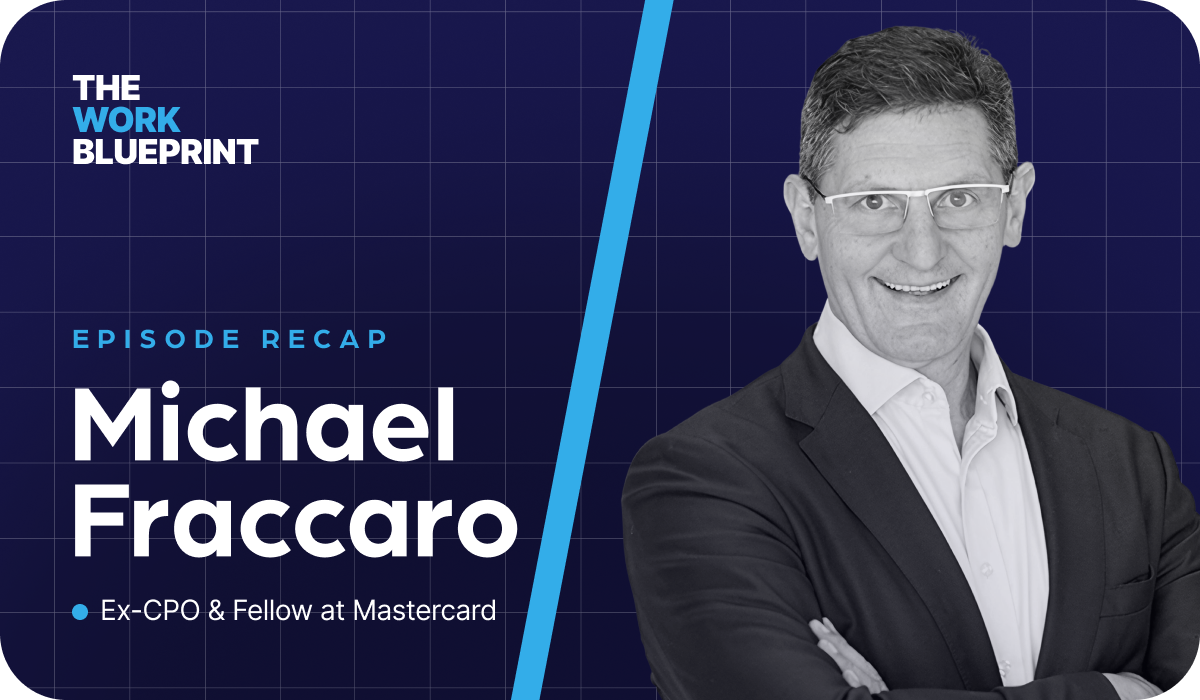
Michael Fraccaro on AI work transformation

Author
Reejig

Read time
11 mins

Published
Jul 3, 2026

Michael Fraccaro on AI work transformation
{height=150, max_height=150, max_width=200, oembed_response={provider_url=https://www.youtube.com/, width=200, height=150, html=, thumbnail_width=480, version=1.0, title=The Work Blueprint with Michael Fraccaro, provider_name=YouTube, type=video, thumbnail_height=360, author_url=https://www.youtube.com/@reejig, thumbnail_url=https://i.ytimg.com/vi/ikueRetzVT4/hqdefault.jpg, author_name=Reejig}, oembed_url=https://youtu.be/ikueRetzVT4, size_type=auto, source_type=oembed, width=200, supported_oembed_types=[video, link]}
Blog Post Body
Table of contents
Catch The Work Blueprint live
Hear how leaders are redesigning work across people and AI. Join us for the next episode.
AI work transformation is the leadership test of the decade, and most organizations are still treating it like a technology upgrade. The enterprises making real progress are the ones who have moved beyond AI deployment into a deliberate redesign of how work actually runs. Michael Fraccaro, former fellow and Chief People Officer at Mastercard, is working with CHROs, boards, and executive teams across industries on exactly this challenge.
This conversation, from Reejig's Work Blueprint series, covers the three strategic buckets every CEO should be deciding between, why HR is now in the front row of AI transformation, how to protect the junior workforce pipeline, and why building internal capability is not optional.
What they covered:
- Why AI transformation is a macro leadership test, not a technology upgrade, and what that means for CHRO priorities
- The three strategic buckets: efficiency and cost, improving products and services, and fundamentally reimagining how value is created
- Why job architecture is wired for an era that no longer exists, and what Work Architecture replaces it with
- How to think about junior workforce development when agents are taking on analyst-level work
- Why the organizations that gave every employee AI access and said "go build" are actually moving slower
- Why HR must build internal work design capability rather than relying on external consultants
Key takeaway: The organizations winning at AI transformation are not the ones with the most AI. They are the ones who understand how their work runs, have decided what to redesign first, and are building the internal capability to keep redesigning as agents get stronger.
AI transformation is a macro shift, not a technology upgrade
The biggest mistake organizations made in the early wave of AI was treating it like a technology upgrade. Buy the licences, give people access, wait for productivity to go up. That framing is now visibly broken.
As Michael Fraccaro, former Chief People Officer at Mastercard, put it: "This is like the next big shift, right? And with any J curve, the role for HR is, how deep and how quickly do you get your organization out of that J and into the optimization. That's the change and transformation period we're in now."
The organizations making real progress have moved to a different question: are we using AI to cut costs, to improve our products and services, or to fundamentally reimagine how value is created? These are not the same question, and the answer determines everything from who owns the initiative to how success is measured. Every enterprise is deploying AI. Almost none can see the work they're deploying it into.
HR is now in the front row, not the back office
For the past two years, AI transformation sat with the CIO. That has shifted. The work of redesigning how an organization operates belongs to the people function, and most executive teams have now recognized it.
What changed the conversation is the realization that deploying AI without work redesign produces chaos, not productivity. When everyone is given access to AI individually and told to figure it out, organizations do not move faster. They move slower.
As Siobhan Savage, Founder and CEO of Reejig, observed: "They've scaled chaos. Everybody's in the rowing boat, going in different directions. Things are actually slowing down."
Fraccaro described the shift he has seen: HR is now a "front-row seat" in developing and implementing workforce transformation. That means owning the question of how work happens today, which tasks should be AI-led versus human-led, and what the organization needs to look like on the other side.
From job architecture to Work Architecture
Job architecture was built for a world of stable, siloed roles. It is not built for agents, dynamic workflows, or task-level AI deployment. From Job Architecture to Work Architecture is not a cosmetic update. It is the foundational shift that makes AI transformation possible.
Work Architecture maps every department, job, level, role, workflow, task, and subtask, structured for both humans and agents. It is dynamic by design, because the work keeps changing as agents get stronger. Job architecture describes what people are called. Work Architecture describes what actually happens.
Fraccaro was direct about the gap: "There is still a tendency to hold on to what we know and what we've been taught, which is the more conventional approach to job architecture. But our organizations will require us to think differently as we deploy agentic tools to do particular tasks. That's a big shift."
The task-level exercise Fraccaro uses with leadership teams, taking a single role and classifying every task as AI-only, human-only, or hybrid, illustrates the scale of the problem. Do that across every job family in a large enterprise, and the scope of redesign becomes clear. You cannot deploy AI into work you cannot see.
The junior workforce pipeline is a strategic risk
One of the most urgent and underappreciated risks in AI work transformation is what happens to junior workforce pipelines when entry-level analytical work is automated. Many organizations have already started pulling back on graduate and intern programs. Most have not thought through the five-year consequence.
Fraccaro put the question directly: "If some of that analyst work can be done by agents, what do you do as an organization? Do you still double down and think about those roles? What happens five or ten years down the track? Where's your pipeline?"
The Reejig perspective is that the question is being framed too narrowly. Rather than deciding whether to hire entry-level people at all, the better question is: what if agents were wrapped around those people to make them productive faster? Instead of three to five years of structured training, a new hire could operate at a higher level much earlier, because agents are handling the repetitive execution while the person develops judgment, craft, and business context. The goal is to protect the people bench while accelerating how quickly people become genuinely valuable.
Build internal capability, not external dependency
The organizations that are outsourcing their AI work transformation to consultants are solving the wrong problem. Work redesign is not a one-time project. It is an ongoing operational capability that compounds over time.
As Savage argued: "We can't rely on externals. We have to build the capability inside our businesses. This is not a one-time change. This is a forever shift. The iPhone keeps upgrading. Work keeps upgrading. You need the capability inside to keep redesigning."
Fraccaro framed this as an oxygen mask problem for HR leaders: fix your own function first. If HR is advocating for work redesign across the business but has not redesigned its own workflows, the credibility is not there. Leading by example means HR demonstrating task-level AI deployment in its own processes before asking the business to follow.
The internal team model that is emerging in large enterprises includes a small workforce innovation group, working alongside HR business partners, that maps AI opportunity, models agent cost against people cost, and drives redesign at the department level. This is not a consulting engagement. It is a permanent capability.
Executive Checklist: AI work transformation
- Decide which of the three strategic buckets you are in: efficiency and cost reduction, improving products and services, or fundamentally reimagining value creation. These are different programs with different owners and different success metrics.
- Replace job architecture with Work Architecture. Map every role at the task and subtask level, classify each task as AI-led, human-led, or hybrid, and make that map the basis for AI deployment decisions.
- Stop measuring AI success through AI adoption metrics. Measure whether work actually changed: time per task, throughput per workflow, capacity redirected.
- Protect the junior workforce pipeline deliberately. Do not cut entry-level programs without a plan for where organizational expertise will come from in five years.
- Build internal work design capability. Establish a permanent workforce innovation function rather than repeating consulting engagements every time the work changes.
- Lead by example in HR. Redesign HR's own workflows with AI before advocating for the same in the business.
- Address culture and organizational trust directly. Employees who do not understand what is changing, and why, will not redirect their time when workflows shift.
Where CHROs and CIOs must partner
|
CHRO Focus |
CIO Focus |
Shared Outcome |
|
Task-level work design: what is AI-led, human-led, or hybrid |
Agent inventory and governance: what is approved and deployed in the environment |
A unified map of which workflows to redesign, in what order, with what guardrails |
|
Junior workforce pipeline strategy and entry-level role redesign |
Agent capability assessment: what analytical tasks agents can reliably perform today |
Entry-level roles rebuilt around human judgment and agent support, not replacement |
|
Internal HR capability building and workforce innovation team |
Engineering and integration support for AI workflow deployment at scale |
A permanent, internal work redesign function that does not depend on external consultants |
|
Employee communication, trust, and adoption at the role level |
Change logging and audit trail for every workflow and agent modification |
AI adoption that employees understand, trust, and can operate within |
Executive FAQ
Why is AI transformation described as a leadership test, not a technology problem? AI work transformation requires decisions about value creation, risk tolerance, workforce strategy, and organizational culture, none of which are technology decisions. The organizations treating AI as a technology upgrade are deploying AI into unchanged workflows and finding no return. The leadership test is deciding what work to redesign, in what order, and how to bring the organization through continuous change without losing people or expertise.
What are the three strategic buckets every CEO should decide between? The three buckets are: using AI for efficiency and cost reduction, using AI to improve products and services, and using AI to fundamentally reimagine how value is created. Each requires a different program, different leadership ownership, and different success metrics. Organizations that conflate them end up optimizing for the wrong outcomes, often short-term cost cuts at the expense of long-term capability.
What is Work Architecture and why does it replace job architecture? Work Architecture is the entity model that replaces static job architectures: every department, job, level, role, workflow, task, and subtask, structured for both humans and agents. Job architecture describes what people are called. Work Architecture describes what actually happens, at the task level, dynamically updated as work changes. It is the foundational map that makes AI deployment decisions possible.
Why is the junior workforce pipeline an AI transformation risk? When entry-level analytical work moves to agents, organizations stop hiring for those roles. Within five years, the pipeline of people with the foundational experience needed to become senior leaders and domain experts has dried up. The answer is not to keep hiring for roles exactly as they were, but to redesign those roles so that new hires build judgment and craft faster, with agents handling execution while people develop the capabilities that cannot be automated.
Why should enterprises build internal work design capability rather than hiring consultants? Work redesign is not a bounded project with an end date. As agents get stronger, workflows change again. An organization that relies on external consultants for each wave of redesign will always be behind, always paying for the same capability, and never building the institutional knowledge of how its own work runs. Internal capability compounds. External dependency does not.
How should organizations measure whether AI transformation is working? The right measures are changes to actual work: time saved per task, throughput per workflow, decisions accelerated, capacity redirected to higher-value activity. Licence adoption, prompt volume, and usage metrics tell you whether people are using a product. They do not tell you whether work changed. AI ROI is proved through outcomes, not consumption.
Conclusion
AI work transformation is not a project with a completion date. It is a permanent shift in how enterprises operate, and the organizations building internal capability to manage that shift continuously are the ones that will compound their advantage. The starting point is always the same: understand how work actually runs before deploying anything into it.
Book a demo to see how Reejig's Work Operating System gives your team the task-level visibility to start redesigning work with confidence.
Speakers

Siobhan Savage
CEO & Co-Founder of Reejig



Michael Fraccaro
Former Chief People Officer & Fellow at Mastercard
Siobhan Savage: The work blueprint, the whole design of these conversations. We work with the most complex customers. Everyone's on this journey, and what they're trying to kind of get together on is like, where is the world going with AI coming through? What does that mean in terms of our people?
Siobhan Savage: What does it mean in terms of how work is designed? And essentially we're all in this space trying to find this new blueprint for how we will kind of organize our organizations, organize what work looks like from our people perspective. And we've got Michael who's coming on.
Siobhan Savage: So, Michael, I had already given everyone context about your incredible career history, your background. You have sat right at the front leading, you know, one of the most transformational times in history as well. And you're nice. I mean, you're a couple of things.
Siobhan Savage: You are now in your portfolio career moment where I get to have access, and our customers at a row and CFO and CIO level have access to you. So, you know, getting your expertise here in the room for everyone is incredible. And we're super grateful.
Siobhan Savage: Why don't you give everyone a little bit of like, what you've been up to, sort of the kind of conversations that you know you're involved in right now, like where you're kind of kind of leaning towards because I think that'll be a really good setting from I've no, I've been, you know, Mastercard. And what what are you up to. Yeah.
Michael Fraccaro: So so thanks for the introduction. Yeah. So since I retired from Mastercard back in January of this year and really stepped out of the chief people officer role in April of last year.
Michael Fraccaro: So I spent a bit of time just doing transition work while I was still there, but in my new portfolio crew, my next season, as it were. I'm sort of dividing my time up in a couple of areas.
Michael Fraccaro: One is around advisory and consulting work, so I'm doing some work with Egon Zehnder, which does a lot of leadership advisory work, and it gives me access to conversations across industry, even though it may be financial services, industrials, pharmaceutical doesn't matter.
Michael Fraccaro: This topic about AI and AI readiness continues to come up, whether it's at the board level or at the management operational level. So spend time there and then I'm spending a bit of time doing some teaching work as well. So I'm faculty at a couple of different universities.
Michael Fraccaro: So it gives me access to executives that are in the the heart of change and transformation. But it also gives me an opportunity to learn from academics that are doing research in this particular area. So so that's really interesting.
Michael Fraccaro: So just recently in the past month, we were doing some work with Harvard, Cambridge and then just recently in Johannesburg with Duke. So so that's interesting.
Michael Fraccaro: And then the other part is obviously with startups and with organizations like Reejig really, which is at the leading edge of looking at tools and solutions to help support organizations leading through transformation. So so that's in a nutshell, what I'm up to.
Michael Fraccaro: And I'm really looking forward to this conversation because I think given the number of people that are on the call, everyone is still eager to learn from each other, but also to take it away from the hype and into real practical implications and ways in which crows and executives can really affect significant change and positive change in their organizations during this period.
Siobhan Savage: It's really interesting. The thing that you have, which I really think is great, is the diverse access point from an academic, from real life being hands on tools in your role, and now you're advising across multiple different industries. What do you think, like from your perspective?
Siobhan Savage: Like when you when you think about work and this new moment, like, what do you think getting work right looks like in this era? Like, what does that kind of like look like when you're talking to these customers and, you know, the sea otter is like, what? What is it? Because it's kind of tricky right now, right. To understand this.
Michael Fraccaro: It is tricky. It really is tricky. And and I think this is like the leadership test of the decade. And I think, you know, organizations have had to deal with so much, you know, the pandemic tariffs, geopolitical challenges.
Michael Fraccaro: But this is like one of the as I think one of the biggest leadership tests of the of the decade, if not the century.
Michael Fraccaro: And I think there's been what I've observed over the last 12 months, there's been this interesting arc of at the beginning, everyone was really looking at AI like a software upgrade, and it was a bit like Y2K, like, this is a big, a big thing.
Michael Fraccaro: And there was a lot of debate around who owns AI. Is it it, is it HR? And I think that's sort of sort of been a debate that's been going on. I think what I've seen now, it's sort of evolved from that.
Michael Fraccaro: And it really is this joint collaboration with HR playing a really front row seat in actually developing and implementing and thinking about workforce transformation, because AI really is a strategic inflection point, and it demands a different level of thinking and leadership clarity around what is it that you're trying to solve for.
Michael Fraccaro: And I think the three big buckets I always go back to is around, are we doing this for using AI to cut our costs and looking at efficiency and productivity? That's sort of number one. Number two is are we looking at AI to improve our products and services.
Michael Fraccaro: And then number three is are we looking at AI as a way to fundamentally reimagine how value is created for our businesses. And I think all of those three things are equally important.
Michael Fraccaro: And depending on where you are in your organization or journey, you need to think about, are we doing this to play defense, or is there an aspect here about playing offense, and what do we lean into?
Michael Fraccaro: And then what role do we need to play from an HR perspective to really help navigate those conversations at the board and at the executive team level? So I think that's sort of the big arc and shift that I've seen over the last six months in particular.
Siobhan Savage: Yeah, it's really interesting.
Siobhan Savage: When I started like Reejig and was really pushing, I had a very low, like the rows weren't really like I was pushing, like I felt like I was pushing the rock up the hill a little bit like 3 or 3 and a half years ago and the last probably nine, 12 months, I have seen this huge recognition that, oh my goodness, this is a problem because at the start it was like very much so like an agent problem.
Siobhan Savage: So it sits with the CIO but everyone's in. I realized this is not a tool problem guys. This is a work reinvention sits with the people team. Like the tool is just the tool. It's actually about the work and the reinvention and the redesign of the work. And this is where I think it's become really important.
Siobhan Savage: And the thing that I remember meeting you years ago, you said it was like a Covid moment where it was like the CIO, CFO or only collaborator collaborating in a way that we've never had to collaborate. Other than that Covid moment, which always stuck with me because it was like, that's so true.
Siobhan Savage: And I've started to see now this new team being formed within the team, like work, innovation, workforce innovation, whatever you want to call it, which is not driving like that. They're not only not that whole space. So I think like I'm definitely seeing what you're saying, play like real time across our customer base. It is.
Michael Fraccaro: And I think the, you know, forums like this, but I think it's getting to that point where HR is really beginning to think about decision intelligence. That's what this is all about. It's like, it's not that is this going to happen or not going to it's going to happen.
Michael Fraccaro: But we have to manage the tension between speed and quality. We need to think about trust and governance.
Michael Fraccaro: We need to think about how do we take people along the German, there's so many different aspects and depending on where your organization is and what values you have, the role that HR plays is really helping to facilitate and have those active conversations to land at the right decisions.
Michael Fraccaro: And I think that's like a really big moment for a lot of our professionals that I've seen. And it's things like we've spoken about this and I think the work that you've been doing around just that basic question around how does work happen, like how will work happen in the future?
Michael Fraccaro: And even, you know, the exercises that I've done with some leadership teams of taking a job description of a financial planning and analysis role and looking at the tasks and doing this manual, which you do an automated and you use your tools.
Michael Fraccaro: But even if you do it as an exercise, what tasks are AI only, what is human only and what is hybrid?
Michael Fraccaro: And even just thinking about that little exercise on one roll, when you're doing that across multiple job families and multiple jobs themselves, that is a huge scale transformation and change that you need to be thinking about.
Michael Fraccaro: Which processes stay, which processes disappear. How do we re-engineer, not just refine what we currently have, but reimagine what these agents could do? Where does human work start and stop?
Michael Fraccaro: I mean, there are big questions, and I and I am encouraged to see that more and more HR leaders and executives are actually taking that journey, that starting path, to basically put a stake in the ground and be able to think about all of these things, of how the organization is going to what the organization will look like in the future and in particular, job.
Michael Fraccaro: So, yeah, it's a big shift.
Siobhan Savage: And I think Erwin was saying right at the beginning, it's like the risk around AI to like most folks that are on this call, probably work with regulated customers that have, you know, whether you're sitting across healthcare or finance, pharmaceutical insurances, like there's actually things that you can't automate and you shouldn't.
Siobhan Savage: So there's also like the practicalities of like like designing the work and understanding it, but knowing where the risk sits and making sure that you can navigate through that. I think that's also like a thing that's becoming very important that we were all kind of jamming on in the chat, like when you were connecting.
Siobhan Savage: And I think I think to your point, though, I believe that like you're even seeing in market the CIO. Now I starting to report into theater. So that's a new shift that's starting to happen. We see that across a couple of our customers. And I think it's regardless of the reporting line, I think the acknowledgment is there and I that this is not an IT problem.
Siobhan Savage: Yeah. Like this is that which is great. Right.
Siobhan Savage: And for folks that are on this call, Michael, like, you know, I have this like rally call to market right now and we're like, this is the greatest career opportunity for all of us right now to be like, in this once in a generation change to work, to actively like drive and design how our companies will work, you know, by being bull but responsible at the same time.
Siobhan Savage: And I think the folks that you and I get to talk to. They're right at the helm of, like getting to make that decision as a company, right? Like, and as the leaders that are in charge of that. And when you think about, like, you know, the CEO, for instance, what is the one data point or like the missing link that you think is there for the CEO?
Siobhan Savage: Like when you think about the CEO and how they're thinking this through, what do you think is like an issue? They're like, what's the missing link that they're not seeing?
Michael Fraccaro: I think I think they're beginning to see it. And I think this is part of the the change that I've seen. You know, one is around the board. So they have responsibility around, you know, how is the board prepared.
Michael Fraccaro: Are they are they adequately equipped to be asking us the right questions to, to put that right tension level? So I think there's a board and a governance piece. I think the other big question, I think on top of mind for CEOs. And it gets back to something you just touched on.
Michael Fraccaro: But I think risk like there's there's risk in all of this. There's thinking about your customers thinking about data, thinking about governance. I think for CEOs, they're beginning, well, not beginning. They do recognize that this is a big, big shift.
Michael Fraccaro: And so this earlier version of, you know, what is AI? This is a big software upgrade. And we're just going to give everyone copilot licenses or allow people to to play with Claude or not play with, you know, different tools and so forth.
Michael Fraccaro: I think the conversations now is this is much more than than just giving people access to tools.
Michael Fraccaro: It is a fundamental shift in the way that CEOs are having to think about all of these bigger macro questions, and as well as bringing the organization along this, this change journey.
Michael Fraccaro: So even things like, you know, chips and power consumption communities.
Michael Fraccaro: So, you know, the discussions last week in, in South Africa, when I'm talking with mining companies, they're saying, look, hey, there's a lot of opportunity here with AI and with with automation and robots.
Michael Fraccaro: But also we have to consider that in certain markets there is a requirement in terms of how many people are hired. There are tax implications as well if you were to automate too much.
Michael Fraccaro: So there's all these other macro questions around how fast the change needs to happen for the organization. So I think this is the missing link. If you if you want to go back to that is around this is like a macro transformative moment for organizations.
Michael Fraccaro: And there are multiple touchpoints. And thinking it's just a technology solution is just focused on productivity misses the whole point around the opportunities that come here, as well as balancing all the risks as well. Yeah, I think like Cordell has a really good question.
Michael Fraccaro: In the chat he said, like, I'm curious how you see HR rule in AI adoption.
Siobhan Savage: I do not think HR should own. I do not think HR should own identity in the highest value use cases, but it may need to help the business understand how work is actually done or where AI agents fit and what has to change in rules and skills and workflows to make the transition work.
Siobhan Savage: And I think one of the things I would say before you answer is there's kind of two voices of this in market right now. There's the voice where there's a team that's getting stood up underneath CRO, who's like building capability internally to do this. Think of the architect as the designer of this new world. And then the builder brings together the agents.
Siobhan Savage: So that's like one rule where it sits under one camp. And then there's this other one which is HR or no, I doing the work design org effectiveness tasks, owning that whole component. And then the business builds their own agents. Like what do you think is HR rule in all of this, Michael?
Siobhan Savage: Like where do you see the boundary of what if you were designing this right now I see what would your team look like?
Michael Fraccaro: Yeah, I mean, I do think and these are the conversations that are happening now. It's like, if you are if you are sitting in the role in you're advocating or you're proposing and influencing the business, the business will ask you, what are you doing in your own function as well?
Michael Fraccaro: How are you creating capabilities within your your own function? And I think one of the areas of focus for HR leaders is, is really doing that.
Michael Fraccaro: It's like leading by example and thinking about what kind of roles do I need, how should my team reimagine the work that they're doing? And these are the real examples.
Michael Fraccaro: So the point about looking at processes and looking at jobs and redesign and job architecture tasks and skills and thinking about a genetic AI, you know, it's a multitude of of different touch points.
Michael Fraccaro: And I think there's a responsibility on HR to upskill itself. It's almost like putting the oxygen mask on yourself before the others. You know, there's safety, you know, call that you have on on flights and so forth. It's the same kind of thing. What are you doing for yourself?
Michael Fraccaro: And so I do see that's a big factor for, for HR in particular, reimagining its own workflows and processes, as well as helping shape and influence the rest of the organization.
Michael Fraccaro: I think it should be like like this sound really crazy, but like, we shouldn't rely on external people to come in and show us how to work.
Siobhan Savage: Like we need a capability inside our own companies to be able to do this forever. Because this is not a one time change. This is a forever shift. Like the iPhones upgrading, you're going to keep upgrading work and it's going to keep changing.
Siobhan Savage: And like so I think like wherever it sits, I got a pretty rigid view now that like we can't rely on externals. We have to build the capability inside our businesses. Like if I was theater and I wasn't doing this right now, I mean, how long will that seem to be a run for?
Siobhan Savage: Just being honest. Like, because you can't keep relying on externals to do something. It's like any shift in like technology or advancements in anything. You know, at the start, you kind of figure it out, but then you become like, okay, this is a Co like, we got to build this practice in and we got to learn how to do this and build it.
Siobhan Savage: So I do have a pretty spicy kind of take where if they're not doing it I'm like, well why would you expect an external to come in and do that for your company? You should know how to change. Work yourself like work is the most important thing that you do as a business. It's how you make money, right? It's not like a thing.
Siobhan Savage: It's like it's the most important thing that makes a company actually successful is like based on like what you do as a currency of work. So like, I really do think and I think it's like the people that like kind of navigate towards these conversations like they're the best people because they're curious.
Siobhan Savage: They know it's never been designed before, but they're up for like that mindset, Michael, you know, like the leadership mindset of like that agility and like learning agility and being able to be creative enough to like kind of like figure it out because no one self this problem. Right. It's this hasn't been solved yet. Know anyone who's promoting that? It's completely solved. That's not true.
Siobhan Savage: Like it's still early innings in the sense of an enterprise deploying AI right now it is. And you know, the the whole if you think about the theory of any kind of new introduction of technology, there's that J curve. Right.
Michael Fraccaro: And so even the adoption of the internet, it took, it took a number of years before people really embraced internet. Right. And web browsers. And that shifted the way that advertising was perceived in marketing dollars and all those kinds of things and the way that we do our work.
Michael Fraccaro: This is like the next big shift, right?
Michael Fraccaro: And with any J curve, the role for HR is that how deep and how quickly you get your organization out of that J and into the you know, the optimization is like the period wherein now that's sort of the change and transformation period.
Michael Fraccaro: And so the more that we can do ourselves, yes, bring in insights and look at best practices and research and so forth. But at the end of the day, a lot of the responsibility is going to come back on us and internally how we make the change and the transformation occur.
Michael Fraccaro: We just need to equip ourselves and our teams with the right data, with the right tools and the space to be able to do this. And I think the the other piece, which we haven't touched on, but I do think it's a really critical one, is around the culture.
Michael Fraccaro: What kind of organizational culture do have is that one that's going to reward this shift and recognize, or is it one that's going to hold people back or to some extent have consequences of people leaning in?
Michael Fraccaro: And so the cultural aspect of this is also a significant one, and particularly when it gets into decision making and what's automated, where's the human decisions and so forth. It's a it's a really important question up front around how you take your organization.
Michael Fraccaro: Yeah. Through this and bringing people with you. And the transparency, I think is a really important question for the organizations to to ask themselves.
Siobhan Savage: One of the one of the things that when you were talking about the CEO and you just triggered me to think about it when you said that. So one of the biggest things that I think has been like, quite hilarious to watch.
Siobhan Savage: So you had all of the CEOs pushing these leadership boards where everyone gets like celebrated for their AI usage, and it was all competitiveness and push, push, push, push push push push. And then, you know, I seen you know, I seen that that cost loads of money. Then they're like. Hold on a second.
Siobhan Savage: Actually we're not we're not talking vaccine anymore. Actually we got to be more disciplined in this. So I think there's this leadership like issue right now where employees are like, hold on a second. I thought we were token vaccine. No, we're not token vaccine. Like there's this confusion around like what is the company culture actually value.
Siobhan Savage: And I think like like that's a cultural thing. It's like what does the leadership push like are we are we pushing AI for the sake of AI, or are we pushing a more strategic surgical approach to how we adopt AI, or is it leadership boards or.
Siobhan Savage: But they've gone from like, we've got to build as fast as we can and it doesn't matter because we get on the leaderboard tonight. We're not spending any money and everyone's got a hold. So there's this like, I don't know, like, you ever watch kids play soccer and they like all run after the ball. Yeah. It's like this like or chickens whatever you want to describe it.
Siobhan Savage: There's this thing happening right now in the industry where. And imagine being an employee sitting in that mess. You kind of go, well, hold on a second. What is it like? I just literally was like, so like, is that where you think the cultural part is important? Just like with that like live scenario that's playing out?
Michael Fraccaro: Yeah, I think that's a really great analogy. You know, the kids on a soccer field and you know, people are running, you know, in different directions wherever the ball is going. Yeah.
Michael Fraccaro: And you know, and I think the other big questions for organizations is they, they go through this, which links to the culture one, the conversations I've been having the last six months or so.
Michael Fraccaro: The question that comes up the most is around, you know, how do we develop and grow talent, and particularly as it relates to junior talent like the, you know, the graduates or the interns and so forth.
Michael Fraccaro: And a lot of organizations had very robust interns and graduate programs. And now if some of that analyst analyst work can be done by agents, well, what do you do as an organization?
Michael Fraccaro: Do you still double down and think about those roles and say, well, look, we're not going to hire those roles anymore, but what happens, you know, 5 or 10 years down the track, where's your pipeline as an organization? So these are these are really important questions for the organization.
Michael Fraccaro: And rather than it becoming a one or the other, those roles become extinct. Stepping back, pausing and saying what are we missing here. Yeah. And should we reimagine, you know, the way that we develop junior talent? Do we do it in a different way?
Michael Fraccaro: And I think the this opportunity about imagination and and reimagination, I think it's a really important aspect that we need to create space for leaders and HR to really not just rush and run to where the ball is, but actually to think about strategically, where will the ball be in five more steps or five more passes and actually go go there.
Michael Fraccaro: So I think that those kinds of questions, I think the other one that we've touched on already is around the role of the leader. And you know what? What role does the leader play in all of this? Are they are they closed or they open?
Michael Fraccaro: And are they creating the right environment with their teams as well for taking them on this journey? So I think that whole piece around collective wisdom, and you may not necessarily be the smartest person in the room, nor should you be, but how do you bring your team along?
Michael Fraccaro: Like even the thing about work redesign, actually, the best person to redesign the work is the person doing the job. But do you do it in a way that's non-threatening? Yeah. Anyway, that's a no.
Siobhan Savage: And I think, I think, I think it's I was I was hanging out with I was in Seattle last week and I was hanging out with this awesome chief talent officer. And her question was like the business and everyone saying that we don't need these entry level talent anymore because agents are good at everything. And I was like, that's rubbish. Like, that's not true.
Siobhan Savage: One, it's going to cause exactly what you just said, the, the talent bench issue. But I also like flipped it a bit and was like, well, hold on a second.
Siobhan Savage: Why couldn't we look at it in a different way instead of us spending 3 to 5 years training up our entry level, people imagine if we design the role in a different way where they enter in and we wrap agents around them, and suddenly they become experts in a lot more things faster, and they become highly valuable a lot quicker because they have this like broader bench of like agent expertise around them, like, imagine how much more value they could bring to the company and then to your customer.
Siobhan Savage: So I think like there's a lot of doomy, gloomy, kind of like perspectives that are coming out from the agent companies right now, which does not help us in our jobs.
Siobhan Savage: But the reality is, like if we look at like the opportunity I've started to take early graduates that have never worked in a company before into my company and like even my company, it's like it's not a Mastercard or these big companies.
Siobhan Savage: But the interesting thing is that I'm now testing and road testing, like, okay, what if I built a whole pile of wrapper to, you know, to really enhance the ability of this individual? Because I've got known ways of working, how fast can they be productive? And it's incredible. Michael. Yeah.
Siobhan Savage: It's like it's such a different like view that this would have taken me years to get someone to this, like strength. And I'm able to like fast track that. So just something for folks to noodle on. Like I'm trying to figure out what the methodology and like, how would you scale that and everything else. But it's just another perspective of like my kind of live lab testing right now.
Siobhan Savage: Like, like, does it actually work? But I think it's important because, you know, especially folks coming out of university and I think you've got kids that are at that university age that they're quite worried right now about what will happen to them and what does career progression look like for them. There's a lot of like anxiety around that for folks.
Siobhan Savage: And a lot of us are parents of of that age group. So I think that's where Karo, chief talent officer, chief Learning officer, that point is important because it's it's not just protecting the company's capability, but it's the societal as a whole.
Siobhan Savage: Like, how do we operate in this new world and what are our kids going to do? And like, what does that mean? And how do we build that strength and bench in our company, too? So I don't know if you think that my my thinking is a little bit off, but that's kind of where I'm trying to push customers to is like this different perspective as well. Yeah. No.
Michael Fraccaro: And look, part of the research coming out of some of these great universities, I mean, they're beginning to look at, you know, is this the death of real ultra specialization because AI can fulfill a role in the future.
Michael Fraccaro: And as we know, AI systems are good at some of the the technical and repetitive knowledge work, but not necessarily good on some of the other aspects which require imagination and storytelling and so forth.
Michael Fraccaro: And I think the talent that will win in the future are probably those that can combine the the specialist skills or the domain knowledge. They may have maybe an engineer, but also this multi-discipline where they've also got other aspects or tools in their kit that they can bring.
Michael Fraccaro: So maybe the foundation is engineering, but they bring in a marketing aspect or they bring in, you know, some other capability, but they remain curious and adaptive to change and that it can be transported across context, because I think it leads to another big question around, you know, our organizations were all built in a 100 year old model, you know, functional and siloed.
Michael Fraccaro: And we see that in all our employee experience surveys around bureaucracy and so forth. This may be a moment to reimagine organizing and deploying talent where there is a need and where those skills match.
Michael Fraccaro: And so things like your internal talent marketplace and so forth is like an example. But that kind of aspect around you'll need some kind of framework.
Michael Fraccaro: But I think there may be an opportunity to really think differently about deployment of talent and career development that can absorb this creative nature in organizations. So I think that's another shift that we're going to see as well.
Siobhan Savage: And I think, like you touched on like another hot button of mine, the job architecture, like sleepwalker way into this, like wiring of a company which is designed not for this era.
Siobhan Savage: And I think like that's one of the big points around like where we like focus is like, it's not a job architecture, it's a work architecture. And it should be dynamic because of the changes. Like what's your view? You've probably done many job architecture projects over your career. Like what's your view of like job architecture and now this new world.
Siobhan Savage: Like how do you see that whole thing playing out?
Michael Fraccaro: I think that's like that's the moment they were in. I think there is still a tendency to hold on to what we know and what we've been taught, which is the more conventional approach to to job architecture, to something which is a little more fluid.
Michael Fraccaro: And I think that's where the shift needs to be, because I do think our organizations will require us to think differently as we start to deploy a genetic tools to be able to do particular tasks and so forth.
Michael Fraccaro: I think I think that's a big question around, are we going to do performance management on these agents? Who's going to oversee the agents? And it's a different skill, and it's a different problem that we're going to be solving that we haven't yet uncovered it yet.
Michael Fraccaro: And I think that's a that's a that's a big shift. And I think the, the other one that sort of links to this is that, you know, are there winners and losers in this, or is there going to be a changing in terms of a leveling up.
Michael Fraccaro: So the example would be is AI going to be a nonlinear approach so that the real talent in the organizations are going to embrace this even more and are going to be even more productive than what they were before.
Michael Fraccaro: But does that create, you know, health and well-being and burnout issues because they're just so, so into it. And then for bottom performers, do they get overwhelmed by all of this change and they fall further behind?
Michael Fraccaro: So there's another argument that says, well, if you're in the lower tier, that the deployment of AI in a responsible way could actually lift them up to another baseline in the organization.
Michael Fraccaro: So even thinking about your population and your performance and potential questions as well, these are really important around the overlay of technology and AI in particular around how you see this playing out in your organizations as well.
Siobhan Savage: It's interesting because Matt put a question into the chat about like Ram and comp and how things will evolve. And one of the pieces of work that I've been working on, Matt, at the moment, has been on one side. The job architecture is kind of like usually it's it's kind of sits half and rewards teams half and talent teams.
Siobhan Savage: It's kind of like in most it's kind of split between those two areas.
Siobhan Savage: One of the things that we we have built out is we take the job architecture from being this kind of like archaic wiring system, and then we evolve it into what's called a work architecture, which means, you know, we understand the levels, the departments, the REM, all these with that, but we're blending it with like ask subtask workflow agent, like all of the broader pieces that we need as a work architecture.
Siobhan Savage: What's really interesting, though, is there's a lot of questions coming to me knowing my DMs around like, okay, what does this mean about reward? How do you pay people differently, and how do you see that playing out? And Michael, one of the things I've been saying right now is that most of the like agents are at subtask level right now.
Siobhan Savage: There's not a lot of areas like, let's be honest, that are taking out 50% of someone's job. Most of the scenarios are like subtask level, like small agent. Not that's today.
Siobhan Savage: Now we look at capability like coworking when that really starts pushing out, like like a Microsoft coworker that goes out into the enterprise, when that starts being alloyed at skill, you're going to start to see like broader shifts in work. So that's where the Ram conversation comes in.
Siobhan Savage: Like if I make a salesperson ten times more valuable because of agents, are they going to expect more reward for that if or in that other scenario, like if we take X percentage of a rule, does that mean the shift in REM? And I think that's where I don't think anyone Michael has sold that.
Siobhan Savage: Have you seen anyone having a strong point of view to Matt's question? Because I think no one knows, because they don't know how real the AI thing is really going to hit the the jobs right now. What's your take? Yeah, I mean, the it's a great question. The tech really is around.
Siobhan Savage: Whenever you're looking at compensation design and organizations, you're also looking at value creation, right.
Michael Fraccaro: And so you need to take a step back and really think about what are we incentivizing for how we funding, you know, our compensation is it creating value for shareholders customers and so forth.
Michael Fraccaro: So I don't think the the fundamental principles shift in terms of good comp design, but in terms of the mix, it might be different in terms of, you know, based compensation versus short term bonus and long term incentives.
Michael Fraccaro: And so I think I think it is a question that comp committees are asking themselves around, where does this go?
Michael Fraccaro: And when you see some of the, parabolic, you know, stock prices of certain companies, you sort of think, okay, is this is this because of hype or is there, you know, some real value that's being created here?
Michael Fraccaro: And then how do we reward people for their contribution to this? And equally, if something goes the other way, is there enough durability and existing compensation plans that doesn't penalize people where they haven't had control over the outcome?
Michael Fraccaro: There's some other issue that's occurred. So it's a bigger question around, you know, reward and incentives and comp design, but it has to be something that teams are thinking about. Yeah. And I do get asked a lot.
Siobhan Savage: I get asked a lot about this with our customer base. But I think the and for for everyone's knowledge, when I say REM, I'm talking about like reward. That's my accent. So thanks, Steve for picking that up.
Siobhan Savage: We need a translation agent here for for my weird accent, but I think the I think the the job architecture first shift has to be modernized. End of story. Forget REM for a second, like reward and remuneration for a second.
Siobhan Savage: Like even just modernizing that Michael and then shifting it into dynamic view so that a company has the infrastructure it requires for decision making support when it comes to like agents, people work jobs and how they orchestrate work to worker. Whether you're people or agents, it doesn't matter like that.
Siobhan Savage: That is like a I think everyone I collectively agrees with me on that, that that's like a we need to do that. I think the reward and remuneration component is still to be decided because it's a much impact. Because here's the other thing that I've seen. So when you're reinventing work and it's changing, you remove tasks. Absolutely.
Siobhan Savage: But you also introduce new tasks you haven't done before. So people only talk about 40% of this job is now gone with agent. Well, yeah. But did you know that you introduced 20% more new things that we never had to do before? Because like those agents don't do the things and there's all these net new task curation.
Siobhan Savage: So I also think there's this other part where I think jobs are going to be less about, like job cutting and job structures and more like evolutions like Jenga, like you take parts up and you're putting parts in like, I think that's kind of the way that I'm seeing it in our data, like across 25 industries right now.
Siobhan Savage: Again, I haven't seen full fledge true identity, like no customer is allowing no human in the loop. Even in my company where I can do whatever I want, I don't allow no human in the loop, like I just don't trust it. It's not strong enough.
Siobhan Savage: So while we're in a world where there's human in the loop, we're going to have this in between. Part of like that Jenga like tasks coming in, tasks coming out.
Siobhan Savage: But I do think when we start to think about the reward, it will be when you start to see big chunks of change, you know, rapid change across multiple areas, like that's where you'll start to see Michael, probably a little bit of a crisis moment where folks are going to go, hold on a second. What do we do? Yeah, I agree, I agree.
Siobhan Savage: It's a it's another fascinating thing.
Michael Fraccaro: And as I said, you know, what are you rewarded for. Are you rewarded for, you know, just changing incrementally what you should be doing? Or are you really being rewarded for creating new value into the organization? And so yeah, these are these are great questions. And and I don't think we're there yet.
Michael Fraccaro: I think it's sort of take take this journey on it's different stages. And like the job architecture question and think about talent and thinking about all design, all of these aspects are really important. And in the background think about the question about reward and incentive and so forth.
Michael Fraccaro: But I'm not I don't I don't hear enough at the moment that it's top of the list in terms of priorities right now. There are just so many other fundamental areas that people are focused on and think.
Siobhan Savage: Speaking of like fundamental things, one of the things that I keep seeing play out in customers is probably two different takes, and I want your view of what you think is the best. So you have customer A and customer A has bought 150,000 seats of copilot. And as I told the people to go and build.
Siobhan Savage: And then you have customer B who has probably taking more of a top down approach where they're looking at the opportunity and where and redesigning. Where do you sit, what's what's the best approach?
Michael Fraccaro: Yeah, I mean that's I always like the it's a bit of both, right. You need to I always think around you need to look at what's the almost the 90 day, 100 day sprint of things that you you need to move and mobilize, but you can't lose sight of the future either.
Michael Fraccaro: And it's it's this ambidextrous, you know, leadership capability that is really good and adaptable to be able to focus on the here and now, but also to be not missing the opportunities of redesigning for the future as well.
Michael Fraccaro: So I always go in terms of it's really got a bit of be a bit of both. If you over a lie on just the short term aspects, I think you miss the opportunities and then you'll be playing catch up and potentially it's a bit too late. Someone else is going to come into that space. Yeah.
Siobhan Savage: You know what's a really interesting thing I've seen play out right now in customer A, where they have ruled out whatever tooling they actually go slower because what's actually happening is like skilled chaos. So everybody's in the rowing boat and we're all going in different directions.
Siobhan Savage: Things are actually slowing down because actually in big companies like ways of working are really important. And like like paying the invoice, like we should pay the invoice in the same way as a company because there's velocity. It's like that formula one pitstop analogy, like everybody's working and knows their role to play in their tasks.
Siobhan Savage: So I think there's this really interesting thing in a lot of the world I've seen is that that probably has a suboptimal effect. But what it did do really well is it got all of the employees feeling that they had a moment and a and got them opening up to the AI. Where I'm starting to see customer shift is like, to this be part where they're going.
Siobhan Savage: We want to look at the highest value areas of opportunity and redesign that, but still allow our employees to have this like moment of like innovation where they can be creative and design and do but like not. It's the skills that we've seen. And again, it came back to my point at the beginning, it was also by cost.
Siobhan Savage: Yeah, because they blew the budgets because they were spending so much money as well as just everybody doing their own thing, slow things down. So it's going to be really interesting.
Siobhan Savage: I'm looking at the data sets right now to see like, okay, what is the best way to to get your culture of folks wanting to innovate and be creative and get your people adopting and feeling that got like empowerment and ability while also like not like causing chaos and like having that kind of formula one pit stop moment.
Siobhan Savage: So I think like, I'm going to hopefully have some data to tell that story in a bit when I've got a little bit more game tape on it. But it's just some interesting signals that are playing out in market. Michael, we have ran out of time. We have had the most awesome conversation. And, you know, it's been incredible to to have you here.
Siobhan Savage: There's been so many questions that have went into the chat as well from folks that we'll follow up and make sure that we've got answered. Thank you, Michael, for joining us for your expertise. And thank you to all of our community folks for joining and your incredible questions, and for saving me at the first five minutes. I love you for that.
Siobhan Savage: And folks, you can follow Michael on socials, anything you need from our sisters DM's and we will see you again next week.
Michael Fraccaro: Thanks, Siobhan.
Siobhan Savage: Thanks, everybody.
Michael Fraccaro: Bye now.
Catch The Work Blueprint live
Hear how leaders are redesigning work across people and AI. Join us for the next episode.