What Ethical AI means and why it matters for your business

Author: Dr. Shujia Zhang
Author

Dr. Shujia Zhang

Read Time
Read time

4 mins

Published Date
Published

Jan 31, 2022

Hero Thumbnail

Blog Post Body

Table of contents

Talk to a Work Strategist

See how the Work OS runs AI-powered work.

Subscribe to our newsletter

Learn how the world’s largest enterprises are rebuilding work for the AI era.

Artificial intelligence is already used in healthcare, retail, manufacturing, banking, and just about any other industry you could name.

It has the potential to change the way we live and work. Whether it's curing cancer, fighting climate change, or reimagining recruitment processes, we face a lack of consistent and universally applicable standards for Ethical AI.

In the current state, organizations across all industries can call their technology ethical based on a self-assessment. Without the input of legal, ethical, or global regulatory experts. The challenge is around independence. Organizations, individuals, and society need the confidence to trust AI. Particularly when it is deemed ethical.

Australia's Artificial Intelligence Ethics Framework is a good place to start. But for AI to achieve its real potential, industries, governments, and society must come together.

The importance of Ethical AI for you and your business

When developing and deploying AI, every application should consider how the technology will be used. And who will be responsible for it. Ethical risks like bias, privacy, and transparency must be factored in from the start. It's complex. Without a background in ethics and data, it's difficult to feel confident you're using AI for good.

Ethical AI isn't just one discrete area. It's not just the data, the algorithm, or the model itself. The ethical deployment of AI considers the end-to-end approach. This includes the data, the process, and the people involved.

Every enterprise is deploying AI. Almost none can see the work they're deploying it into.

At Reejig, we have an unwavering stance on the ethical development and deployment of our AI. We want our customers, their people, and society to trust the data and recommendations we provide.

For this reason, in partnership with the University of Technology Sydney (UTS), we quantitatively and qualitatively test our algorithms. We ensure they meet global regulations on human rights, anti-discrimination, and equal opportunity.

With a panel of data, legal, ethical, and regulatory experts, UTS assesses our work. They ensure we effectively eliminate bias from the data, the models, and the process of building our AI. UTS checks our AI talent matching algorithm against four key ethical principles: fairness, transparency, accountability, and privacy and security.

We run them through methods for eliminating bias from datasets. We test how AI learns and improves. We review how we manage role matching and search terms. We assess the capabilities of our Work Operating System. We also work with industry partners. They test that AI-generated shortlists are fit for purpose and aligned with role requirements.

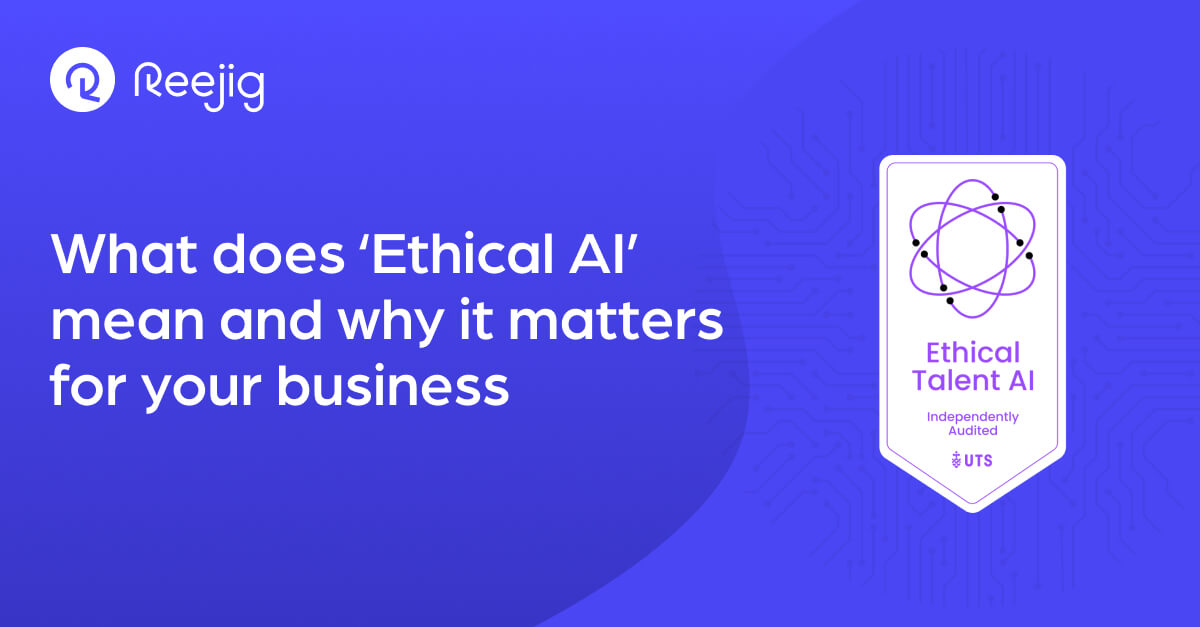
The result: we are the world's first independently audited Ethical AI engine. Certified by UTS. Setting a new benchmark in trust and ethics for our industry.

A practical checklist for implementing Ethical AI

Reejig practical checklist for implementing Ethical Talent AI with sample questions and planning guide.


Implementing AI into organizational design is not simple. Understanding what it's used for, how it's going to be used, and who will use it is critical. No matter what workforce strategy you're planning, there are ethical risks. Bias, privacy, and transparency are always at stake.

Use this checklist for your decision-making process. It will close the gaps in your understanding of ethical AI in practice. It gives you the confidence to have knowledgeable conversations. You determine trust in any system you evaluate.

The bigger ask and everyone's responsibility

Now is the time to go beyond current recommendations. We must remove a key barrier to AI adoption. We need governments to provide firm guidance on ethical issues. But business and the academic community must also play a part. An ethical approach to AI should be central to business operations. From workflow and customer feedback to building models and process engineering.

Ethical AI offers a huge opportunity to get ahead. Bias sneaks into decision-making when there isn't enough data. Taking AI ethics seriously leaves no room for bias. It ensures a stronger, more diverse workforce.

Dr Shujia Zhang
Dr Shujia Zhang

Dr Shujia Zhang

Co-founder & Chief Technology & AI Officer at Reejig

Talk to a Work Strategist

See how the Work OS runs AI-powered work.

Subscribe to our newsletter

Learn how the world’s largest enterprises are rebuilding work for the AI era.