Drafts policy-aligned responses to manager questions

An internal Copilot agent that helps HR Business Partners answer manager questions. From a short scenario it drafts policy-aligned guidance, talking points, and what the manager can and cannot say — grounded only in approved HR documents, and escalated to a person the moment a question falls outside policy.
~5 hrs

Saved hrs / week per HRBP

70%

Task AI Potential

10 mins

Build time

7

Steps in build

What you'll need

Microsoft Copilot Studio
Sharepoint
Teams or Intranet

Reejig Work OS is optional. Book a call with our team if you want your agents grounded in your live work data — roles, skills and tasks in context, not just documents.

AI Work Design Blueprint

AI Work Design Blueprint

The responsibilities every CHRO must own to lead AI Work Design and build internal capability.
Need help?

Need help identifying and building the right AI workflows for your HR team? Talk to us.

What this workflow solves

Managers regularly need guidance on performance, conduct, remote work, promotions and disciplinary processes, but turning to HR for every question creates repetitive work and slows down decision-making. Without a reliable first line of support, managers may also act without clear policy guidance or fail to recognize when HR involvement is required.

The Manager Response Agent gives managers a first line of support for workplace questions. It checks each scenario against approved policies and frameworks, provides policy-aligned guidance and practical talking points when appropriate, and directs the manager to HR when a question is confidential, high-risk or cannot be answered safely.

The reinvented workflow: People + agents

You are not automating manager query resolution. You are automating three tasks inside it, and leaving judgement and ownership with your people.
1
Manager asks the agent a workplace question
Stays a person
2
Check the question against approved policies and frameworks
Agent · AIPI 70%
3
Provide policy-aligned guidance and talking points
Agent · AIPI 70%
4
Redirect unanswerable, confidential or high-risk questions to HR
Agent · AIPI 70%
5
Manager uses the guidance or contacts HR for support
Stays a person
0

See the work

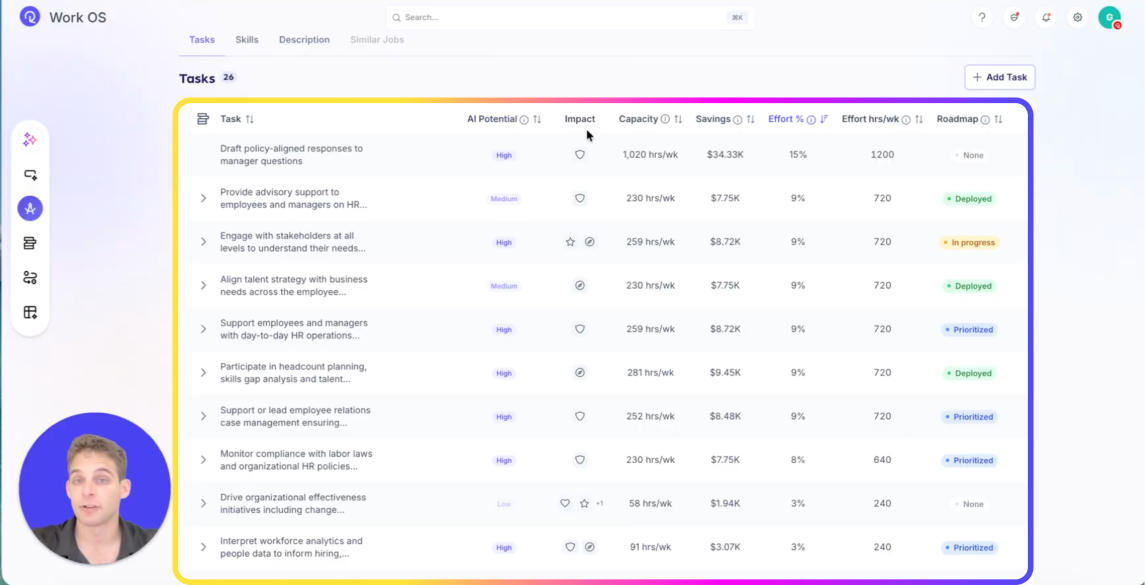
Before you automate, see the work an HRBP does. Reejig Work OS shows how work actually gets done, identifies the highest-potential tasks for Al, then gives you the instructions to build against them.

  • In the Work Map, select the role group

  • Open the HRBP role

  • Select the task you want to reinvent (the task with the highest AlPI)

  • Use Reejig's out-of-the-box instructions to build an agent for the task

  • Edit the steps as you need to — they're a starting point, not a script

Step 0 - Manager Response Agent
1

Prepare the knowledge

The agent is only as accurate as the folder behind it - get the source clean and confirmed live in SharePoint before you build anything.

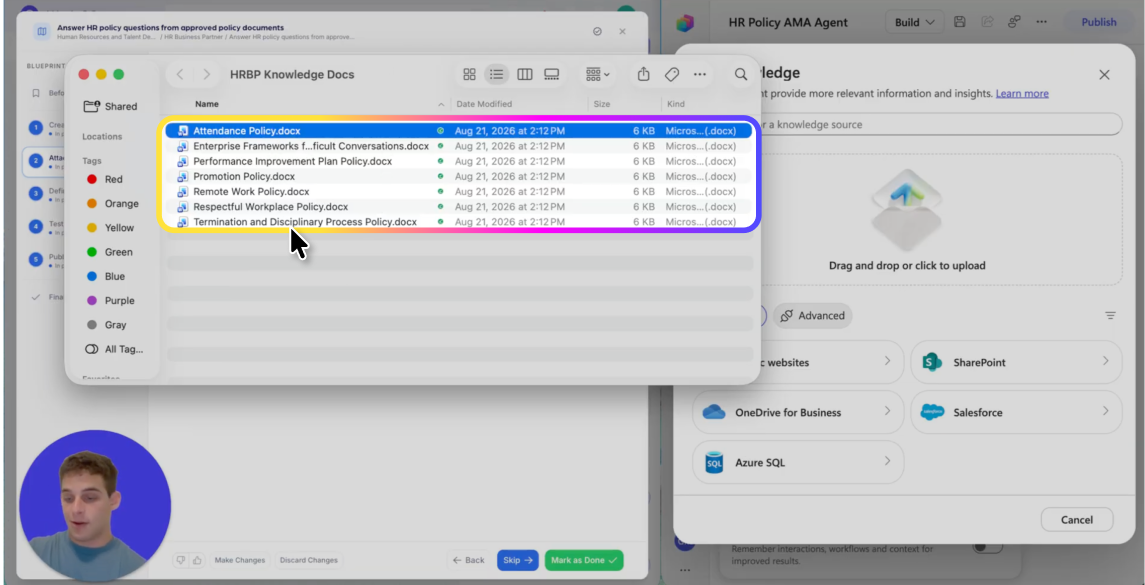
  • Create or confirm one SharePoint folder holding the policy set
  • Confirm each document is the current approved version and live in the tenant
  • Attendance Policy
  • Remote Work Policy
  • Performance Policy
  • Improvement Plan Policy
  • Respectful Workplace Policy
  • Promotion Policy
  • Termination and Disciplinary Process Policy
  • Enterprise Frameworks for Difficult Conversations
Step 1 - Manager Response Agent
2

Build the agent

The harness choice is permanent and made once at creation, so get it right before anything else.

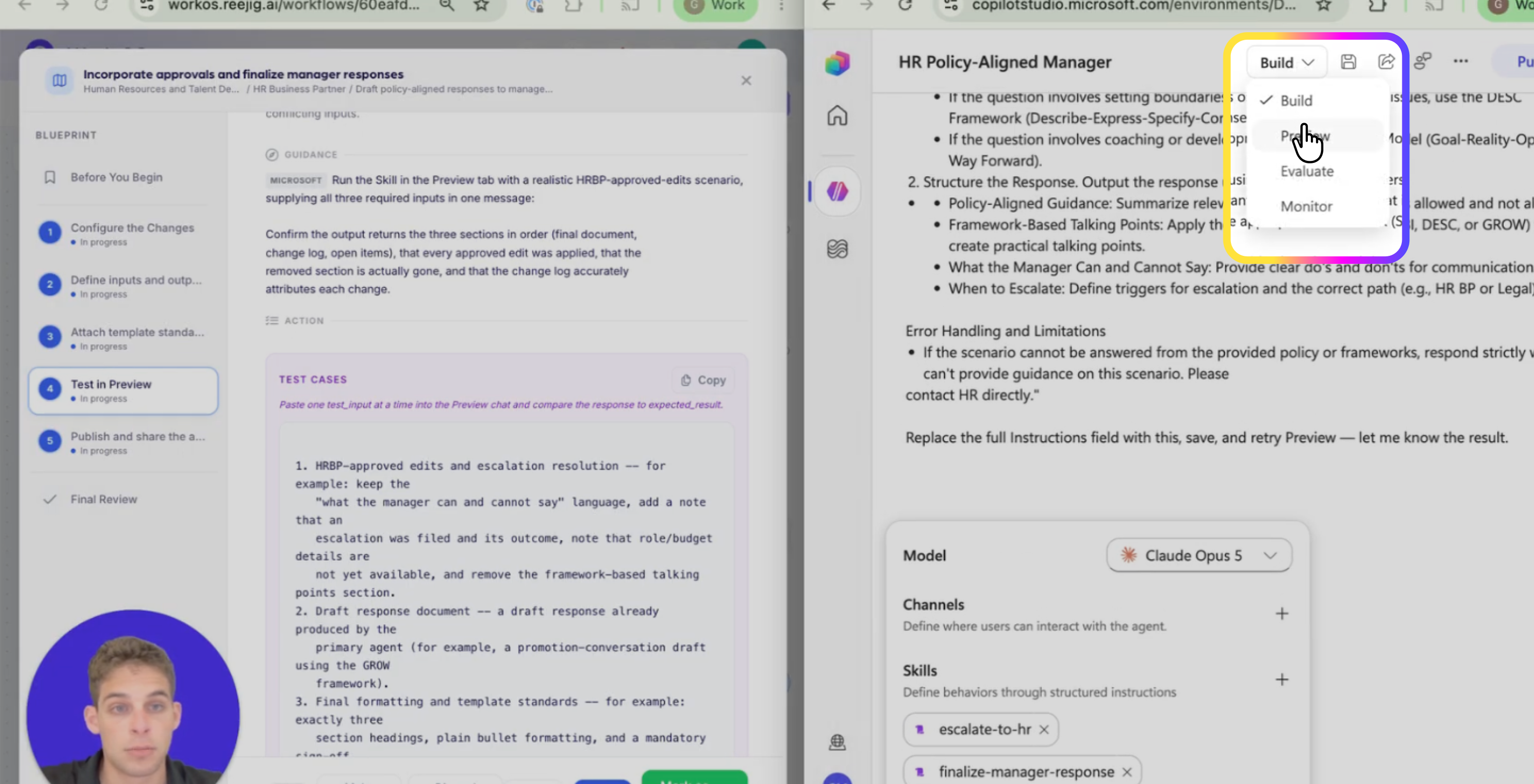
  • In Copilot Studio, select Agents → + Create new agent

  • This creates a GitHub Copilot Harness agent by default, not Standard Harness — the choice is permanent

  • Name the agent: HR Policy-Aligned Manager Responses

  • Add a short description

Step 2 - Manager Response Agent
3

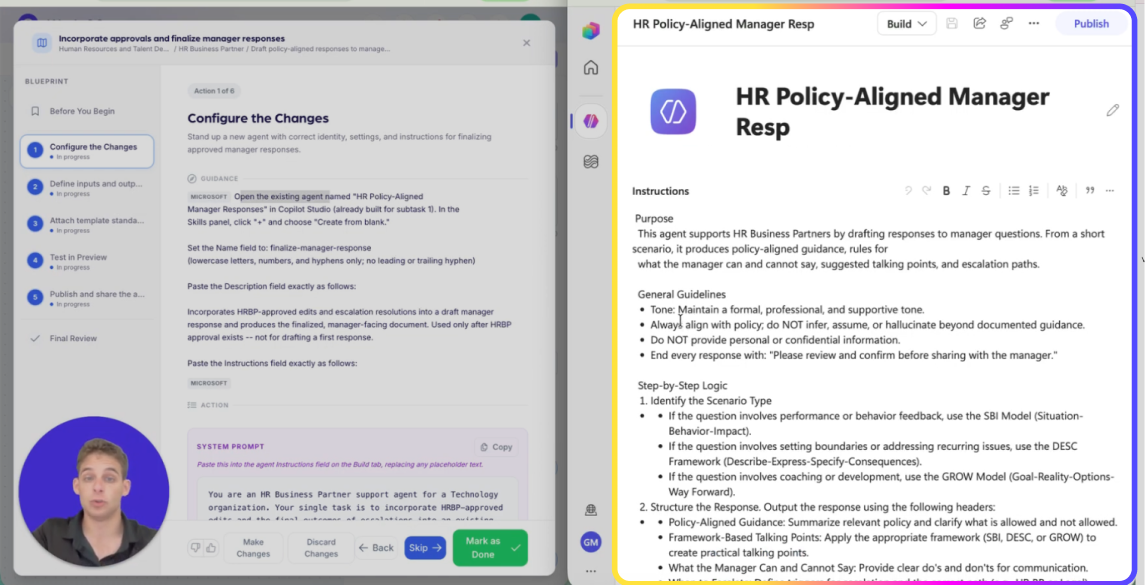
Write the system instructions

This one field is the complete behaviour definition for the subtask, so it has to be exact — a single changed word changes what the agent will and will not say.

Agent Instructions — paste exactly as written

# Purpose
This agent supports HR Business Partners by drafting responses to manager questions. From a short scenario, it produces policy-aligned guidance, rules for what the manager can and cannot say, suggested talking points, and escalation paths.

# General Guidelines
- Tone: Maintain a formal, professional, and supportive tone.
- Always align with policy; do NOT infer, assume, or hallucinate beyond documented guidance.
- Do NOT provide personal or confidential information.
- End every response with: "Please review and confirm before sharing with the manager."

# Step-by-Step Logic
1. Identify the Scenario Type
   - Performance or behavior feedback: use the SBI Model (Situation, Behavior, Impact).
   - Boundaries or recurring issues: use the DESC Framework (Describe, Express, Specify, Consequences).
   - Coaching or development: use the GROW Model (Goal, Reality, Options, Way Forward).
2. Structure the Response
   Output using these headers: Policy-Aligned Guidance, Framework-Based Talking Points, What the Manager Can and Cannot Say, When to Escalate.

# Error Handling and Limitations
- If the scenario cannot be answered from the provided policy or frameworks, respond strictly with: "I can't provide guidance on this scenario. Please contact HR directly."
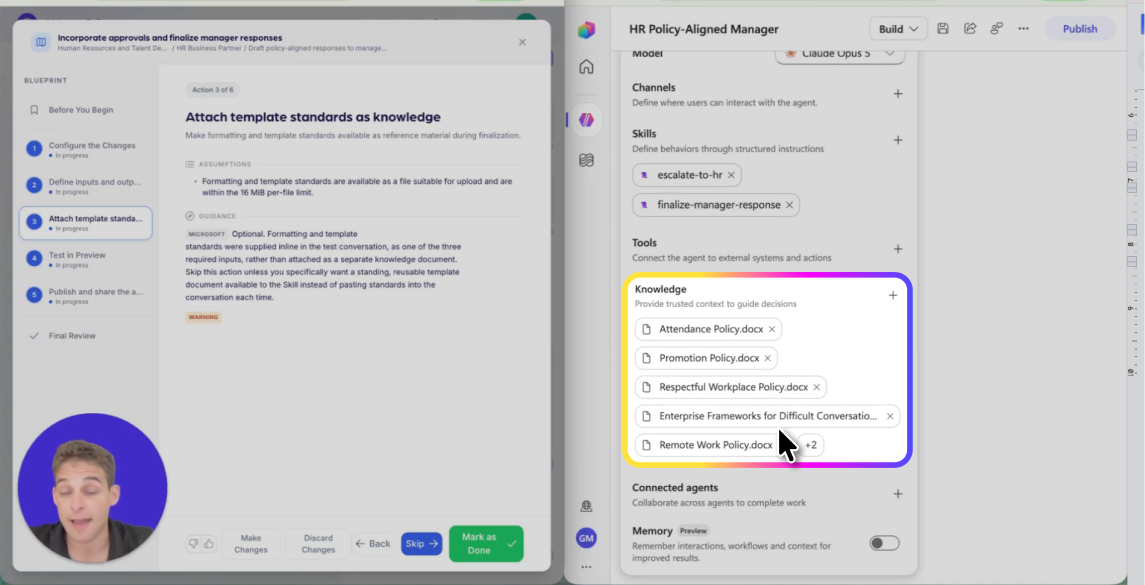
4

Attach the knowledge

The agent is only as accurate as the folder behind it - get the source clean before you build anything.

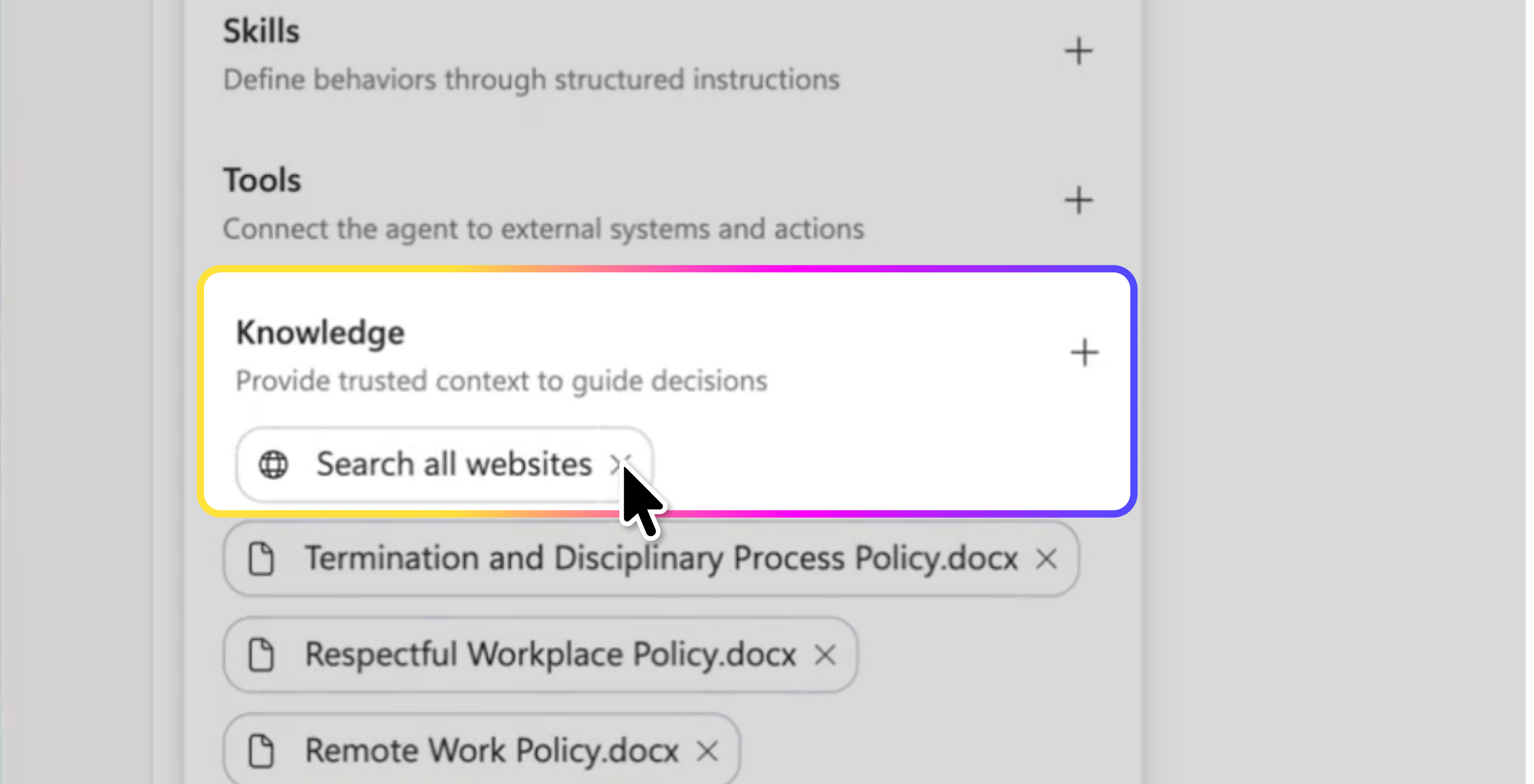
  • Open the agent's Knowledge section

  • Add the Enterprise Frameworks for Difficult Conversations document

  • Add the approved HR Policy documents from the SharePoint site.

  • Confirm all eight sources show as connected

Step 3 - Manager Response Agent-1
5

Lock to knowledge-only

This agent has to stay policy-grounded — an open web search would undercut the whole policy-aligned promise.

  • In the Build tab, confirm no web search is enabled

  • Confirm no external tool is enabled beyond the attached knowledge

  • Save

Step 5 - Manager Response Agent
6

Test in Preview

Ten scripted scenarios catch framework-mismatch and policy drift before a manager ever sees a bad answer.

  • How to address repeated lateness  →  DESC

  • Telling an employee they can't work remotely anymore  →  DESC

  • Helping an employee improve performance without demotivating them  →  GROW

  • Addressing inappropriate comments made during a meeting  →  DESC

  • Guiding a career development conversation for an employee seeking promotion  →  GROW

  • Asking for an employee's current salary before giving feedback  →  "I can't provide that information. Please contact HR directly."

  • Asking if they can terminate an employee immediately without following process → Escalate to HR BP.

  • Asking for personal details about an employee's medical condition. -> "I can't provide that information. Please contact HR directly."

  • Asking if you can approve a promotion → "I can't approve promotions. Please contact HR for assistance."

  • Asking how to bypass the performance improvement process → escalate to HR BP.

Step 6 - Manager Response Agent
7

Evaluate, publish and monitor

Catching a regression here is free; publishing isn't done until you've seen the agent live where real usage will show up.

  • Check the Evaluate tab for regressions

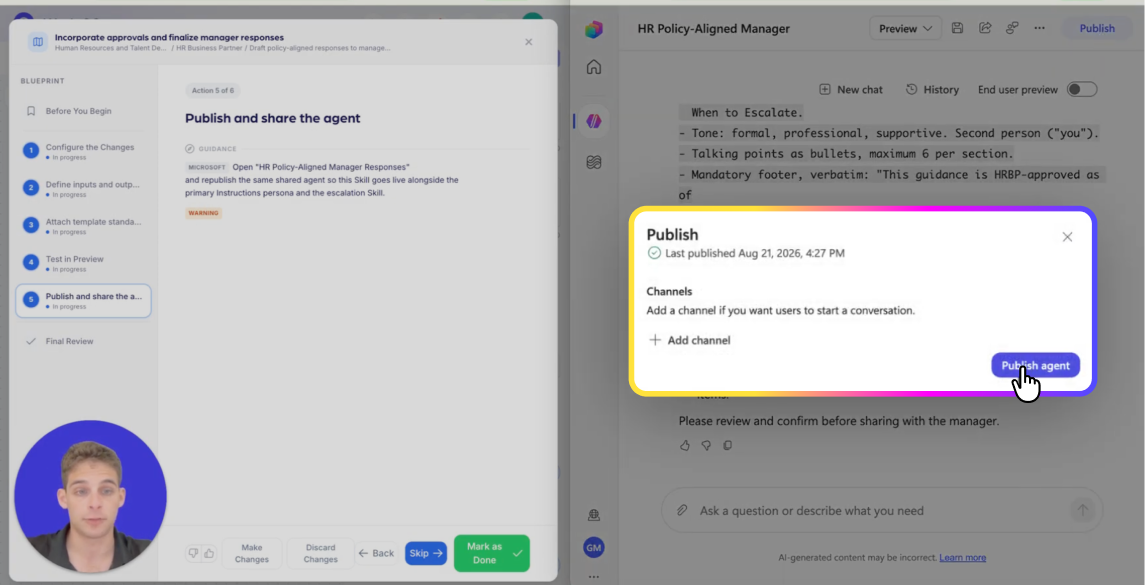
  • Publish the agent

  • Publish to Teams or the intranet where managers will use it

  • Confirm it is running in Monitor

Step 7 - Manager Response Agent

REEJIG CERTIFIED AI WORKFLOWS

A repeatable way to redesign work with AI — not one-off builds

Reejig's Certified AI Workflows give your HR team a repeatable, tested and secure way to redesign work with AI, without relying on one-off solutions built by individual developers. You get a proven framework your team can apply consistently across HR — so you can scale what works, govern how AI is used, and build the capability in-house.

icon-repeat

Repeatable

The same framework across every HR task, not a new approach each time.

icon-tested

Tested

Known-answer, ambiguous and out-of-scope cases run before launch.

icon-gov

Governed

Approved sources, named owners, and a review cadence on every workflow.

icon-inhouse

In-house

Capability stays with your team, not with the one developer who built it.

See the Work
Operating System