Jasmine Jaco: That's rough.
Siobhan Savage: Master, yep. She's got, like, a really bad chest infection, though, too.
Jasmine Jaco: Yeah, that's rough, I'm sorry to hear that.
Siobhan Savage: I know, she's okay, though, like, she's not, like, where we were last weekend, but she's still just… it must have just, like, smashed her completely, her immune.
Jasmine Jaco: Yeah.
Siobhan Savage: I didn't rea… I've never… I've seen her have bad ones, but never that bad before. this one was, like, too close to talk about, you know? But I just didn't realize that it would have such an impact on our body.
Jasmine Jaco: Right. Recovery.
Siobhan Savage: But also, we went to a really shitty hospital, because we went to the one, the closest one to us, in Times Square. You know, like, so it wouldn't have been, like, it wasn't the children's hospital, and it was, like, grubby as, like, it wasn't, like, super nice, so she could.
Jasmine Jaco: Right.
Siobhan Savage: Picked up bugs there, too.
Jasmine Jaco: Oh, for sure, yeah.
Siobhan Savage: Well, the emulence was, like, bring her to the… one that's, like, 2 minutes away, like, versus going to a kid's hospital.
Jasmine Jaco: Right.
Siobhan Savage: Oh, yeah, you are taking me over. Do you know what I'm really over? The grids. on our branding. Yeah. I'm over… I can't wait till we do our full rebrand? It's gonna be so cool.
Siobhan Savage: So just a heads up, there's a little delay on this in the livestream. As in, we signed delayed, or it's just, I say stuff, and then it comes out? Oh yeah, that's fine. They won't know, the audience won't know. Yeah. Should we just hit start and get in?
Siobhan Savage: Oh, it says we're on air already. But let's not start, start, and give people a few minutes to join. Yeah, we can just chit-chat about what I'm up to. Good.
Jasmine Jaco: There's nothing else we need to do to start, correct?
Siobhan Savage: No, you're good, you don't need to worry about anything. They're operating it in both different rooms. We look really pretty!
Jasmine Jaco: Well, you look great.
Siobhan Savage: We've just seen the prettiness of the two of us. Right. Today, I didn't even… usually they, Shayla organizes hair and makeup. But I did my own hair and makeup, because it actually makes… it actually takes, like, an hour and a half to get hair and makeup done. I don't have time for that.
Siobhan Savage: So are we live now? Just hit go live. Alright. Hey Jasmine, how's it going?
Jasmine Jaco: It's going well! How are you, Siobhan?
Siobhan Savage: That is a very familiar office that you're sitting in, and those babies, they look like my babies.
Jasmine Jaco: They, they might just be.
Siobhan Savage: I love it, I love it. Hey folks, welcome! Jasmine is currently dialed in from my office in New York, and I am dialed in from our studio, where I'm doing a whole pile of education and recording, so the backgrounds are all looking a bit different for me, but it's good to see my little babies in the background. I love it.
Siobhan Savage: How has your week been, Jasmine, being in New York with all of our customers?
Jasmine Jaco: It's been great, being here in the city with, with the team and our customers live. It's been, jam-packed. A great kind of busy.
Siobhan Savage: We're 2 minutes early, just so you know. Like, we're actually, like, ahead of schedule, because it doesn't actually kick off until 1 o'clock.
Jasmine Jaco: We're just so excited to have.
Siobhan Savage: I know. Very punctual. I was nearly… New York traffic being as horrific as it was. We had a really important meeting, as you know, yesterday, with one of our… one of our soon-to-be customers, and the 20-minute cab ride turned into an hour and a half or something. So I… I do not want to be late for anything.
Jasmine Jaco: So here we are, early, ready to go.
Siobhan Savage: it's really cool, I'm down in, like, Midtown or downtown in, like, a huge studio, doing recording today. Like, last weekend, I recorded the HR Business Partner course.
Siobhan Savage: So, from HR Business Partner to Workforce Advisor, and today I am doing the workflow design and work designer course. And tomorrow, I'm doing the CHRO course, and on Sunday, I'm doing the tokens…
Siobhan Savage: Economics course as well, so we are cranking out the education for everybody.
Jasmine Jaco: Indeed.
Siobhan Savage: No rest for the wicked, they say. So we are on 1 o'clock, so we should start to see folks joining live.
Siobhan Savage: For those who are dialing in, super exciting! Happy Friday! Do you know that today is Friday the 13th?
Jasmine Jaco: I did not.
Siobhan Savage: And this is the first time that we're testing a LIVE stream on… I was about to say TikTok, but we're not on TikTok, we're on LinkedIn. When you joined Reejig, did you think that you would be made to do so much social media?
Jasmine Jaco: I did not. Siobhan, I was just texting my husband that. This is fun.
Siobhan Savage: She's making me do it again!
Jasmine Jaco: Pretty much.
Siobhan Savage: I had to go live again today. I love it.
Siobhan Savage: So today, we're gonna get really kind of focused on the new, sort of, like, moment that's happening in the market. So, I don't think I've ever seen a more exciting, sort of, period in my career, anyway, where there is just this once-in-a-generation change that's happening to work.
Siobhan Savage: And when I think about the opportunity that is for, you know, folks like us, With our backgrounds.
Siobhan Savage: you know, AI work design is becoming the most exciting thing I have seen. I mean, I seen, GE Aerospace yesterday posted, like, the roles that they're building out their team, and I was sharing it with a lot of my folks in my network, and Jasmine, I was saying, like, if I wasn't doing what I was doing, I would be applying for that, you know? Just in terms of, like.
Jasmine Jaco: 100%.
Siobhan Savage: The exciting opportunity that is existing in market. So today we're gonna focus on really bringing to life, like, what we're seeing in market. Like, guys, anyone who's dialing in knows we love to share what we're learning.
Siobhan Savage: everyone is inventing this while jumping off the cliff and building at the same time. So, like, I've committed to everyone in my network to try and share as much of it. It won't be perfect, it'll probably keep evolving, but what we're committed to doing is just sharing as we learn. So today, we're going to focus on really driving out what we're learning in terms of the team and the capability required for this.
Siobhan Savage: What are the rules and things that we're seeing that are needed for this moment?
Siobhan Savage: And really, like, what… when you're thinking about structuring your team, or if you're a career professional thinking about your next move, like, what are the things that you need to be thinking about, and how do we structure this going forward? So, a lot of what we're going to do is kind of give you some slides, but most of this will be conversational, so just let us know, you know, any questions, put them in the chat. If you want to sort of, like, bring it in a different direction, you can, you know, we'll try and respond
Siobhan Savage: As much as we can to all of the questions that's coming through as well. So the first thing we're gonna do is I'm going to show you a couple of slides, but before I do that, Jasmine, we kind of got stuck into this pretty quickly. Would love to, you know, for you to give a quick introduction of, you know, who you are, your background, and how you fit into the whole picture at Reejig.
Jasmine Jaco: Wonderful. Thanks, Siobhan, and hello, everyone. Jasmine Jaco, so I lead AI work design here at Reejig. But I came to Reejig, actually, as a customer. So just prior to this role, I was at Boston Scientific, where I led, organization transformation and HR strategy, very focused on, you know, AI-driven, work and organization design. And then prior to that.
Jasmine Jaco: I actually spent most of my career in management consulting, leading big, you know, global, complex transformations, functional, digital, you name it.
Jasmine Jaco: But certainly over the last few years, very focused on the impact of AI on the organization, on employees, and on the workforce. So, it's, it's kind of been interesting to be in three different places, from a consulting perspective, doing the work in industry, and now, with a platform like Reejig. So, excited to, you know, excited for this conversation, and super happy to be here.
Siobhan Savage: No, I love it, and that was the reason why I was so excited to have you in the team, because, like, just like you said, you have both, like, strategic advisory at the Accenture level, then you have, you know, the practical, live, doing it in the trenches in real life, and then, you know, I get to work at Reejig, where we've got a different, sort of.
Siobhan Savage: Like, approach to it, but also, like… Getting to work with the best customers in the world, which is why I love my job. And one of the things that I think is going to be really interesting is, like, you know, you've got Jasmine's background mostly deep in the business side, and then my background is workforce optimization, workforce strategy.
Siobhan Savage: And also I've built an AI company. So, I sit right in this, like, sweet spot of optimization, strategy, but also, like, I've actually built AI, not, like, talked about it. So, a lot of you're gonna get from the both of us is, like, really different expertise set as well. So, what we're gonna do first is we're gonna kick into, what we're really seeing play out in market.
Siobhan Savage: So, I'm just gonna, like, share, like, a quick, slide, just so that people can visualize it. This is not gonna be, to be clear, like, me showing slides. This is really gonna be focused on, like, getting you a picture of what I'm saying. So, I am seeing this massive, massive moment playing out in market.
Siobhan Savage: In one side, you have, you know, everyone is being driven towards AI, but what's actually happened is a lot of that AI is not, like, really getting to P&L value. And the reason that everyone is starting to see this play out is because, actually, you have to redesign the work.
Siobhan Savage: for the AI. Now, I think, you know, we've all been kind of, like, hurtling towards AI, and we haven't, like, slowed down a second to think this through, but we've now seen this collective view from our customers and from the market that in order to be successful, we gotta focus on, you know, redesigning work, making sure the reallocation of, you know, the value is unlocked back into the business.
Siobhan Savage: And actually, what this has done is it's created this moment where HR have this
Siobhan Savage: so exciting opportunity, where not only is it an opportunity, but they're actually needed. The technology side is more in the IT and the tech side, but actually majority of the problem comes down to that work. And we're sitting with teams, you know, in all of our customer bases, with all your companies, where we're really having this opportunity to step up.
Siobhan Savage: and drive this new motion around AI work design. Now, one of the things that we've seen is, you know, we've all been kind of, as I said, hurtling towards AI. We've got consultants in, we are doing patches and pilots.
Siobhan Savage: But what that is coming out as is, like, think of it as a bridge, not the destination. The destination will be that you are doing this forever, this is not a one-time change to work, and you're also building in the full-time capability to do this ongoing. And that is why this conversation is so exciting, because this is a moment where everyone on this livestream right now, and everyone that listens to it after, this is a career moment and a career opportunity.
Siobhan Savage: Like, if I wasn't building Reejig, I would 100% be pushing for Chief Workforce Officer role, you know, VP of AI work design. That would be where my career would be going, because it's going to be the hottest career moment of 2027.
Siobhan Savage: What we're also seeing, as well, is the CHRO role is starting to change, Jasmine. So, when we look at traditional, like, chief people officer, CHRO, we're typically talking about, like, people in jobs. What we now have is, like, people, agents, and work.
Siobhan Savage: And what's happening now is the CHR role needs to evolve broader than just being human resources. And by the way, I hate that title, I think it's horrible. We need to find a rebranding moment where it doesn't sound like resources… it just, I don't know, there's something weird for me that it just doesn't feel right. But what we're seeing now is this, like, emerging, sort of, you know, HR leader that's coming through, which is actually kind of being rebranded into this chief workforce
Siobhan Savage: Force Officer, which is people and agents. And you're seeing a couple of, sort of, core moments that are playing out, in terms of, like, the responsibilities with underneath that chief workforce officer. So, they need to make sure that they understand the work, they need to understand who their people are and what their agents are, and the cost of both.
Siobhan Savage: We need to ensure that we know how to design a bold. And responsible workforce strategy, so we want to make sure that we can boldly reinvent, while also making sure that we don't leave our people behind.
Siobhan Savage: And that means that we have to learn how to do work redesign, we need to build a new architecture, so the job architecture is like the dinosaur days. We now are in a world where we're looking at work architecture, which is task, subtask, skill, all connected to how our company is wired.
Siobhan Savage: And then we need to understand how to partner better with IT on building out these agents.
Siobhan Savage: Think of agents as a capability. So if you've got Microsoft Copilot in your organization, that studio, or Scout, or, you know, co-work, that can be built and designed to do many, many, many different things and capabilities. So imagine you can build an agent factory within your organization.
Siobhan Savage: To design that capability already in your org? And then looking at that total workforce. Then you need to think about your people. So, when you go and redesign work, and when you do success of building in, you know, new workflows with agents, what you're gonna find is you are going to impact your people and your jobs.
Siobhan Savage: So every time you deploy a new workflow, you're going to remove a task, but you're also going to introduce a task that you haven't done before. That means that you're going to impact your skills, you're going to have to think about, you know, transitioning and pivoting and reskilling, so this is all super important.
Siobhan Savage: And then the final thing that we're seeing as well is that the CHRO is now requested continuously to inform the board. Boards are focused on risk, right? And risk can come in a couple of different areas. They care about, like, the company rapidly moving towards AI and spending and changing without seeing the ROI.
Siobhan Savage: But they also care about reputational risk. They care about the impact to workforce, the social responsibility on making sure that, you know, they're not impacting their people in a way that could cause harm to the organization, and making sure that all of this transformation is sort of being driven in a governed way. So this is why the CHRO rule, the Chief Workforce Officer rule, is really starting to change. I mean, Jasmine, would love to get your take
Siobhan Savage: On what you've seen, but this is kind of what we've seen across, you know, 70-plus major enterprises, plus what we see out on the market as well.
Jasmine Jaco: Absolutely, Siobhan. I think I've seen the same, again, from a consulting perspective, as well as at Boston Scientific. I mean, I think you've summarized well, really, these four key aspects around having to get visibility to work down at the subtask level, where AI, you know, plays, that, you know, few organizations have had, until now. Really understanding the importance of redesigning work
Jasmine Jaco: not just building agents and layering it on top of the way that work gets done today. That was a… that was actually one of the biggest challenges that we had at Boston Scientific, starting at the executive leadership level, is to really help everyone understand that the reason we're not seeing that P&L return that you mentioned earlier is because work wasn't changing, right? You've got to actually, you know, good tools free up capacity, but that capacity isn't value until you redesign work in such a way that
Jasmine Jaco: into value, whether you're trying to grow revenue, reduce cost, etc. So just can't emphasize enough the importance of that, and then, to your point, bringing people with you. People are the biggest part of this equation. It's not really about the tech, it's about the people. And then measuring, you know, return. All of this should be… enable you to drive more return, so… Spot on.
Siobhan Savage: When you were building out your team, and, you know, the work that you've seen across, you know, the Reejig customers, like, what are the core, kind of, core capabilities that you're seeing are needed for this moment?
Jasmine Jaco: Well, I think you're about to get into it here, which I agree with. I mean, you've got the work architecture, which is the evolution, as you mentioned, of job architecture into really getting visibility to work and how work runs in the organization, and somebody's got to own that new work architecture. Work design, I just mentioned, is absolutely critical to actually starting to see some real value and hard P&L return on your AI and
Jasmine Jaco: investments, and that's a very new space, you know, work design. So really being able to build that capability internally is going to be important, and I think you'll get into, like, what is a work designer, a builder? That relationship with the business is critical, making sure that you've got engaged business leadership and sponsorship, and that you've got involvement from the employees, from the subject matter experts who actually do the work every day as you reimagine it.
Jasmine Jaco: And then workforce design, you know, really understanding the implications of all of this changing work on people.
Jasmine Jaco: In terms of, you know, what skills are emerging and declining, and how do you… how do you dynamically feed that into all of your people systems from, you know, the way you hire to the way you develop and the way you deploy, and move resources around the organization?
Siobhan Savage: And it depends, like, whether you're a huge organization or whether you're a smaller organization, these are technically capabilities, we're not saying these are jobs. You could actually be someone like me and could do all of these things.
Siobhan Savage: Or you could do one area of them, like, it really just depends, but the core capabilities are what's required. You know, like, understanding to make sure you've got a structured way of doing, you know, and understanding a new architecture for work.
Siobhan Savage: AI work design, so workflow design, building agents, and then what's the impact to our workforce, and how do we deal with that? And we see a lot of… if you can see all these titles in here, this is where, like, we start to cluster teams in there as well. And that's starting to be… you're starting to see, like, folks go out to market for this now. You know, Reejig, as you know, has been talking about this for a very long time. We've been right at the forefront of designing this new world.
Siobhan Savage: I'm so passionate about everything I do. Like, I'm even live in a content studio right now, building all the courses for all of this, because we're so passionate about making sure this capability exists. To be clear, Jasmine, this doesn't exist right now. We're relying on externals.
Siobhan Savage: to come in and do it for our company, and it's costing us a lot of money, and we need to have the capability ourselves to do this forever. So this is why, like, you know, folks that are listening in, like, this is the most exciting moment, career-wise, to get into this moment before it's a real thing, because next year it's gonna be really big.
Siobhan Savage: When we see this play out, Jasmine, like, give us, like, a little bit of context on, like, the different models, because I talked about the big companies with all the money, and the smaller companies, like, how do you typically see them? What were you doing at Boston?
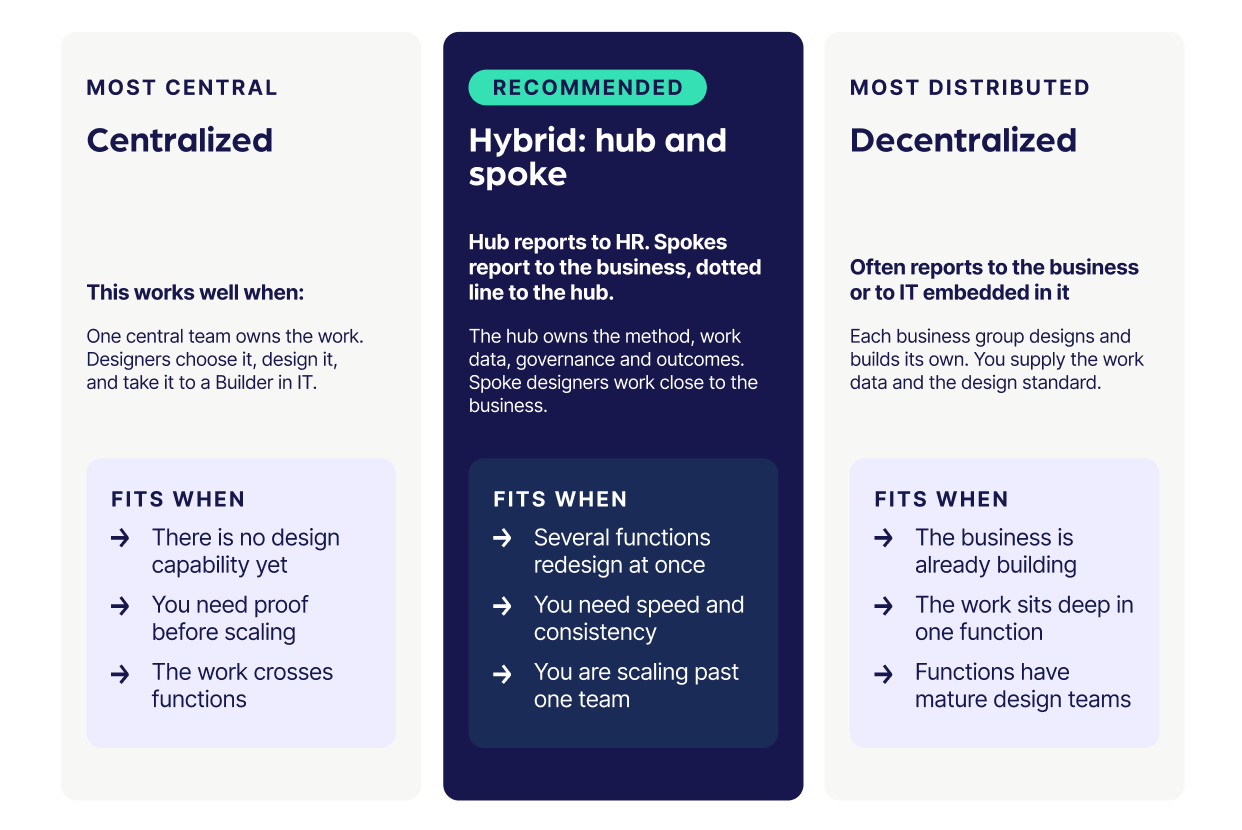
Jasmine Jaco: Sure thing. I'm seeing it play out a few different ways, Siobhan. I think that, you know, a lot of organizations, when this is a brand new capability, are building centralized teams of people who know how to do this work from a work design perspective, from a builder perspective, from a workforce transformation perspective. And that's a good way to start. I think that a lot of organizations, though, are
Jasmine Jaco: finding that that's not really scalable. Most organizations aren't in a position where they can hire 50 people. You know, and by the way, there's not a lot of people who know how to do this work and have done this work before. So it's one way to get started, and I'm certainly seeing that. I think another way that you see on the far right here is through decentralized teams. So either, you know, if the business is already moving and can't wait for
Jasmine Jaco: an organization to build a centralized team. They're just putting teams in place, you know, within their own organization, or it can be part of a distributed IT team, you know, across the business, but these are decentralized groups where the business wants to move fast, and they put people in place to do it. The problem with that is, first of all, you need connected intelligence, so a platform like Reejig that sees how all of the work is changing across the organization and feeds your core system
Jasmine Jaco: with that. But also, you know, you need to be aligned. You want to make sure you're not duplicating your investments. You're not building solutions and agents in one part of the organization that could also be leveraged in another, but there's no visibility there. So there's some challenges with that model, and I think, you know, what we did at Boston, which is what I recommend for a lot of organizations, is taking a hybrid approach. So I call it a hub-and-spoke model, where you've got a small, centralized team, the hub.
Jasmine Jaco: who are very, you know, deeply experienced in doing this work, both from a work design perspective, an agent-building perspective, that can guide, really set the playbook, the methodology, really guide how this work is done, and has visibility to all the work that's happening across the organization. And then you have spokes, which are typically teams that roll up to the business or, again, to IT that's embedded in the business.
Jasmine Jaco: That are… that are doing the work on the ground, but that have this kind of central team to… for… for support and for kind of guardrails.
Jasmine Jaco: And advisory and recommendations. And then we at Boston set a tiered service delivery model to make sure we were putting the right resources against the right initiatives. And by that, I mean at the top tier, those really big enterprise bets that you're making, you know, three, your top three or five programs, that's where the central team of real experts are deployed directly to helping, you know, deliver that work.
Jasmine Jaco: A middle tier would be big transformations like functional, you know, HR or finance or IT transformations that don't quite make it to that level, but that central team is providing more kind of internal consulting or advisory support to those spoke teams. And then finally, more of a self-service model, where as you build this capability in the organization, you know, you are building… you're providing methodology, you're building skills, and you're giving teams an AI
Jasmine Jaco: platform like Reejig to enable this work.
Siobhan Savage: Yeah, and I think the thing that I've seen to be really common now is that everyone's at the point where they realize that, one, they need a new architecture for how work runs, and that has to feed both the AI work redesign
Siobhan Savage: and also the workforce design. Because if you think about it, right? If you go out and you reinvent how work happens within the business, and we don't know how the work is changing, so as you know, every time you bring in a new workflow, you remove tasks and subtasks, but you introduce new work that you haven't done before.
Siobhan Savage: What you'll typically find is that if the HR folks in this team aren't connected to that work, everything downstream is wrong.
Siobhan Savage: So you don't know how it's impacted your architecture, work days out of date, you don't know what the impacts will be to your workforce, so making sure that you have, like, one architecture that feeds both your AI work redesign as well as your workforce design, that is super important. And we had, Pioneers Club on Monday, which is where we bring all of our top customers together.
Siobhan Savage: And what we find is that, you know, 6 months ago, we weren't really talking about workforce design. Like, the market has, like, moved so fast. When you think about it, like, 3 plus years ago, you know, we built out, you know, task intelligence, which had AI potential.
Siobhan Savage: And I spent, like, 2 years telling everybody that they needed to do that, and then we got to the point where everyone was like, yes, we need that. But, like, you need that, like, at the beginning, but what happens really quickly is the market moves really fast into, okay, cool, you've just told me the potential of opportunity in my org, now I gotta reinvent this work, and that's where you're then into, now our customers are deep into, like, process, workflow reinvention, but the third part of the puzzle, which is now becoming
Siobhan Savage: really, you know, rapid, is we're now starting to see workforce reinvention. So because I've done, you know, this change in the business, what does that mean to our workforce? And what is the transitions? What is the reskilling? And you know who's playing a really cool role in this moment? The HR business partner.
Siobhan Savage: So, they have really, like, I completely underestimated… you know, in my mind, when I was designing Reejig, I thought it was, like, a centralized team. That would drive this.
Siobhan Savage: But actually, what's happening in all of our customers is that you've got the HR business partner, or the activation layer, and because they know the business, they know the context, they have the relationships, they know what's happening, and they're using Reejig at the front to really kind of advise, and I would say they're more workforce advisors than talent advisors or HR business partners. So they're, like, up as a workforce advisor, and then what they're doing is triaging and funneling back into this, like.
Siobhan Savage: kind of centralized AI work design team. And that AI work design team is kind of like your hub-and-spoke, what you were discussing, which is, you know, work design, workforce design, and then they work alongside, whether it's the business or IT, to reinvent the workflows itself. That's what's seeming to play out in market. Now, my prediction for what's going to be 2027 is we're now going to have the next wave, which is everyone
Siobhan Savage: has been freaking out about, you know, AI ROI, that hasn't even touched the surface yet. Because if you look at… there was a study by Gallup, under 10% of employees in enterprise companies are even using AI. Which means, like, we're not even… and even those 10% that are using it.
Siobhan Savage: They're not even using it properly, they're using it like a glorified Google, right? They're just chatting to it like a, you know, searching things, right? Actual, pure use of AI will be workflow-enabled AI. And what I think we're gonna hit a wall pretty quickly on is
Siobhan Savage: the business, the CEOs, the CFOs, I start to get a lot more calls from CFOs, as you know, because they're starting to say, hey, we've, like, deployed all of this, where's the value, where's the ROI?
Siobhan Savage: And I feel like we're gonna start to see that being a big question, and one of the biggest blockers that we're seeing in that moment is employees adopting the new workflow. And that's where, like, I truly think that we've gone from, I know my work, I know where to go after in terms of opportunity.
Siobhan Savage: I can now reinvent workflows. I need to measure the ROI, but actually I need to get my people to adopt this new way of working. So this is where, like, imagine this is why this operating model is so important. You know, the HR folks have actually the most beautiful touchpoints within the business.
Siobhan Savage: who are able to help both on the work design as well as that workforce design. I mean, Jasmine, I don't know, like, I get pretty excited about, you know, this moment, but I also see that sort of ROI component and the adoption part being our biggest thing for 27. What's your thinking?
Jasmine Jaco: Absolutely, and that's, you know, I started with the comments around, value, because that was actually the entry point when I was at Boston Scientific for starting to build… it was the business case for building this capability internally, right? Is that our invested token costs are going up.
Jasmine Jaco: Right? Our AI investments were going up, and yet our executive leaders weren't seeing really material return, like, hard, real P&L return. And… and so the pitch was easy. Redesign the work, and then we'll see the return. So absolutely, I think more and more organizations are gonna start to feel the cost pressure.
Jasmine Jaco: Of, you know, their AI investments, and really be interested in figuring out how do we unlock more value, with those investments. So I think that's a big piece. And your comments around adoption, for sure. I think it's not just about driving adoption of AI tools. I think a lot of progress has been made there, but really helping employees understand that this isn't a one-time change, that, you know, our tools and agents are going to continue to evolve in their capabilities, and it's going to be an always-on.
Jasmine Jaco: change. So, you know, while you're, yes, drive adoption of the workflows and the agents, but also start to drive a culture of experimentation and growth mindset, right, where people appreciate and embrace. You know, what's gonna continue to evolve.
Siobhan Savage: Yeah, I love it. I feel like from a… from a team perspective, like, I was describing this yesterday, at a customer's office, and I was saying that, like, think of this moment for the employee like an Apple iPhone upgrade.
Siobhan Savage: If your people do not get used to the idea that work will continuously change, this is not a project with a start and an end. This is a forever change to work. And what you're gonna see is this forever change to work means you're gonna have to, like.
Siobhan Savage: slightly shift your culture expectations on your employees, because your folks need to get used to the idea that I'm gonna go and run out a new way of working for them, and by the way, in 3 months' time, when Copilot gets even better, I'm going to upgrade it and give it an even more evolved way of working. So there's this continuous, like, always-on, like, shifting of work.
Siobhan Savage: And I feel like that's one of the things from a, like, CHRO's perspective, or Chief Workforce Officer, even your HR business partners, where we gotta think about what is the… because it's not just change management. Change management feels like it's, like, a time-bound thing, whereas this is also… I call it more stealth change management. It's this ongoing, consistent, like, drumbeat in the company.
Siobhan Savage: And I'm pretty obsessed with that right now, because I'm trying to figure out, like, how do you get a company with 200,000 people to work in a new way every 3 months?
Siobhan Savage: Like, how do you do that? I can see a question in the chat, the HR business partner needs to be involved early in the process in developing this up front. Completely agree, Karen. Most business leaders are just looking at it through, not how to make work easier, but not thinking about the downstream impacts.
Siobhan Savage: I agree. Or the workforce implications. Completely agree with you, Karen. I think one of the things I see is that, not only are they not involved, they're having to clean up the mess. So, like, the problem is that most of my customers are heavily regulated, they have to notify any major changes to work.
Siobhan Savage: To whether it's their unions, etc. So, there is real-life consequences in many countries where, you know, HR business partners need to be actually involved, but also there is incredible HR business partners who already understand the business context.
Siobhan Savage: And what they should be doing is helping advise the business leaders to make good, fair decisions on what they do. Because we've seen with customers where they might go and reinvent one area without even thinking about the implications and ripple effects onto other teams.
Siobhan Savage: And they have no view of how that's gonna impact. So, Karen, completely agree. And folks, keep… if there's any questions, like, feel free, you know, to jump in. Like, anything that you're seeing, would happily, you know, walk through any of them. We're getting used to this whole TikTok live, LinkedIn Live streaming. It's a different platform for us. It's probably my more suited platform, because it's a little bit more chaotic. Whereas Jasmine, this is a little bit less structured for you.
Siobhan Savage: So feel free, if there's any questions, I do think as well, like, a lot of the things that I'm seeing, and there's a question in here from Jada, hopefully I've said that correctly, Jeda. from NetGap, joining in, a few miles from Boston Scientific, such a coincidence.
Siobhan Savage: Thanks for joining us, I love it. I mean, any kind of views from folks in terms of, like, in your org, some of the things that you're trying to figure out, you know, or even from you as a career professional, like, what do you want to do in this moment? Because I can tell you, I'm doing a lot of flying all over the world right now, activating
Siobhan Savage: HR Business Partners is actually where I'm spending a lot of my time, you know, rooms of, like, a couple hundred people in some of the biggest companies in the world, where I'm spending time, like, helping them rethink their jobs so that we can free up capacity from them.
Siobhan Savage: So that they can actually do more of this workforce advisory role. So that's kind of, like, one part of my job right now. And the second part of my job is, like, advising CFO, CIO, CHRO in this moment. So, we're happy to, like, any questions, just chuck them in the chat,
Siobhan Savage: And we can get you a sort of clear… as clear as we can answer to that. From a… from a learnings that we're seeing as well.
Siobhan Savage: I'll kind of give a couple of things that Jasmine and I have been talking about. So, the P&L thing is going to be a real thing, and that really doesn't sit with the HR team per se, but it is critical as part of work design. If you do not… if I tell you that you've got, you know, 2 hours a day that can be unlocked.
Siobhan Savage: In this, like, job, where you can free up, let's say paying an invoice, 100 people do it, and we could free up 2 hours a day. If you don't redesign where that time goes, what will happen is your employees, in all good intent, to be clear, will fill that up with other things that they think are really important for the company.
Siobhan Savage: And it's really important that you, one, acknowledge that and understand it, but then work with the business to then reallocate where that time goes. Because to Jasmine's point, if you don't reallocate where that time goes, what will then happen
Siobhan Savage: is you will actually find that you don't even get that value back. So, one of the things that's really important is to make sure that you're doing that allocation as well. We've also got another question. Karen, thanks for joining. Would like to hear your thoughts about how to position it as IT HR partnership for implementing this work.
Siobhan Savage: Met with IT leader to discuss the governance model and adding HR to it, so it is required to bring the CPO into the work. I mean, you've done a pretty cracking job of that, Jasmine, you know, partnering up. Why don't you give your take on that?
Jasmine Jaco: Happy to. I mean, I… Karen, I 100% agree. It's got to be a really strong partnership, all the way… going all the way to the top, so the way that this work is governed, you've got to have your, you know, AI technology and data teams
Jasmine Jaco: on board, you've got to have HR leadership on board, you've got to have business, leadership on board. So when we structured in that hub-and-spoke model that I mentioned earlier, that it was cross-functional at the top, from a governance perspective, all the way down to those spoke, you know, those spoke teams across the business, making sure that we had all of the representation from all of those areas, the business, HR, IT,
Jasmine Jaco: Because that's required to do this work. I mean, we've got to have the builders sitting alongside the team that's redesigning work and helping drive enablement and manage change around that work. We've got to have the right people in those teams, and HRBPs often play this role, even in the design process, before you get to downstream workforce implications around, you know, what should stay human and why. Just because you can AI
Jasmine Jaco: augment or automate something doesn't mean you should, especially if it's going to erode your early career talent, for example. There's a lot of reasons to think through, beyond AI potential, you know, what… where you should be employing, you know, this new kind of technology and data. So, couldn't agree more, and I think it's got to be reflected down on the ground, in your teams, this cross-functional partnership, working in parallel, not just handing off
Jasmine Jaco: To each other, all the way up to the top, in terms of how you're governing the work.
Siobhan Savage: Yeah. And I see another question as well. I wonder in bigger organizations, which are more prone to be siloed? How do you really understand the thousands and thousands of workflows to ultimately redesign them in the way that incorporates downstream effects?
Siobhan Savage: I mean, I've spent a lot of time… so when we built out Reejig's work architecture… so, let me step back for 2 seconds. There's kind of two parts to how you need to understand, like, context of an organization and how work runs. One, you need to have a structured understanding of the company itself.
Siobhan Savage: Think of it as, like, your work architecture, your anchor, and then when on top of that, you want to know the tasks, the subtasks, the workflows. Now, in a context graph, you're going to see two things. You're going to see that structure of the, like, actual architecture, but then everything correlates, so you may have a process that runs across several jobs, you have jobs that sit…
Siobhan Savage: There's, like, the angles and the different flows of this work is really important. What Reejig does is we basically give you a full view of what is all the work that's happening in your company, and then what we are telling you is, based on each industry that we see.
Siobhan Savage: what is actually the sort of tasks and subtext that happen, and what are the workflows and processes that we typically recommend? So we're gonna get you to 80% accurate out of the box.
Siobhan Savage: And then when you're doing your prioritization, that's when you'll know, like, where to actually go and put your energy in, and then you just, like, have… as an SME or an end user, they're gonna come in and correct Reejig, or recapture that context from the customer.
Siobhan Savage: So, we're able to capture 80% of your org without even, like, watching anything. And then you… people, really interestingly, I've learned in building the product, if I give you, like, a blank page. That's gonna be very challenging for you. But you see if I tell you, hey, Jada, this is how I think, you know, you do this task.
Siobhan Savage: you're gonna correct me in seconds. It's gonna be very, very easy for you to really, like, get that view. So, really what you want to do is actually start from an out-of-the-box model, and then improve it, and train it on your context. Rather than going and, like, trying to map all those workflows yourself.
Siobhan Savage: Hey, Kara, so good to see you! How do you find… how do you, or how have you… if I can read, how do you, or have… how have you seen orgs find the balance between understanding the current ways of working to redesign with AI, so optimize existing types of approach, versus a more full, holistic reimagination of a function?
Siobhan Savage: more of a future-fit version of work-backward type approach. I don't know, Jasmine, you want to take a crack at that one?
Jasmine Jaco: Sure, I think it's, it's an and, if I'm understanding the question correctly. I think, we often get asked, you know, should we start in a bottoms-up way, at the kind of role and task level redesigning work, or should we start, you know, more top-down with, end-to-end cross-functional processes?
Jasmine Jaco: And I think it's an and, is what I'm basically seeing play out. I think, you know, going top-down with really, cross-functional, complex, end-to-end processes is harder. It's more complex, but I think, you know, you prioritize the few parts of your business where it's worth that investment, and you do that. Meanwhile, across the broader enterprise, you're working in a bottoms-up.
Jasmine Jaco: kind of task level, redesigning how work gets done, because you can move faster, you can measure real return, in addition to that value that you're going to get out of it, you're bringing leaders and employees along with you in that bottoms-up kind of, approach, where they start to see how this works, they see the value of it, they get more and more bought in, so when they are participating in one of those bigger, more complex, top-down.
Jasmine Jaco: you know, process-driven transformations, they're engaged, right? They understand the value. So I think there's, I think there's a lot of value in taking both approaches.
Siobhan Savage: Yeah, and I do think, like, one of the things I've seen is customers have started on a couple of big bets.
Siobhan Savage: But you're gonna have to, like, do this forever, so you want to have your big bets, and then you're always on, ever-growing work that you want to look at both. So I agree with you, Jasmine, that it's a little bit of both. We're gonna wrap up soon, so if there's any other questions, folks, like, please do, like, put it in the chat. Couple of things I just want to kind of give you context on before… before we wrap, and make sure we haven't missed anyone's question. So, one, we're going to share with you this operating model that we're seeing play
Siobhan Savage: AI, so as you think about building your teams. Think about the capability that you're going to have to build into them. We also have at Reejig a whole pile of courses that we've built to teach you everything that we are learning, so everything from the HR Business Partner course to the Work Architecture course. I'm currently in studio right now recording the work design course, and also the CHRO course.
Siobhan Savage: So there's lots and lots of, like, learning that we're trying to give to everybody to make sure that they know what's happening, because it's moving so quick.
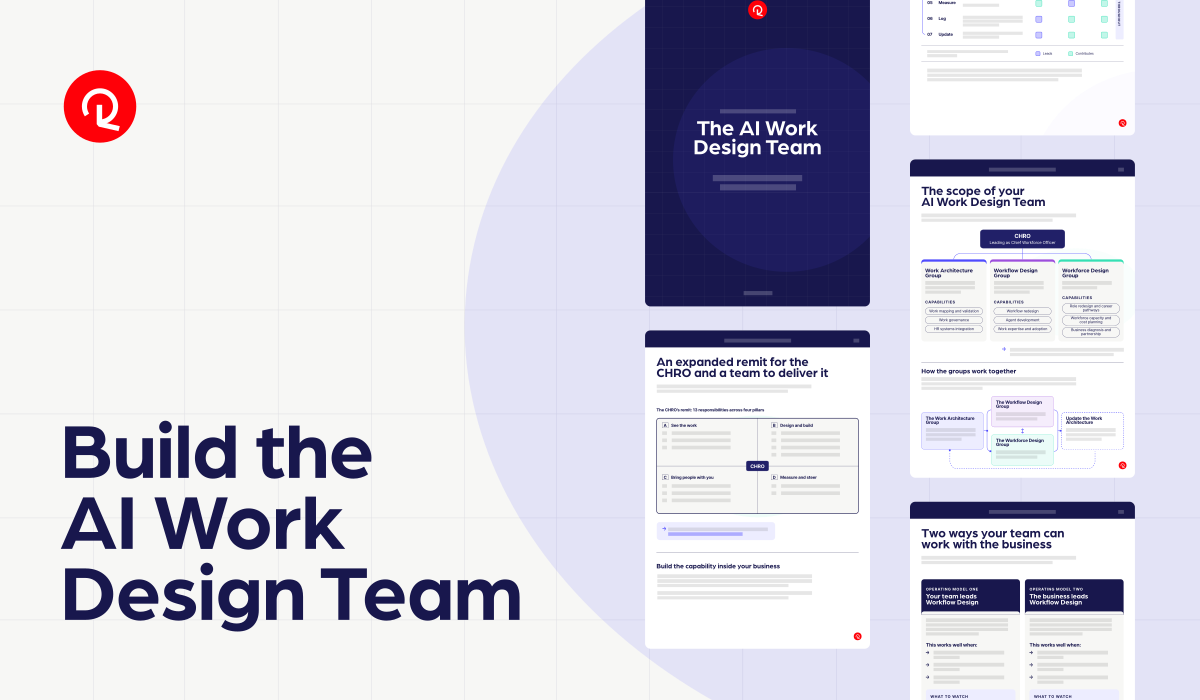
Siobhan Savage: The second thing we're seeing, and my team will just drop it in the chat, is the new operating model that we just kind of quickly went through. This is what we see today. I think this is going to be one of the biggest teams that will play out in HR next year, so get on it. This is exciting. Have a look at sort of the capabilities and DM me if you've got any questions. But there's plenty of resources that my team have built for that as well.
Siobhan Savage: And then the third thing is, we're gonna start, like, these weekly cohorts. Where we're solving a new problem every Friday. So, look out for, you know, a new problem every Friday, where we're gonna kind of share what we're learning. We'll probably bring some customers into it as well, who can share their perspective.
Siobhan Savage: So, you know, Fridays will become a fun day, hopefully. But if there's no other questions, folks, have an amazing Friday. It's Friday the 13th today, did you know that? So hope everyone has a great Friday. And it's not an unlucky Friday. And have a good Friday. Let's get excited about this space. There's never been a more important time for what we're doing, so I'll see you all soon, folks.
Siobhan Savage: Thanks, Jasmine!
Jasmine Jaco: on. Bye-bye.
 Get the Operating Model