-
Platform
-
Resources
-
Company
- Work Architect Course
- Contact us
 Platform Overview
The Work OS for AI-powered Work
Platform Overview
The Work OS for AI-powered Work
 Work Architecture
Live entity model of your enterprise
Work Architecture
Live entity model of your enterprise
 Map
Build the Work Context Graph
Map
Build the Work Context Graph
 Analyze
Your GPS for reinvention
Analyze
Your GPS for reinvention
 Build
Builder Studio · Workflows + agents
Build
Builder Studio · Workflows + agents
 Run
Deliver the new way of working
Run
Deliver the new way of working
 Measure
Track real, board ready ROI
Measure
Track real, board ready ROI
 Log
Source of truth · audit trail
Log
Source of truth · audit trail
 Update
Keep architecture current
Update
Keep architecture current
 All Resources
Content for AI-powered work
All Resources
Content for AI-powered work
 Certified AI Workflows
Proven builds you can copy
Certified AI Workflows
Proven builds you can copy
 Articles
AI work design thought leadership
Articles
AI work design thought leadership
 Events
Roundtables, webinars, dinners
Events
Roundtables, webinars, dinners
 Webinar Recaps
What we learned, from the people building
Webinar Recaps
What we learned, from the people building
 Playbooks & Guides
How to build capability in your team
Playbooks & Guides
How to build capability in your team
CUSTOMER STORIES
View
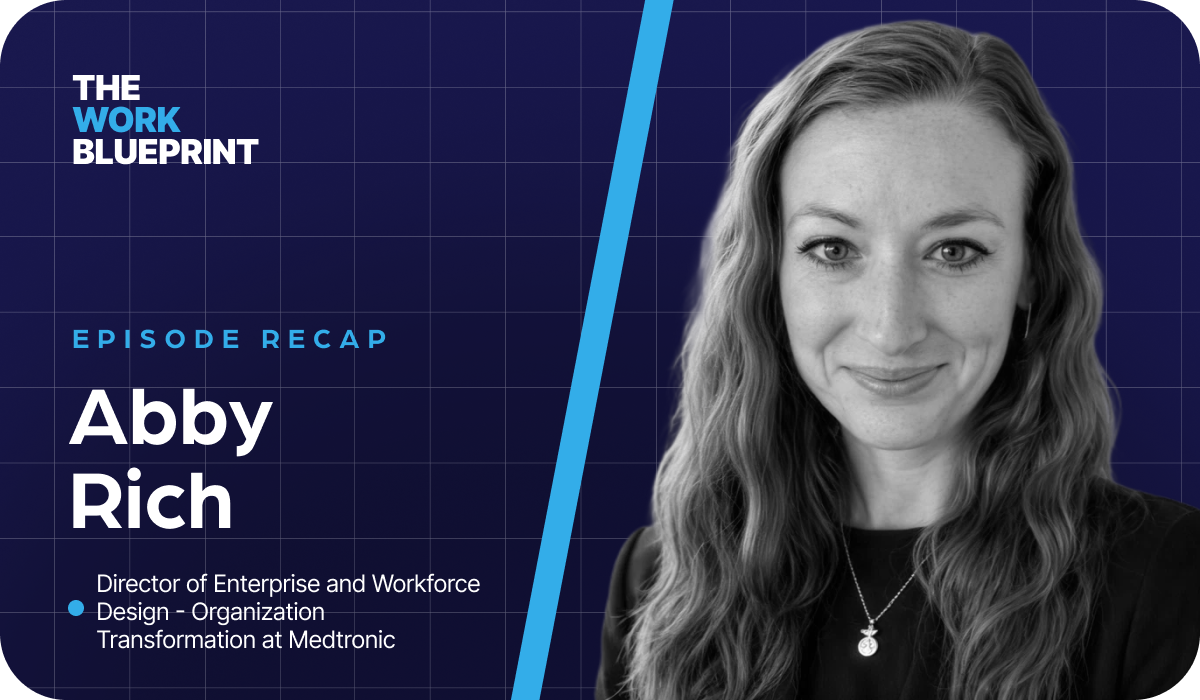
Abby Rich on building an internal team to redesign work with AI

Author
Reejig

Read time
5 mins

Published
Sep 23, 2026
Abby Rich on building an internal team to redesign work with AI
{source_type=oembed, supported_oembed_types=[video, link]}
Blog Post Body
Table of contents
Catch The Work Blueprint live
Hear how leaders are redesigning work across people and AI. Join us for the next episode.
Like many organizations, Medtronic began its AI journey by giving employees tools and prompt training. But a familiar question soon emerged: how did any of it fit into their actual work?
“Great, but training for what?” Abby Rich recalls. “Like, how am I supposed to use this?”
For Abby, who leads enterprise and workforce design at Medtronic, this became the starting point for a deeper shift: understanding the work behind each role, deciding where people and AI could contribute, and building an internal team to keep that work evolving.
In her conversation on The Work Blueprint with Siobhan Savage, CEO and Founder of Reejig, she describes a journey that began in HR and is shaping a broader enterprise approach to AI work design. Her next focus: measuring how redesigned workflows improve outcomes and deciding how to reinvest the time AI frees up.
When AI adoption leaves the work unchanged
Abby’s path into work design ran through leadership development, HR strategy and strategic workforce planning. Understanding the workforce increasingly meant understanding the work itself.
Tool deployment exposed that need. Employees could learn how to prompt AI without knowing where to use it in their roles. Meanwhile, bottom-up experimentation was creating another challenge: teams were building duplicate agents and establishing different ways of doing similar work.
People were doing what the organization had asked them to do. But improving those workflows later would mean navigating the variations they had created.
For Abby, the response required a clearer view of the work and deliberate decisions about how it should happen.
Start with the outcomes, then redesign the tasks
Within HR, Abby and her team examined the work behind roles: what belonged with a business partner, what could sit in shared services, and where AI could contribute.
Working with Reejig helped provide the work data to examine roles at that level. Abby’s team used that understanding to understand where AI can support people’s work and where human expertise remains essential.
Her starting point is straightforward: what does someone in this role need to achieve, and how can we better support them to do it?
From there, the team examines the tasks and subtasks that make up a workflow. Abby uses month-end financial reporting as an example: understanding the inputs and steps involved helps identify where AI could assist and where people’s expertise is needed.
That examination also helps identify activities that take up time without contributing enough to those outcomes. In HR’s own evolution, this meant questioning work that continued simply because it had always been done and considering how that time could be better spent.
Build the capability to keep redesigning
Abby says HR’s own transformation demonstrated progress and built credibility with other executive leaders. Their interest brought a practical question: how could they do this in their functions?
Supporting that demand required an internal team with the expertise to keep redesigning work as needs and technology changed.
Abby sees a place for consultants in getting started. As she puts it, “It’s a bridge. It’s not the destination.” An ongoing capability needs expertise inside the organization as work will never stop changing.
That does not mean rebuilding every role. Her approach distinguishes between opportunities to streamline work and disruption significant enough to require a role to be redesigned. As work changes, employees need clear expectations, relevant development and support to succeed.
The unexpected insight: where to invest in people
Examining AI’s potential also sharpened the view of the human elements of a role - and where development investment could matter most.
“What are the human elements of a role that need to remain uniquely human,” Abby asks, “and then how it can signal for you how you do additional upskilling, reskilling, redeployment.”
The work-level view also opened conversations with talent management partners about career mobility. Different job titles or families can obscure similarities in the tasks people perform. Seeing those similarities creates a basis for considering less traditional pathways for people with the interest and capability to move.
These were emerging insights and opportunities, rather than a claim that every pathway had already been put into practice.
The next test: what happens to the time AI frees up?
At the time of the interview, Abby described enterprise priorities spanning commercial work, product and R&D innovation, business services, supply chain and operations. The aim was a more consistent approach to major workflows, alongside continued employee experimentation.
But deploying technology is only part of the challenge. Abby is focused on defining new expectations and workflow-level KPIs so that people understand how to use the time AI frees up, with clear priorities and support from their leaders.
Her own experience makes the problem tangible: becoming more productive can simply leave room for more meetings. Leaders need to decide what people should do with the time they gain.
Employees also need clarity about what AI means for them. Abby stresses that a role being affected by AI does not automatically mean it disappears. People need context, answers from their leaders, and support as expectations change.
For CHROs, her journey brings the next decision into focus: once you understand where AI can change the work, what will you ask your people to do differently - and how will you help them do it?
Explore more pioneer stories and practical guides to help you redesign work across people and AI.
Explore AI Work Design resources →
Speakers

Siobhan Savage
CEO & Co-Founder of Reejig



Abby Rich
Director of Enterprise and Workforce Design - Organization Transformation at Medtronic
Siobhan Savage: Hello everyone, and welcome to the Work Blueprint. The Work Blueprint, as you know, is a show designed to make sure that we can bring the most awesome leaders who are sleeves rolled up in this moment. Really designing and redesigning hard work gets done. I am super grateful that we've got Abby here from Medtronic. Abby, welcome.
Siobhan Savage: We are super excited to have you. Abby. Abby, listen, one of the things that we would love to know is like, how did you get to this moment? Like, tell us a little bit about your background. Like share a little bit with folks online here on sort of like what you do at Medtronic. What's your previous career? Yeah. Give us a little bit of context about who you are.
Abby Rich: So Abby Rich, I have been at Metacritic now for about 11 years and in various different HR roles. In that time I really started so premed was in HR, consulting came to Medtronic, was more in the leadership development space. So kind of grew up doing like leadership programs from there, started working much more with our top of the house, our executive population and their their overall learning journey.
Abby Rich: And then from there kind of got put into more of a special assignment where I was working on helping to articulate our new strategy as an organization's. We had a new CEO at the time, and so helping to work with our executive committee to say, how do we get really crisp and clear on where are we headed as an organization
Abby Rich: so that as we're operating within this new model that we had, everyone was singing from the same song sheet. And so after that, that was really supposed to be a moment in time special assignment. And as things happen like that got asked if I'd be willing to do more of that type of work full time. So moved more into HR strategy
Abby Rich: several years back, was also kind of the chief of staff of our SVP of talent, and I was owning strategic workforce planning for Medtronic and defining, first of all, what a strategic workforce planning. Yeah. What is it?
Siobhan Savage: Every single person has a different definition of that. Right. And then from there, I started to really shift more into the space of as we're thinking about strategic workforce planning and what is the what is the workforce that we need or the future defining
Siobhan Savage: what is work of the future and figuring out, as we are now all entering this new landscape of work, modernization and AI in the loop, helping to set a path forward for Medtronic for how do we identify where does opportunity exist?
Abby Rich: How do we make sure that just because we can AI something that doesn't necessarily mean we should. And so being really thoughtful and using data to drive those decisions, setting a methodology then for, you know, how do we work with our digital teams to put new new technology in place?
Abby Rich: And then the most important part of that equation is to figure out what does this mean for our people? Because without people, none of this can be successful. And so managed to now make a full career out of that part of the equation. And so I am leading our enterprise and workforce design practice,
Abby Rich: which sits underneath enterprise transformation and HR. And so we kind of help to manage enterprise transformation efforts at large. So think like large scale business transformation efforts, whether that's model optimization, business consolidation. And then of course, the majority of our time right now is really focused
Abby Rich: on setting a methodology and blueprint for AI modernization.
Siobhan Savage: It's so exciting. It's listening to your how you got to this moment is also awesome. And for folks listening, like everyone's always asks me, how do I get these, these jobs? And that's the thing. Just putting yourself out there for a special assignment can bring you like so much opportunity to just lean in and try and figure something out
Siobhan Savage: because you would agree, as much as I would agree on this, like no one, this isn't figured out yet. Like we're all at the start of this. We're all kind of like fumbling through a little bit like, and it's changing kind of day on day as well. So like I love that. Like it started out with Special Assignment which led to Workforce Ponti, which give you the context of understanding
Siobhan Savage: like the bigger picture. Yeah.
Abby Rich: Which then led to, well, we don't know really what the workforce will look like because unless we know the work, we can't really define it. And that's one of the big things that we have seen. I don't know if you know, my my previous background was workforce strategy. Right. And the thing that used to catch me, I was we used to do it on people planning.
Siobhan Savage: It was the most basic sense of like how we were thinking. It was never about the actual work that the company was like actually going to be forecasting. And I think, no, because of agents, it's really changed the concept of like whether you want to call it workforce, strategy, workforce, but it doesn't matter.
Siobhan Savage: But every organization night will need to know what is all the work that happens in the company and why is it forecasted to shift? What are all the people that I have and capabilities that I have within my org, and how much do they cost? And then they're going to want to know what is all my agents capability and what have they cost.
Siobhan Savage: So kind of think there's like these three kind of buckets that are now leading into whatever you want to call that. And then your role becomes really important because you need the data. But then talk to me more about this, like work design, you know, the design element of your role. Because I think that's like a super emerging role that we're seeing pop up
Siobhan Savage: like across most of our customers now. So I mentioned before, we really started to see the need of work and work implications being part of the upfront planning and now the downstream effect of AI rollout.
Abby Rich: And so, you know, Medtronic, like many other companies, have been on a journey in which like our first step and foray into, you know, AI for the workforce was to push tools at people and to hope for adoption and to do things like prompt training or to try to get adoption up.
Abby Rich: And like the reality is people are like, great, but training for what? Like, how am I supposed to use this? How does this fit into the context of my role in the work that I'm doing? And so it became really evident that, you know, tool deployment isn't going to be a way in which we're going to see a new way of working,
Abby Rich: or actually realize any type of value from AI deployment in the organization. And so as we have gotten more crisp in that definition of what do we need to understand partnering with you, all that reach out to have the data to understand within, you know, a family group and then a role group and then a specific role.
Abby Rich: What is the work that's actually happening? And then where within that workflow does make sense. And so part of that is modeling, you know, and understanding where does that work sit today. Should it sit in it. So even before you touch AI you have to figure out the workforce implications, which is like, you know, should that sit in a shared service?
Abby Rich: Is this something that should be more of a business partner driven work? Is this something that we want, you know, AI to own, end to end, have to be able to understand, like where does that work fit before you even figure out, okay, so now where within that work we actually start to deploy agents or technology. And so we really use it on the front end.
Abby Rich: Identify like what are the different components of the role. Deconstruct the job, figure out then what's the right blueprint for machine and task. Sorry machine and human. Within that task, mix and then partner really closely with our digital teams to then deploy the solutions.
Abby Rich: And then it's this downstream effect of really figuring out how do we recommend how to use free capacity. And so first we have to be wildly clear on expectations of people in their role. And so whether whether their role is fundamentally changing, like in the types of outcomes they're being asked to do, what
Abby Rich: we'll need to fundamentally change is like then what's what's the requirement? So if you have 20% creative capacity, someone needs to know what they're supposed to do with that 20%. Because even in the best case scenario, like with me, I've become much more productive. But I just get a ton more meetings added to my calendar. And so then ultimately,
Abby Rich: is that the right output for what should be happening with my friend? And unless there's really clear expectations around that, we can't expect people to then, you know, have additional output. If that's that's where the redeployment is supposed to go. The capacity redeployment is supposed to go more towards bottom line. We have to figure all of these things out.
Abby Rich: And so you can't just like hope that implementing a a technology into your workflow is then your value realization. So that's kind of step one is figuring out what to do with that capacity redeployment. And then the second step is for roles that are fundamentally changed dramatically as a result of it,
Abby Rich: like understanding where is disruption the greatest. We need a methodology then for redesigning. What should that work stack look like? And so not thinking about it from a role based perspective, but rather from a work driven perspective of understanding, you know, do we do we say that this the expectations of this role,
Abby Rich: not just from an output perspective, but actually like, what is the type of work they're doing? Does that need to change? So as I think of like an HR business partner for me, and my guess is a lot of people are likely from HR. It's a big one.
Siobhan Savage: This one is the constant one. Like the HR. We get asked that constantly. HR are going to have to operate differently in the future, and a lot of what they're going to be asked to do is this exact work that we're talking about that no one knows how to do yet. And so we had to free up their capacity through ways of digital enhancement or work shifting to other places.
Siobhan Savage: But then we have to redefine what is the role of an HIV in the future, because we have to be able to then reskill and upskill accordingly to that new definition.
Abby Rich: And so that's really the process of work redesign. And there's no intention to do this for every single role at Medtronic. I mean, we should be looking at every role and understanding where this opportunity exist and streamlining and uplifting work in general. But for places where there's disruption, we need to make sure that we are really intentional about what is the rebuilding of those roles
Abby Rich: and how do we set their expectations, and then make sure that they have the right support around them from a skilling and upskilling perspective, to be able to then be really successful in that context.
Siobhan Savage: The one thing that I think is really interesting about what you're saying is a common theme that I've been seeing as well. I'd be like, companies like used to do this where they thought it was like a one time change, and they would do a consulting project and maybe have a look at a transformation program. But what we're now seeing is, like the most ambitious customers in the world,
Siobhan Savage: they realize that this is a forever change to work, and what they're doing is they're invested in capabilities and experts like you and building teams up to know I drive like an AI work design practice in their org, which I think is, you know, you're right at the front of doing that. And the one thing that I think will be interesting to see is like,
Siobhan Savage: given the complexity of your org, like you're not going to go out and just like automate everything because you've got, you know, FDA, you got regulation, you've got compliance, you've got governance, you've got a whole pile of things that are there for a good reason that you've got to like, navigate knowing what is all the work and how to redesign the work.
Siobhan Savage: And you might redesign that example of the hope it might evolve. No. But by the way, in six months can evolve again. And there's this like constant like evolution. How have you got the businesses mindset to the point where they invested in putting this team in place unto you because like,
Siobhan Savage: customers are like kind of like doing this patchy thing right now. But I am seeing like maybe 50 or 60 of our customers who are now building on, you know, all the pioneers, right? You hang out with them all the time in our club. But a lot of these have got this team. But it's not like common yet in market. It's like surging. How have you seen the mindset of the business to get to that point
Siobhan Savage: where they believe this is a forever we need to invest here properly. So I'm going to give a ton of credit in this case to our crew, Matt Walter, who's really been on the front end of saying that HR. So his own function, right, would be a digital first function at to the point of a couple of years ago,
Siobhan Savage: his entire strategy was an AI strategy versus like a functional strategy.
Abby Rich: So we have been gone through our own transformation within the HR function to really reimagine our own work. And how are we approaching things from a digital first perspective? I think because of that, we started in a place of we've proven some success. It gained a ton of credibility
Abby Rich: then for Matt with his peers on the executive committee, who then saw, you know, the future of, we need to make sure that we're making these right investments in our own areas. And then with that comes a lot of questions of like, so how do we do this? And so we needed to be able to set up an internal team to be able to support this type of work. Otherwise we're just going to spend endless money
Abby Rich: on management consulting companies. And so I think you brought up this point already. Yes, you can do that one time. And, you know, at a large company, you can probably afford to do so if you're and it gets you going. It's in my view, it's not a negative. It's just like a it's a bridge. It's not the destination. Right.
Abby Rich: But if you if your vision is that this isn't always on capability and something that we're going to need to do, you need to have that internal capability and expertise in-house. And so that's really what this is for our team being set up. And because Matt is really on the front end of this and has gained a lot of credibility with that's made that conversation
Abby Rich: easier, it's not made it like entirely smooth sailing. We still have a lot of work to do that we're doing right now to help our businesses understand that in order to see any value in AI deployment, then we have to be really thoughtful about understanding the work and the workforce implications,
Abby Rich: because people are our drivers of success here. And so we're doing a ton of work right now. My team is leading developing an AI philosophy and operating principles, which is essentially a way at which Medtronic that we can say, what do we believe in as it relates to AI,
Abby Rich: how do we think about it and how do we talk about it? And how is all of that anchored in our mission, which our mission is inherently people driven? And so as an organization, for those who don't know, is the largest medical device company. And so everything we do is patient centric and patient.
Abby Rich: And so ensuring then that people are at the center of the things we do, while also ensuring then that we can get more innovation, more product out to people as quickly and safely as possible. And so AI is a really good method to help us accelerate our, our overall mission.
Abby Rich: And so rounding in something that feels tangible but feels people centric is kind of a first step that we've taken. And then we're being really intentional about like having every top leader at Medtronic understand that and be able to talk about it really transparently and proactively, because we want we know the questions are on everyone's
Abby Rich: mind of like, what does AI mean for me and my job? And the more we can be transparent about that and talk about, yes, work is going to change fundamentally change that. The goal of that is to make work elevated and easier and be able to get people the types of relief from the like, sticking points that they've had in their work for so long.
Abby Rich: And so that was kind of step one is finding that narrative. But step two is then helping business leaders who want to move quick really understand that the only way that this is going to work or be successful is if the the work output then changes on the back end, which I've talked about a little bit. My biggest fear
Abby Rich: is for those who want to move quick, is that technology costs money, right. And so either you're going to be only okay with like your your net net only spending more if you only add technology to the equation. And unless you're really thoughtful about what are those work outputs, the reaction that some companies we've seen across the board have is that they just make
Abby Rich: kind of layoffs across the board to fund the technology. The problem with that is beyond it being like ethically not fantastic, is also then that you haven't examined all of that work that you've done, go from the organization, and your AI isn't solving for that work because you didn't do it within the process,
Abby Rich: within the context of the work that you are redesigning. You've just made choices so that you can find a new technology. And then what happens is that work still needs to be done. And so fundamentally then what you do as an organization is you hire all of that back and then you say, slow down, right? Like so.
Abby Rich: So unless you're really intentional, it's not it's not possible to see the value that comes from these AI workflows. And so we're working really hard with our stakeholders and business leaders at the top of the House to understand that and understand that that process takes time. And you have to be really intentional
Abby Rich: about where within the overall workflow does all of this play out?
Siobhan Savage: Yeah, it is interesting because there's like so many parts of what you said that are like little podcasts in itself. You know what I mean? Because there there is the the unlock of opportunity. How long does it take to get there? And the reality of that, because given, you know,
Siobhan Savage: the most complex organizations in the world, like yourself, have things in place where there's not many things that will have like full agent and and without a human touch point because of risk. So that tells you then that it's critically important that your people adopt the new way of working, because if they don't, it all feels so.
Siobhan Savage: That's kind of like one thing I heard you say. The second thing is the cost of the agent. In some respects it's more expensive if done in a certain way compared to what we were paying. So then it becomes like a hold on a second, like we need to be really clear on where we're deploying, what for who
Siobhan Savage: and the loop, and much that will cost from a tokens perspective, because also like the the agents are still figuring that out as well, right? Like they don't know that like in some instances, you know, in certain technologies that it's \$250 for a presentation to be made and everyone celebrates the employee for for doing this beautiful presentation,
Siobhan Savage: but at the end of the day, just cost you \$250. So there's this like thing that no one's kind of figured. I like the trade offs of like, cost. And sometimes things I've noticed with like some of the work we've seen and like inherently has happened to you to like,
Siobhan Savage: we have designed something that probably didn't need to be signed and actually took us longer because it was annoying and it caused friction for like, you know, like tribal knowledge is a real thing and like ease and flow of work as a real thing. So that's like an interesting thing. But I think like with to back to your point,
Siobhan Savage: if you don't understand the work and when we're talking about work, just to be clear, Abby, you're talking task subtask like the depth of data that incorporates like high workflows within your org. Right? We're not talking just looking at a job title and making an AI potential score. We're talking like, give me more underneath the hood of like
Siobhan Savage: how you're defining what what is work in your world. You know, essentially in the simplest form, it's understanding what are the outcomes that you need.
Abby Rich: Like at the end of the day, what are the things that have to be done? What are the things that have to be produced? What are the things that have to be checked off of a list? And so if you think about like an outcome as the tasks or task being at the highest level within, you know, a then a roll of when you break down a roll,
Abby Rich: the task isn't for those who aren't aren't working very closely with Reejig already is really a set of things. Right? So it's not like when we're talking about tasks. It's not like, what is Abby Rich doing every single moment of every single day? It's really like, what are the fundamental outcomes that are most critical in a role? And so once you look at that,
Abby Rich: that's really what you want to look at from a work perspective. You need to go deeper than that. When you start to think about a workflow or think about where does AI show up within that? Because if I if I'm a financial analyst and my task is that I need to create month end reporting, that shows where we're trending against our PNL and, you know, forecast
Abby Rich: that's you can't just AI that without really understanding, okay, what are all of the inputs that then go into that. And so that's the subtasks that are beneath that. I say the subtask is more like once you get down the road of identifying where you're going to go after, that's when you start to look at that level of detail. You don't need that level of detail really, on a day to day basis.
Abby Rich: The day to day basis is more that what are the what are the absolutely like mission critical things. As an organization, we need to do and need to continue, regardless of if it's a human that does that. It's a it's a bot that does that or some combination thereof. But then you can also, at the outcomes level, start to see, like, are there
Abby Rich: things that we're doing that we might not need to do in a future state? And I think like there's a lot of that valuation that's happened as we've done our own HR model. Evolution is understanding, like there's things that we've done just because we've done them or they're a nice to have. We need to free up capacity in the future state. So what are those tasks that we've been doing that we actually don't need.
Abby Rich: They're not necessary. And so just as critical for that evolution is thinking like, you know, what is the work that we're doing today? What is the work we need to be doing in the future. What's the delta between. Yeah. And the to the point that you made is really interesting. So you've got two parts you've got to and high level intelligence is like a think of it as like a DS
Abby Rich: like signaling you to like heat of where change is coming.
Siobhan Savage: But then when you want to actually change the work itself, you need the subtask level data, because the agent is most of the time taking subtask, not task. So one of the things for folks to like when you're trying to figure out, and I got you excited when you're looking at like providers of data, if you don't have subtask data, it's not going to help you solve the problem.
Siobhan Savage: It'll give you an interesting, oh, this is interesting. But as soon as the business gets their hands on that, they want to go quickly into like, okay, how do I actually change this work? So what I'll be saying is completely true. And to be clear, we felt that pretty hard. As soon as we move from architecture of work into insights
Siobhan Savage: and like CEO, CFO, CIO, see it getting data and then you're going to get hit like pretty hard in the face because they're going to go, okay, we want to take action because these leaders are asking you for this intelligence, not because they want to do like, oh, like, what's the future going to look like? They want to make change and they need you to help them make the right decision on where to go.
Siobhan Savage: So I think like that subtask level is super critical. And I mean, the other thing that you've said is interesting as well is like, at what point is human agent assist? There's like a combination of like a recipe in a, in a new way of working where you're kind of like orchestrating human and agent together.
Siobhan Savage: And at some parts the human will do all some parts it'll be a review, some parts will be agent. And that's kind of like how you have to think about like designing the work as well. And I think the, the what I found really interesting too. And I wasn't expecting as we entered our journey with you at Reejig, is
Siobhan Savage: I knew what we would see in the data is understanding where is our AI opportunity and how do we quantify that? What's the hours on lock? What's what are we talking about from an overall value realization perspective, what I didn't expect to find as fascinating as I have is actually it's the inverse of that. It's understanding which parts of our role
Siobhan Savage: are actually uniquely human and will always need to be uniquely human, because that's really important data too, because what that signals to us as an organization is also the value of upskilling and reskilling in those spaces, because we need to make sure then that people can do those things really well. Shows us when we're starting to, to interview for open roles
Siobhan Savage: like probably focus on these capacities that need to be human. We need to really understand people's judgment or ability to critical thing, be able to see where errors may be copulating as we start to introduce more technology. And if you don't have that fundamental human capability, that's a huge risk for you as an organization.
Abby Rich: And so that's been really neat as well, is to be able to understand, okay, so what are the what are the human elements of a role that need to remain uniquely human. And then how it can signal for you how you do additional upskilling, reskilling, redeployment as it relates to those things as well.
Abby Rich: And the it's been very interesting for, for me and my talent management partners to be thinking about. Okay, so then what is this unlock for us as far as, you know, career mobility opportunities or thinking about roles in a different way than we have before. If you start to understand the task that fit into a role,
Abby Rich: it removes a lot of the noise about things like a job title or a job family even, because you see, like, well, fundamentally a lot of the tasks, the work that they're doing is relatively similar. So could we think about a nontraditional pathway for really good talent or or someone who has an interest and capability,
Abby Rich: the fact that they maybe don't have a traditional background behind them? We do have some some data to prove that, but they can do this type of, of output. So that's do you know what's one one of the things that's come up more recently from one of our big customers that you know, is task adjacency
Abby Rich: for redeployment purposes versus skill.
Siobhan Savage: It used to be skill adjacency. But it's like, well, if someone can do a task and they can be assisted by an agent and there's enough adjacency that there's this commonality, that's been like a really interesting thing we've seen and we've run models out in a pilot to test it, to see if it's real. And it is. It's actually really interesting. So I'll share.
Siobhan Savage: You'll probably hear about this at Pioneers Club like in the next few weeks. But like that's a new thing that we've started to see. One there's like task duplication. A lot of tasks are done all over the company that no one knows exists that we're all duplicating each other without realizing. But then there is like in the in the moment where AI does the thing I think we all think is going to happen, we're going to have to start
Siobhan Savage: really thinking about redesign and workforce because of these changes. Like how do we think about that pivot? And the pivot can actually be an even more used to be just skill. But like I actually think task adjacency plus like agent assist, like I mean, I'm I'm a perfect example.
Siobhan Savage: I am running a company and I have no background in finance, no background in technology. I have like a whole pile of energy and a passion about a space and some workforce strategy background. But generally speaking, like I am agent assisted the whole way through. So if I can figure out how to do all of these things,
Siobhan Savage: imagine when we think about our workforce, how do we create a culture in our org where people can kind of upgrade their ability because they can work alongside like agents with context and think of them as a context. Bombs like like agents that do have expertise in certain things, I reckon, like when I finish this Reejig thing, like that's
Siobhan Savage: where my head's going to go a little bit is like, how do we think about, you know, building like this, like incredible talent capability where it's like that, like imagine all your graduates that come in and you usually have to give them like two years. You could actually get a graduate to higher performing success rates a lot quicker.
Siobhan Savage: But bolting like agents around them to make them more productive, like imagine like if we start thinking about like development of people and talent with agents as well. How cool that could be.
Abby Rich: Yeah, it's a very exciting space. And this is why I like to be fair. I think like the role that you hold right now, everyone who's listening, like everyone when we grow up, want to be like you and have the opportunity to do this. So you given time to share what's like working, what's not working.
Siobhan Savage: I think I've heard you say like get visibility of the work is step one so you can make decisions. Then you want to look at like people, dual agent people or just agent and like look at that. Then you want to look at the cost implications of that. Then you want to look at the workforce impacts because of that.
Siobhan Savage: That's one of the things we haven't fully nailed yet is, is because what we've seen play out in customers is like, you can go and say, I'm going to completely reinvent HR, right? And you're going to like build into all these agents. You don't get to value overnight. Some of the agents won't work, some of them won't stick,
Siobhan Savage: some of them will work, but they take more like you create a new task that you never realize you had to do to make that work. So you're like switching work capacity. So there's all of these scenarios where your scenario playing in a couple of different bases where you don't actually know the outcome,
Siobhan Savage: and it takes a little bit of time to see end to end it flush. And then if there's going to be changes, and I think that's the one we've got to figure out. Solving as, as an industry is like, how do we predict well enough that there will be change? Because the biggest gap I see is adoption from employees. Like your point
Siobhan Savage: by prompt training is my like like I feel like I rent it constantly. It's like if you give prompt training to people and expect them to be able to work in a new way, it's kind of crazy. Like it's a it's a theoretical methodology. It's not like a pay the invoice like this. And where I see the biggest drop off right now in adoption is not because
Siobhan Savage: copilot, it's not because of work, it's because the people don't ever want to or are not equipped to work in a new way.
Abby Rich: Just understand, like, what does that mean? Like, their brain hasn't even been able to see the opportunity of how could this help me in my work? And so it's not even like even in the best case scenario for people who want to be able to explore it, like where do I start? And again, comp training isn't isn't the place to. Sure. I mean, it's good to understand,
Abby Rich: like a basic foundational understanding of what AI is and can do, but until you put it in the context of someone's role or help people understand like this is how this fits into the flow of the work, it's just been something that's sitting on the side and like, oh, well, this is cool to play with. But it's not like fundamentally changing the way that I'm working,
Abby Rich: unless we're really intentional about helping people understand how to do that. And if you're a fast like, I don't know if you find this, but when you're in your flow state, you just get stuff done fast.
Siobhan Savage: If you have to work in a new way and it slows you down, it's very frustrating. Like it's super frustrating. Like, I definitely see that there's this thing that I'm spending a lot of time on is like, how do you give like a new SOP to folks to make sure that they know how to adopt? And then this other thing I'm seeing, which is kind of also kind of
Siobhan Savage: semi connected to this, is if like, let's say we go and your example of like the financial reporting we go when we build a new workflow, you see the by 3 to 6 months time, there's going to be a really awesome upgrade available because copilot now has more capability that it's offering because like the agents are getting so much stronger
Siobhan Savage: and you want to be able to upgrade it, it now doesn't become about the agent. It becomes this workflow needs to be like a lockdown, seeing that the company owns because you want to upgrade it as well whenever an upgrade, and it's going to take more and more of that task. So I don't think people are realizing that when they're going out
Siobhan Savage: and they're designing these new workflows on a whiteboard or in a spreadsheet, they're losing so much like key Intel of the organization that they should be capturing in a system because like, work should become programable, right? Like it should be like constantly changing and evolving. And I think that's one thing that like, I feel like I haven't cut through
Siobhan Savage: hard enough yet on in industry to be like, guys like, you need to capture it. It's critical so that you don't have to keep doing all the work to go and find out the way of working. Right.
Abby Rich: And I think what we've discovered, so we've done a lot of work to uncover, like our AI maturity at Medtronic, what is our readiness for the workforce? And as we're doing that and just wrapping our arms around like what's out there right now, people have done what we ask them to do, which is experiment, do their their bottoms up approach.
Abby Rich: But what that has resulted in and an organization. So we are over 100,000 people. We are global organization. We are wildly matrix as well as wildly siloed in a lot of ways. And what that's resulted in is so much duplication of agents and builds. And so you're starting to have, you know, investment
Abby Rich: that is not ill intended. I mean, people are doing what we've asked them to do, their their improving their productivity. But we now have like systematically enforced completely different ways of doing things. And, and and so then to your point of then as upgrades happen or we start to optimize or make things better,
Abby Rich: you're trying to do that across like 20 different processes. This is a standard way of doing things. And we're also are big. And so there has to be freedom within that of like there's no like we our sales force goes out and has to sell in slightly different ways to different customer segments. So it's not like we're saying there's just a one way to do things,
Abby Rich: but there needs to be a much better way in approach than just every single group does it differently and does it on their own and funds it on their own. And so what we're doing is really looking at what are the most important big like big bold plays that we can look at at Medtronic that need to be forced forces backward or choice boards,
Abby Rich: but need to be in force from a top down perspective, where are the things that we could see the biggest lift as an organization and actually commercials one thinking about things like our product cycle, our and innovation cycle, thinking about our business services, supply chain, operations, right. Thinking about
Abby Rich: then our enterprise functions as enabling functions like these are the area where we need to get AI right and make sure that we're doing it in a consistent enterprise approach way, because then it serves the entire ecosystem at large. So there's things that we're looking at truly end to end to say, like, these are the things we will own at an enterprise level.
Abby Rich: We are saying like systematically, we're going to invest in the right level of technology and improvement here and be able to have a common and core way to do it. And then we're still going to encourage this. Bottoms up and personal productivity. And it's really important from an engagement and from a learning perspective that people can get in and the tools
Abby Rich: and we also like comes from that as well. It's just like the good ideas or cried source from the field. Right. Like but what you're saying is like the common thing that I've seen happen across companies, there's been pressure to become AI first.
Abby Rich: Everyone is ruled by whatever teams go out and do what they want. Everyone is driving in many, many different directions.
Siobhan Savage: You're tripling your spend. You're slowing things down because teams that work in different ways don't work really well. Like like I kind of imagine that I want to build. Like, do you ever watch the formula one like pit stop? Like I want my business to run like that. That's like the that's the dream I remember I got, I went to with AWS
Siobhan Savage: to the one up in Texas, and I just sat drinking champagne on my own. It was with all these like, CIOs, and I was like, just looking at this going, I want to do that. How is that possible? And I started to think about it, and I was like, there's no way that I'm going to be able to do that if everybody doesn't know what their thing is. How do we all work?
Siobhan Savage: Like, there has to be like this thing, and then I'm a tiny little ant in the scheme of companies compared to you as a company. So imagine the scaling of that problem in a company of your size. And it's real. Like everyone was trying to like get it out there. And also, let's be clear, the agents are the companies that sell the technology
Siobhan Savage: are incentivized for you to do that too, because they make more money. Right? So in the short term they make money. But I think the, the, the, the way that these companies will make more money is actually driving workflow, not individual productivity, like driving teams to work in new ways where costs can be pulled out and reallocated in an organ,
Siobhan Savage: you are increasing more outcomes to patient care where you are driving up more sales and marketing, which is how you make money. Like this is where I think like smart companies are really starting to think about hold on a second. We got to be focused like surgical on our approach to this, which is where you guys are heading. And it's great. And in a lot of ways you're right at the front.
Siobhan Savage: But the the space is still it still happening. Right? Like it's still evolving. And I don't think like companies like yours will get to the point where agents will run everything. You will have human in the loop. And pretty much most areas because of who you are, because of an because at the end of the day,
Siobhan Savage: what we make is so critical to humanity that it would be a it would be negligent for us to say that we're not going to have humans in the loop. I'm sure quality and safety as the highest measures and we you alluded to the fact we're wildly regulated, but for good reason, because, yeah, great
Siobhan Savage: bodies like I want us to be wildly regulated. I agree, I agree. So yes, that's absolutely the goal. It's just also then how can we make sure then that we can we can get more product to market or enhance innovation, make our make our life saving, life saving solutions be able to be, you know,
Siobhan Savage: quicker and faster and and bring more of that critical, deep thinking to the table so that we can continue to enhance healthcare and reduce like supply chain risk, like make it faster to market, like free up more time to teach people how to use the technology so that we can get more of that technology to patients.
Abby Rich: Like there's so many parts that I just think and my favorite like work is where I get to work on stuff that like, has that ripple effect back into society, from the nurses to the work you guys do. Like there is so much in that for me that it's like really like it gets me like really like passionately excited about hold on a second.
Siobhan Savage: And one of the things that we built into the product. So not only do we have the tasks and the subtasks, but I know, I know what tasks are connected to make any money. I know what tasks are connected to risk. I know what tasks are connected to patient customer. And the reason that we did that is I kept going into every single room,
Siobhan Savage: and the more ambitious customers are not just like throwing it at all, hoping something sticks. They're going with your what did you call it? You're building like like that philosophical vision mission. What what did you call it at the start? Our AI philosophy and operating that thing.
Abby Rich: They've got one of those where they have like, like North stars that are saying as a company, we believe in these things and they make decisions because I reckon having a compass to lean on in the hard times, to make a good decision is really important, because you could go in and put AI into like a lot of things, but like some things you shouldn't.
Siobhan Savage: So I think like having that like belief system. So for instance, like with healthcare, it could be we want to like free up more time for patients. We want to increase our revenue base because, you know, we can then supply more into like patient care, like we want to reduce low value work, we want to reduce risk.
Siobhan Savage: And when you know all of the tasks and you know what the task composition is, and I don't know what to call this in the product. So if you've got a good idea right now it's like task impact or something. I don't think that's it. But the ideal scenario is, you know, the composition of work in your company and where energy should flow because of business goals. That means you should be able to like triage that through as well.
Siobhan Savage: And I think that came from a lot of customers going, we have over 100,000 people work in our company. We have millions and millions of tasks. Where do we even go? Like, and we use all of these technologies that say they can do all of these things. Which ones are feasible?
Siobhan Savage: Which ones are going to be cheaper, which was the best model? And I think that's going to be where we're going to hopefully. I think in 27, I had like a really big session yesterday with a whole pile of leaders and it was like the old way we used to do it is not gone. Like, don't throw the tool light there and hope for the best. You're going to make decisions
Siobhan Savage: with data and drive it, and then go to the value areas that the business cares about and then repeat the look. I'm hoping that that becomes more of a norm, the way that you're operating as a team. And I think it will because I think there's fatigue in the system companies are fatigued with. I mean, I don't know if you see social media, I've got a bit of a lurking profile.
Siobhan Savage: There is a lot of negativity at the employee level where they're so sick of leaders first telling them to token max, and no, either not being allowed to token max. There's drinking games where people like every time an AI strategy comes up, you take a shot, like in a meeting, like there's all of these like, like
Siobhan Savage: underground themes which are not positive about our leadership in this moment. Right. That's mistrust because people haven't been haven't seen the proof in how what is in it for them and how is this actually a good thing for them.
Abby Rich: It feels to them like we are designing a system that is intended to take their jobs. And so we have to be able to demystify that. And the only way to do that is to start to prove it. And for people to actually see it and feel it or feel the uplift of it. They also have to have transparency around like what's coming, because otherwise
Abby Rich: it just feels like this, like looming cloud in the distance of of doom. And so until we can help people understand fundamentally, yes, work is evolving. But here's what that means for you. Here is what what our organization will do to be able to ensure that you're successful.
Abby Rich: As work starts to transition and your ways of working our our, our changing, the expectations around that are changing. But so here's my role in this. Here's the employees role in this. And then here's where let's be really transparent about how we're making decisions, which is what's really important
Abby Rich: about these operating principles is it gives us an anchor to be able to say, like, these are the ways in which we make decisions, and they're grounded in our mission. And they'd insurance and employees are are essential to this process that we built into all of this and that, you know,
Abby Rich: we're being really thoughtful about where it's showing up and where it isn't and where it never will. And so just being really transparent about that, it's also just a change journey. And as we all know, it makes time for people to meet along that change journey. And a lot of times executives are people in our types of roles. We need to acknowledge that we're just much further down
Abby Rich: on this change pathway than that employees are. And so it's our responsibility to help bring people along.
Siobhan Savage: I just honestly can't believe that anthropic and OpenAI leadership took the approach that they would go out to the world. How they make money is if they're if people use their tool. But they decided to do this like, like death spiral of depression of, we're going to take all your jobs. I did not get that.
Siobhan Savage: I really did not get. Why would you do that? Like you completely like it's it's in some ways with a weird marketing. Was it it in purpose? Surely. Like like did they think who was advising them? Like, that's kind of like where I'm like, hold on a second.
Siobhan Savage: Were you doing that to the CEO because you thought the CEOs were sitting around in the boardrooms going, yes, this is great. I'm going to run a company with ten people and I and blah, blah, blah. Like, I think they kind of misread the room massively there because they probably slowed us down by by 12 months. And know what's really interesting? I don't know if you've noticed the change in perception and market
Siobhan Savage: now they're all getting ready for IPO. Jobs are going to be fine. Guys. Like like we got that. Like we kind of jumped the gun and they're pulling back on it and it's like, do you know I know what you've caused for companies and leadership. You're trying to like get their business on board. And now there's this whole pile of fear.
Siobhan Savage: And like, you would have seen like the graduation ceremonies in summer in America, like where there was an incredible amount of booing that was happening. And that is like the next entry of our workforce. And they're all coming in going. They don't like AI and they don't want to adopt AI. And I think like, that's not a good thing
Siobhan Savage: because you want people to be open and and be comfortable doing it. But if they're already resistant to it, change management, as you know, is already hard enough with like an already preconceived perception of that. So I think, yeah, like whoever was like advising those CEOs,
Siobhan Savage: I think, yeah, that was a bit weird. One of the things I would love your, your feedback on. So, you know, I have all of the tasks out in the world. I know what tasks will be impacted, which means I know the job impacts. Do you think companies will get to the point where they would want to put that data in front of the employee, or do you think that would
Siobhan Savage: freak employees out without having the voice of the Chief Learning officer and the support system that Medtronic has to translate that? Like, do you think because they can easily go and see online all of the doom that people are saying about jobs because like all of the consultants are pumping out data, World Economic Forum, like, what do you think?
Siobhan Savage: Like what do you think is the best way? Because I get you want to be fully transparent, but like transparency without context also can cause fear, right? What's your take on that? That that context is so important because I think it's really easy to misconstrue
Siobhan Savage: what we even mean by impact, because I mean, at least in the in the HR world, if you hear the word impact, you're thinking like a risk, right? But that's not what we're at. When I say a role is impacted by AI, I am not meaning that that role is cease to exist.
Abby Rich: I mean that there is a need to really thoughtfully think about how AI works within the flow of that role and and that fundamentally, that role may look different in the future. But that's not to say that that that impact means that that role ceases to exist.
Abby Rich: And so I think without that context of what we mean by that impact might mean that, you know, you're using copilot on a day to day basis to be more strategic. Fantastic. That's not like wildly changing fundamentally your overall approach to work. It's just making things streamlined or fester.
Abby Rich: You have a thought partner who's like, right at your side, right? And so I think that that things can be misconstrued really easily without the right context. And also just because something is ripe for AI doesn't mean that it's being sequenced that way within the organization and the broader context of everything else that's going on. There's also a lot of things like there's a large Venn diagram
Abby Rich: we're seeing of work that's AI able and work that we've already done a lot to put in a best cost location and therefore, like is not on our roadmap for really thinking through, at least in the short term. How are we integrating tech into that solution. So there's this economics component. There's so many factors that determine where an organization
Abby Rich: is going to put their effort in first. And this is going to be an always on and continuously we'll continue to think about it in the future. But I fear that then somebody goes and finds this list and sees that their role is, you know, impacted by AI. And now, like, afraid that the sky is falling when that's not the right context.
Abby Rich: So I don't think I would I would lean in the direction of making it wildly available in that context. But the transparency instead to say we are evaluating work, we will be really thoughtful about where AI fits in the flow of work. And if that changes, then the way in which you are expected to work as an employee.
Abby Rich: We will support you in that process of the reskilling and upskilling required to do that. And we will, you know, equip your leaders to answer the questions that you have as it relates to that. And so, like transparency in that we're not going to just pretend that AI isn't going to change anything but transparency in that.
Abby Rich: Then as we start to identify where that changes happen, will be really thoughtful and ensuring that we get people's questions answered. Yeah. It's incredible. What you're saying is like, it's like I'm been thinking a lot about like, what should I do on that? But I agree with what you're saying with the context of the impact,
Abby Rich: because impact definition is like you understand what it means, but someone without that context could take that and then that stalls out productivity because they're like, well, she's going to get rid of me anyway. So you know what I mean. You have all these like negative like, you know, do you want to hear like a really funny I don't have enough data to like, like call this like hard.
Siobhan Savage: But the word transformation has like a, like at the moment. So there's something around that word that we probably need to change at because it has this like people hear redundancy, they hear cuts when transformation is being brought up. And I've seen that across a lot of customers.
Siobhan Savage: And I don't know what the answer to it is, but I've definitely seen across the employee base, when they see a transformation program, they think consultants coming in and doing a transformation and doing big change, and that ultimately means job losses. And I think in the economy where people are just still not sure what the economy is doing and the press is not helping any of this at all.
Siobhan Savage: You know, in terms of like the anthropic OpenAI press thing that they do. So, yeah, that's been really interesting because I think that's going to be the biggest problem next year. Like we've solved understanding work at the point where it can be changed. We know the agents, the agents are going to get better.
Siobhan Savage: We know how to design workflows. We know how to deploy the workflows and get it through risk and governance and compliance. Now we've got to get the people using it. And I think that's where we're going to see probably our biggest gap. And I do think you're if we can figure out the path of like, we show folks exactly how they do work in the new way and equip them like that,
Siobhan Savage: like upgrade that you get in your phone and that whole version. Plus you will also tell them, like what this means for them, not for the business. So you know, you can free up more time to do this, this, this, this and this, which hopefully is work that they enjoy doing. But also if there is actual like changes coming in the future, that you have that scenario
Siobhan Savage: where you're able to say, well, here is how Medtronic is going to support you in that future state and what the future of your role from that task adjacency or, you know, connecting back into like the learning that's available within your company or knowing the job pathways to head towards like, I think like if we can figure out those three things,
Siobhan Savage: I think you'll get a much higher rate of employees. Or the alternative will be like, what? Like you're just told to do it. The other one I think will actually be important is like if you go to someone and say, hey, this is what I think, but they get an opinion and they get to co-create.
Siobhan Savage: Imagine like a world where the employee gets to say, I don't like doing this task. This task is horrible. This doesn't give me energy. Like, I love doing this work. I don't like doing this work. And I, you know, if there's this other like co-creation, it's like when I come to customers and I say, I haven't figured this out, but like, can you like, I want to co-create with you and you get involved.
Siobhan Savage: You have energy to feel like you have a voice. Right? So I wonder if there's like some kind of co-creation element at the employee level as well.
Abby Rich: I think that and part of that too is the like experimentation that we want to continue to support and say like that bottoms up approach of the work, find the things that don't spark joy in your current work, and find a way to help have AI do some of that. And again, that starts to build trust. People start to see the benefit of it.
Abby Rich: And so I think the more that we can get people to understand, you know, what this means for them and have some wins. And people see like, oh, that wasn't just corporate speak. This was actually something that will make my job better. And we're evolving and it's uplifting.
Abby Rich: The type of work I can do and the way in which I can do things, that that's when we'll start to see some more of that sentiment. It's a really good idea.
Siobhan Savage: I wonder if, like, you know, what the SOP that I've created, there's like this, like, here's a view of how you do the work. I wonder if you could also say, like, here are the kind of common tasks that are done. And then you ask the employee, like if you could redesign, like which ones give you joy, which do you love? And I wonder, capturing that and feeding that back to work.
Siobhan Savage: OS so it also tells you like that no joy work or like people love doing this work. I wonder if that's like a future like sorry guys, you're getting caught up in our, like, product design. But yeah, I mean, I think but I do think that this is such an important topic though,
Siobhan Savage: because if folks don't figure this out, the whole reinvention doesn't work. Like the redesign does not work. The money spent on copilot doesn't work. All of the work does not work unless we get our people adopting this. So I think it's a really important topic for us to to really spend time on. Abby, you have been like such
Siobhan Savage: a source of clarity and inspiration. I get to work with this all the time and it's very, very exciting for those of you like, kind of like like I gotta give you like a recap of everything that sort of Abby said. And I make sure that I if I've missed any key steps. One you got to understand your work at task and subtask use data
Siobhan Savage: to make good decisions with the executives in the business to figure out where you're going to go. You want to then look at like feasibility of agent. You want to look at cost. You want to look at like the what did you say, the kind of you've already done the work in kind of lower cost regions. You've got your agents and then you've got your like location strategy.
Siobhan Savage: Then you're like redesigning workflows, which then have impacts into jobs, which means you're going to have to think about how you change the jobs and scenario, play out what that looks like. And then the final part is like, how does that connect back up and keep your architecture, your workdays and everything up to date? Because every time you go and change a job and change a task, it's going to impact.
Siobhan Savage: So there's this part of what we're trying to solve, which is how do I keep the whole wiring of my company dynamic and live? And then this kind of like really important part that you brought up, which is about the workforce, you know, how do you bring your workforce on the journey? How do you make sure that they're equipped? How do you know that they're going to be impacted
Siobhan Savage: and have enough time to plan for that impact? Did I miss anything from what was like a university course condensed into like half an hour?
Abby Rich: I think maybe the only other thing that I've been spending a ton of time thinking through. And so, you know, as you all are brilliant on the phone as well. I can't wait for you to reach out and tell me how you cracked the code on this. But it's really being really explicit around new expectations as workflows have changed.
Abby Rich: And so what to do with that freed capacity? And not just from a recurring like we go in and we cut jobs as a result of that. And now we get that back. It's just fundamentally if if we want to prove value of this, we need to make sure that we've set very clear KPIs tied to like a specific workflow to say,
Abby Rich: now, this is what the new expectation of outcome is and how we're reinvesting that great capacity in a really thoughtful way.
Siobhan Savage: Yeah. It's incredible.
Siobhan Savage: And like, there's so much in this masterclass that I'll get my team to package it up so that folks kind of I know it's a lot. We're working in this every single day, Abby and I. So folks that are kind of like stepping in for the first time, we'll kind of like give you a playbook and send it to after this as well. So if anyone wants that, we'll have that available because there's just so much in what Abby is saying.
Siobhan Savage: That is like everything that I have seen across all of our customers, this is not like a like Abby's point of view. That's just individual. I'm validating that this is across all industries. It's a very similar theme. So Abby, I'm so grateful for your pioneering. I'm so grateful that you give time out of your schedule to share with us all.
Siobhan Savage: Thank you for joining us on The Work Blueprint, and everyone should follow Abby's incredible work. And thank you for joining everyone. Take care folks.
Catch The Work Blueprint live
Hear how leaders are redesigning work across people and AI. Join us for the next episode.