AI is reshaping media and entertainment at the task level. Not just at the level of jobs or departments. Scriptwriting, post-production, marketing, and distribution workflows are being redefined. Automation and AI-assisted decision-making drive the change.
The organizations moving fastest are not just adopting AI. They are redesigning work, restructuring roles, and building a workforce that operates alongside AI.
Why this matters now
- Streaming and direct-to-consumer models intensify competition and cost pressure
- AI adoption in media workflows increased by ~30% in 2023
- Digital advertising now dominates revenue models. It requires advanced analytics and personalization.
- Leaders balance AI efficiency with creativity, IP protection, and workforce retention
Every enterprise is deploying AI. Almost none can see the work they are deploying it into.
How AI changes work in media and entertainment
AI shifts work from manual production and intuition-led decisions. It moves toward AI-assisted creation, automation, and data-driven optimization.
Key AI-driven shifts:
- Content creation is becoming AI-augmented. Not fully automated.
- Post-production workflows are increasingly automated and faster.
- Marketing shifts toward predictive and personalized targeting.
- Distribution decisions are driven by real-time audience data.
- Administrative and coordination tasks are being automated.
Task-level redesign example:
|
Traditional task
|
AI-augmented task
|
Likely impact
|
|
Script drafting
|
AI-assisted script generation and iteration
|
Faster production cycles
|
|
Video editing
|
Automated editing, VFX, and rendering
|
Reduced timelines
|
|
Audience targeting
|
AI-driven segmentation and prediction
|
Higher campaign ROI
|
|
Content scheduling
|
Algorithmic optimization of release timing
|
Improved engagement
|
|
Reporting and analytics
|
Automated insights and dashboards
|
Reduced manual effort
|
The workforce redesign challenge in media and entertainment
Most organizations struggle because they apply AI to jobs. Instead of redesigning work at the task level.
Common barriers:
- Workforce planning based on job titles, not tasks
- Fragmented ownership across creative, tech, and business teams
- Resistance from creative roles concerned about AI replacing people
- Lack of visibility into how work actually gets done
- Difficulty measuring ROI across creative and operational workflows
AI capability is compounding. Work visibility is not.
Executive concern areas:
- Protecting creativity while improving efficiency
- Managing IP, copyright, and data privacy risks
- Balancing cost reduction with workforce retention
- Aligning AI investment with revenue outcomes
Uneven redesign across functions:
- Post-production: high automation potential and faster adoption
- Marketing: rapid gains due to mature AI approaches
- Content creation: slower redesign due to human creativity requirements
Why AI workforce strategy must start with tasks
Job-based planning is too blunt. Task-level visibility identifies what AI automates, augments, or leaves human-led.
Why job-based planning fails:
- Jobs bundle together tasks with very different AI potential
- Automation decisions become inaccurate or overly conservative
- Capability-building efforts misalign with actual work changes
Task-level AI impact example:
|
Role
|
Task
|
AI impact
|
|
Scriptwriter
|
Drafting scenes
|
AI-assisted
|
|
Scriptwriter
|
Narrative development
|
Human-led with AI support
|
|
Video editor
|
Rendering and effects
|
Automatable
|
|
Marketing analyst
|
Audience segmentation
|
Automatable
|
|
Marketing strategist
|
Campaign strategy
|
Human-led with AI support
|
Reejig equips organizations to:
- Map work at the task and subtask level
- Identify automation and augmentation opportunities
- Redesign jobs and workflows
- Target capability-building and redeployment pathways
- Support work movement into emerging roles
- Track workforce and business ROI together
From Job Architecture to Work Architecture.
Framework: building the AI-powered workforce in media and entertainment
A structured, task-first approach turns AI adoption into workforce redesign.
Five-step framework:
- Map work at the task level
- Analyze AI impact across workflows
- Redesign jobs and workflows
- Build new capabilities and redeploy employees
- Measure redesign outcomes
Workforce redesign checklist:
- Identify high-volume, repeatable tasks
- Assess AI maturity and applicability
- Redesign roles around human and AI collaboration
- Align capability-building programs to future tasks
- Establish governance for responsible AI use
- Track ROI across productivity and revenue
Metrics that matter:
- Time saved per workflow
- Cost reduction per project
- Content production throughput
- Campaign performance improvements
- Work movement rates
- Retention of people who built new capabilities
What the AI-powered workforce looks like in media and entertainment
Work shifts toward creativity, strategy, and oversight. AI handles execution and optimization.
People focus more on: creative direction and storytelling, strategic decision-making, audience engagement and brand differentiation.
AI handles more of: drafting and iteration, editing and production workflows, data analysis and targeting.
Emerging roles:
|
Emerging role
|
Description
|
|
AI Content Supervisor
|
Oversees AI-generated content. Ensures quality and alignment.
|
|
AI Marketing Strategist
|
Uses AI insights to drive campaign performance
|
|
Workflow Automation Specialist
|
Designs and manages automated production pipelines
|
|
Data-driven Content Planner
|
Aligns content strategy with audience analytics
|
Where media and entertainment leaders should prioritize first
Prioritize areas with high automation potential, strong ROI, and achievable timelines.
- Post-production workflows. High automation potential (~60%). Significant efficiency gains. Strong ROI from faster delivery.
- Marketing and campaign analytics. Mature AI approaches available. Immediate impact on revenue and customer acquisition.
- Content creation (augmented). High impact but requires human oversight. Moderate ROI but strategic importance.
|
Function
|
AI potential
|
Operational efficiency impact
|
Likely time to value
|
|
Post-production
|
High
|
Very high
|
6 to 12 months
|
|
Marketing
|
Medium-high
|
High
|
3 to 6 months
|
|
Content creation
|
Medium
|
Moderate
|
2 to 3 months
|
How leading media and entertainment organizations prepare today
Leading organizations align AI, workforce strategy, and business outcomes from the start.
- Embedding AI into core production and marketing workflows
- Building hybrid creative and technical teams
- Investing in capability-building at scale
- Establishing governance for AI use and content integrity
Cross-functional alignment:
- CHRO: workforce strategy and capability-building
- CIO/CAIO: AI infrastructure and approaches
- Business leaders: revenue and operational outcomes
The Work Operating System. Critical infrastructure for humans and agents in the AI era.
FAQ
Will AI replace jobs in media and entertainment?
AI will change tasks within jobs, not eliminate entire roles. Most roles will become AI-augmented.
Which functions should media companies prioritize first?
Post-production, marketing analytics, and selected content workflows offer the fastest ROI.
Why is task-level visibility so important?
Because AI impacts tasks differently within the same role. Without this visibility, workforce decisions are inaccurate.
What skills will matter most?
- AI tool proficiency
- Data literacy
- Creative direction and storytelling
- Workflow design and automation
What should CHROs do now?
Map work at the task level, align capability development programs, and enable internal mobility pathways.
What should CIOs and CAIOs do now?
Focus on scalable AI infrastructure, integrate AI into workflows, and partner with HR on workforce redesign.
How should leaders think about responsible transition?
Prioritize capability development, transparency, and internal mobility to retain talent and maintain trust.
Conclusion
AI is fundamentally changing how work gets done in media and entertainment. The shift is not just technological. It is structural.
Leaders who succeed will move beyond job-level thinking and focus on tasks, workflows, and workforce design. The goal is not just to deploy AI, but to build a workforce that can use it effectively and sustainably.
About the data & methodology
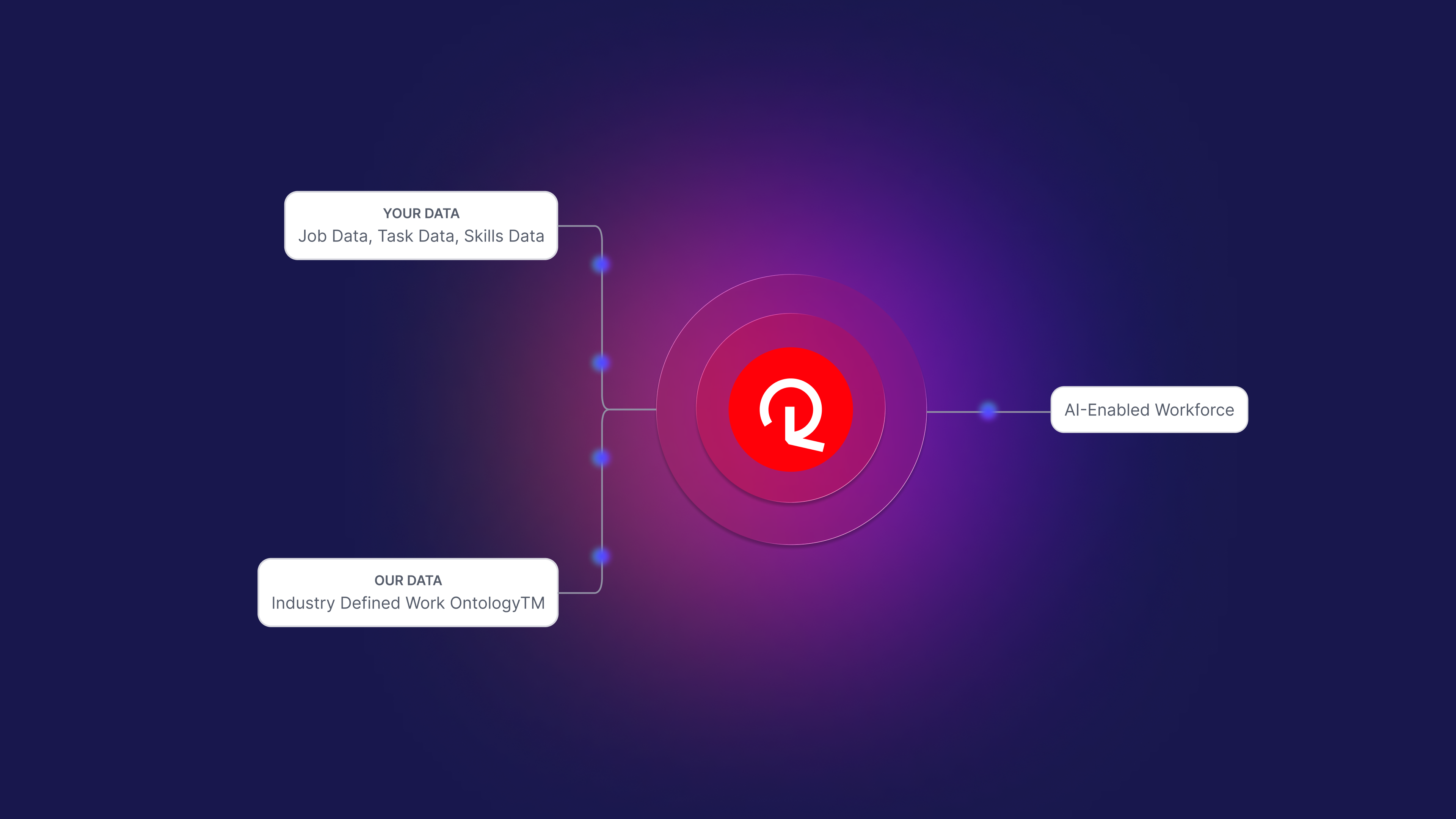
Reejig’s workforce insights are built on independently audited Ethical AI and Work Ontology™, designed to map how work is actually performed at the task and subtask level.
The methodology analyzes 130M+ job records spanning the last 5–7 years, representing 41 million unique proprietary and public data points across 100+ countries and 23 global industry sectors.
Key elements of the methodology
Data integrity
The dataset consolidates insights from proprietary data, leading labor market platforms, and publicly available datasets. Reejig workforce strategists validate work structures and apply domain expertise to refine the analysis.
Unparalleled scale
More than 130 million job records were processed and deduplicated into 41 million unique job and role data points.
Global and industry coverage
The dataset covers workforce activity across 100+ countries and 23 industry sectors, providing a dynamic and current view of how work is evolving globally.
Validated outputs
Data is structured and verified to support reliable insights into task-level workforce transformation, automation opportunities, and reskilling pathways.
Disclaimer: The information in this article is general in nature and does not take into account an organization’s specific circumstances, operating model, or location. Workforce transformation priorities may vary by organization, sector, and regulatory environment. For tailored insights, consult a workforce transformation expert.


 Platform Overview
The Work OS for AI-powered Work
Platform Overview
The Work OS for AI-powered Work
 Work Architecture
Live entity model of your enterprise
Work Architecture
Live entity model of your enterprise
 Map
Build the Work Context Graph
Map
Build the Work Context Graph
 Analyze
Your GPS for reinvention
Analyze
Your GPS for reinvention
 Build
Builder Studio · Workflows + agents
Build
Builder Studio · Workflows + agents
 Run
Deliver the new way of working
Run
Deliver the new way of working
 Measure
Track real, board ready ROI
Measure
Track real, board ready ROI
 Log
Source of truth · audit trail
Log
Source of truth · audit trail
 Update
Keep architecture current
Update
Keep architecture current