 Platform Overview
The Work OS for AI-powered Work
Platform Overview
The Work OS for AI-powered Work
 Work Architecture
Live entity model of your enterprise
Work Architecture
Live entity model of your enterprise
 Map
Build the Work Context Graph
Map
Build the Work Context Graph
 Analyze
Your GPS for reinvention
Analyze
Your GPS for reinvention
 Build
Workflows + agents
Build
Workflows + agents
 Run
Deliver the new way of working
Run
Deliver the new way of working
 Measure
Track real, board ready ROI
Measure
Track real, board ready ROI
 Log
Source of truth · audit trail
Log
Source of truth · audit trail
 Update
Keep architecture current
Update
Keep architecture current
Reejig x Workday
Unlock more value from Workday with AI Work Design.



Author
Siobhan Savage

Read time
2 mins

Published
Jun 10, 2025
.png)
Blog Post Body
AI Work Design Blueprint
The responsibilities every CHRO must own to lead AI Work Design and build internal capability.
To truly realize the potential of AI at work, we need more than new systems. We need better infrastructure.
Not technical infrastructure. The architecture of work itself. How it's defined, structured, and deployed across an organization.
Without that, AI can't deliver real value.
Not a framework. The critical infrastructure layer for AI-powered work.
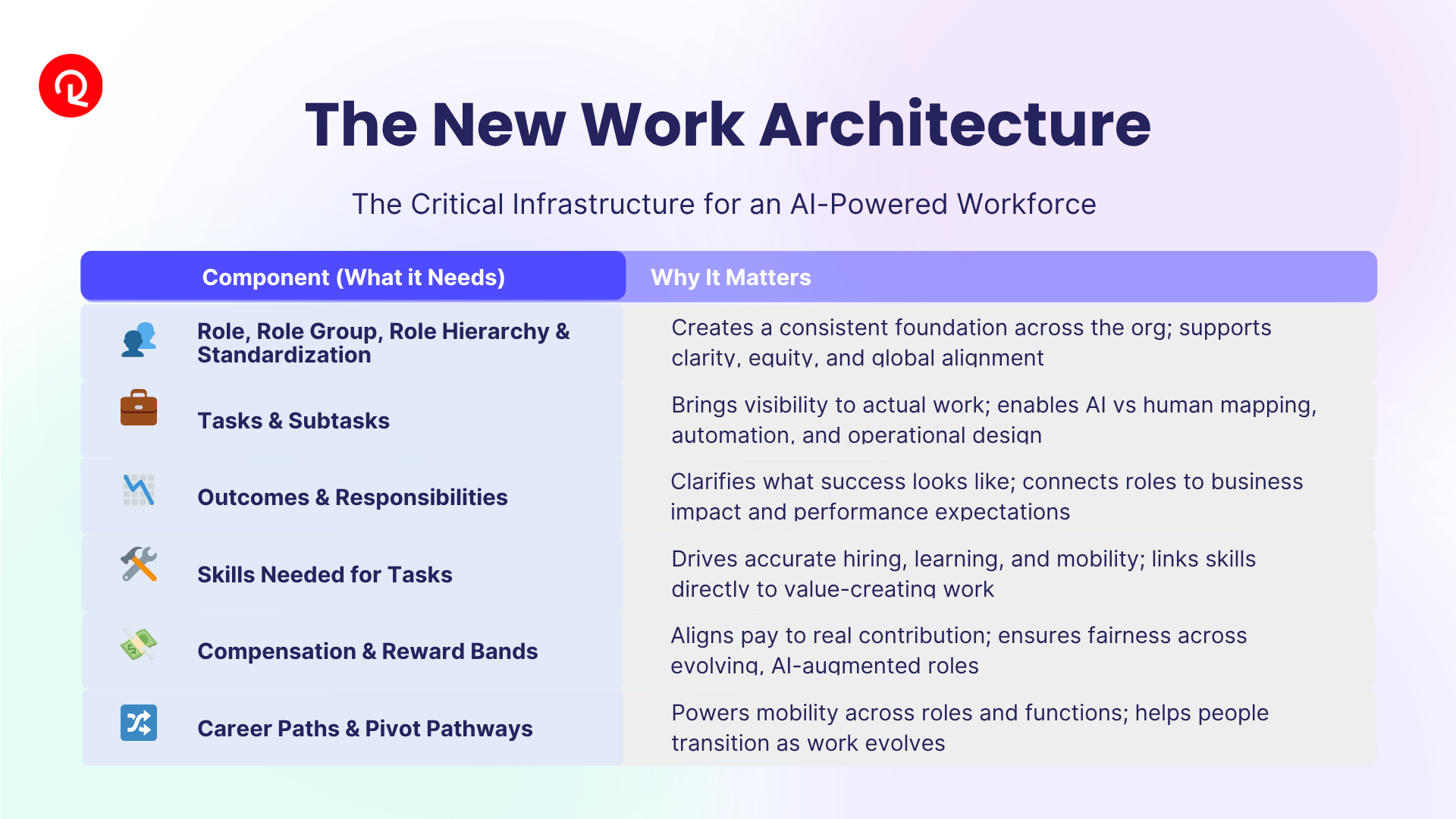
Here's what that architecture looks like.
First, the basics still matter
You still need clear roles, role groups, role hierarchy, and standardization. This creates a consistent foundation across the business. It supports clarity, equity, and alignment at scale.
But that's just the start.
You need visibility into the real work
Tasks and subtasks bring clarity to what's actually being done. Not what we think is being done. This is essential for automation, human-AI collaboration, and smarter org design.
AI capability is compounding. Work visibility is not.
Outcomes and responsibilities
It's not enough to assign duties. Outcomes and responsibilities clarify what success looks like. They connect roles to business impact and performance expectations.
Connect skills to the work
AI can't do everything. Neither can people. That's why we Map skills to tasks. It drives accurate hiring, targeted learning, and work movement.
This links skills directly to the value-creating work.
Rethink compensation and reward bands
As roles evolve, reward systems must evolve too. It's time to move past static levels. Align pay with real contribution. Especially in hybrid human and agent roles, to ensure fairness.
Work movement is non-negotiable
The career ladder is now a career lattice. We need clear career paths and pivot pathways. People must shift, grow, and stay relevant as the nature of work evolves.
This is Work Architecture
And without it, we're trying to power a next-gen workforce on last-gen foundations.
Let's build smarter.
Siobhan 💜


Siobhan Savage
CEO & Co-Founder of Reejig

AI Work Design Blueprint
The responsibilities every CHRO must own to lead AI Work Design and build internal capability.